Rising Above

An individual has not started living until he can rise above the narrow confines of his individualistic concerns to the broader concerns of all humanity.  MLK, Jr.

I’m not sure if I’m haunted or inspired.  

  • 20 years and I’m still trying to figure out living.
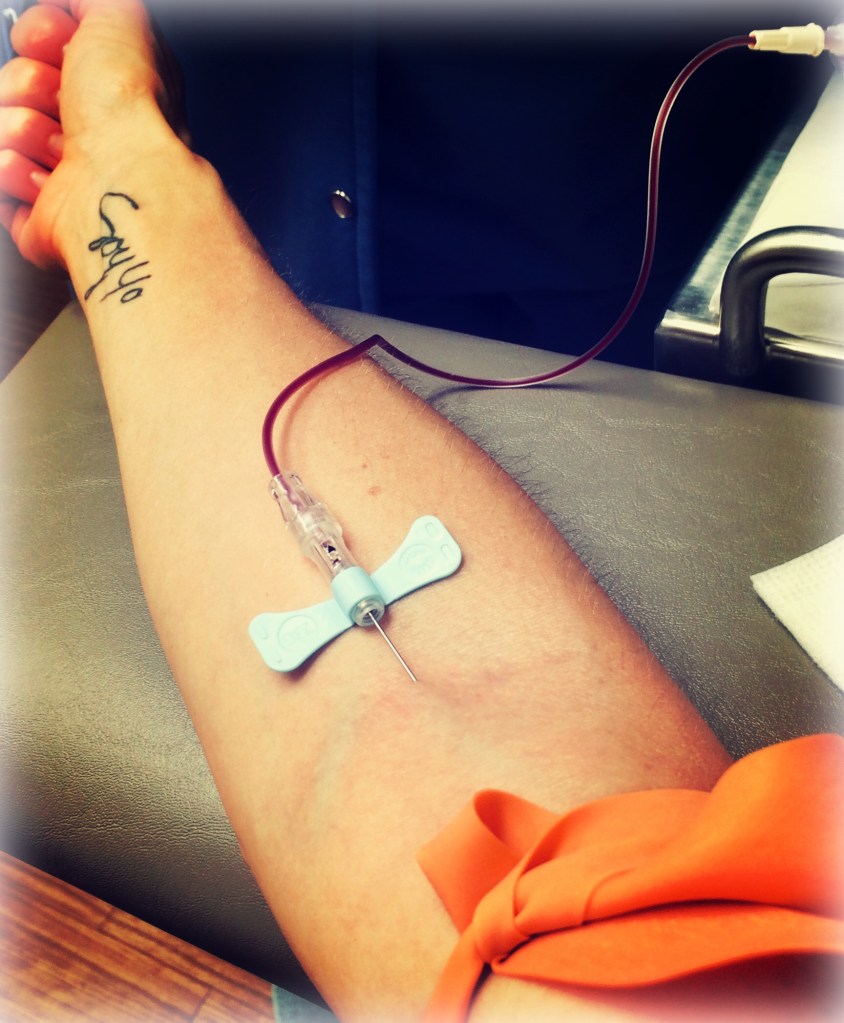
  • 20 years since my leukemia diagnosis in September of 2000.
  • 20 years of grasping at my sense of self in the midst of chronic limitations. 
  • 20 years of a tenacious spirit learning to dance in fragile body.

How can I rise above my personal cancer and be a part of treating malignancies that face all humanity?

This question has been weighing on my mind since last September.  I needed to rise up for my journey of Chronic Hope in order to clarify my identity.  

20 years later, there is clarity to rise.  But rising above is not a climb.  

It’s a descent. 

My challenge, quarantined in 2020, has been to listenlament, and repent of injustice in myself and in our culture.  To weep with those who weep and mourn with those who mourn.  I really wanted to just take action.  But I had not stopped to consider the lack in my understanding of justice and society.  And how justice for all reflects the heart of God.

There is a lot of humble stillness and lowly heart work involved in rising.  Nothing glorious or stunning.  Just quiet, dark, quarantined heart work.

If the world had not shut down in a global pandemic, would I have done that work?  

I don’t exactly know how to take action, but one thing has become clear: 

If I don’t take action, something in me will die.  Or will never have the chance to truly live.  

So, from this humbler and haunted place I desperately seek to learn in community from those who are taking action. To join. To grow.  To serve.  I thought the vulnerable and the marginalized needed me.  It turns out, we need each other.

Rising above is not mine to achieve.  Starting to live is not mine to map out.  

Mine is to quietly join the labors of love.  

  • To learn from those who weary their hearts and dirty their hands for the plight of others.  
  • To allow the plight of the vulnerable to be felt deeply and personally.  
  • To understand how to do justly, because I cannot truly love mercy without it.  Mercy accompanies justice.
  • Ultimately, to surrender the sense of self I’ve worked so hard to grasp.

Mine is the work of vulnerable humility.

Rising belongs to the Divine Hand that is strong and wise enough to lift me up in due time.

Just curious… what are the daunting malignancies you’ve been called to rise above?

Responding to a Hurting World: Lessons from the Little Drummer Boy

There are so many ways to get involved in a hurting world.  Which is a good thing, because there is SO. MUCH. HURT. in our world.  My heart leans towards people in transition, humans who are suffering, those who are trying to make it out of messes.  Immigrants coming to a new land.  Refugees fleeing war and manmade disasters.  Those who have left home, and in humility come to a new place.  They just need a little help along the way.

IMG_2249

So, what to do about it?  Turn to the wisdom of some classic Christmas lyrics for inspiration… the little musician who gave his all, even though it felt like so little.

Come they told me, pa rum pum pum pum

COME.  The first step is to receive an invitation and just plain show up.  The invitation is there to join something bigger than ourselves.  To be a part of something we can’t fix or solve.  To make it personal.  To just come.

IMG_5884
A new born King to see, pa rum pum pum pum

SEE.  Come and see the things that are happening in the world around us.  Let need, curiosity, pain, and empathy compel us to observe and join the messiness of our world in new ways.  To walk alongside a stranger in a strange land. To enter someone’s story.

Our finest gifts we bring, pa rum pum pum pum

BRING.  Come, see, what’s happening.  Bring what you have.  It may feel small and insignificant, but it is your offering to bring anyways.  Sometimes all I have to offer is myself.  And in a big, scary, complex world what I have feels so insignificant.

Slide2.jpg

To lay before the King, pa rum pum pum pum

LAY IT DOWN.  Let’s lay down our gifts, time, talents, resources as an offering. To show honor.  It may feel insignificant, but showing up has value. Taking time for someone shows they’re worth it.  Honoring another through a life-changing transition, and laying before them what we have expresses incredible value.

…When we come.

IMG_1027

BUTwe all face very real and present excuses, fears, and limitations…

I am a poor boy, too

I’m just one person, with limited talents and resources.  Many say… I’m not a teacher like you.  I would say… I’m not a lawyer like so-and-so, or an activist, or an influencer.  I’m just a ………………. trying to make it in the world (you fill in the blank).

Even our best is so limited.

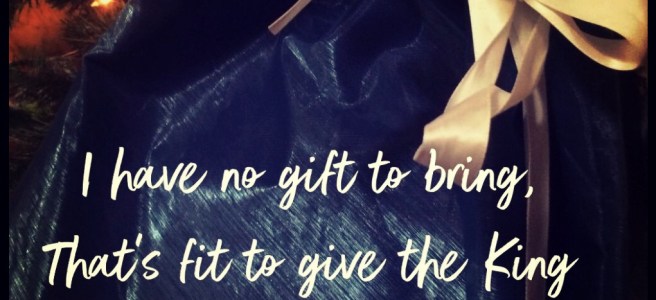
I have no gift to bring, that’s fit to give our King

I have nothing to give that would be of significance.  How can I help?  How can my small offerings possibly make a difference?

Start small.  If we all scooch over just a little in our row, we could make room for one more person to sit down.  What if everyone came, saw the need, and brought their little offerings?  That would be a significant number of insignificant offerings.  Maybe it would change the world.

What could those insignificant offerings look like?

Just come.  Show up for someone you know doing a work you admire in the world.

Just see… just listen.  Ask tough questions, hear difficult stories. Take time to process another perspective or another person’s journey.

Just bring yourself, your unique talents, your small offerings.

  • Maybe you have moments to read to a child.
  • Maybe you can pick up that book you know might challenge your thinking.
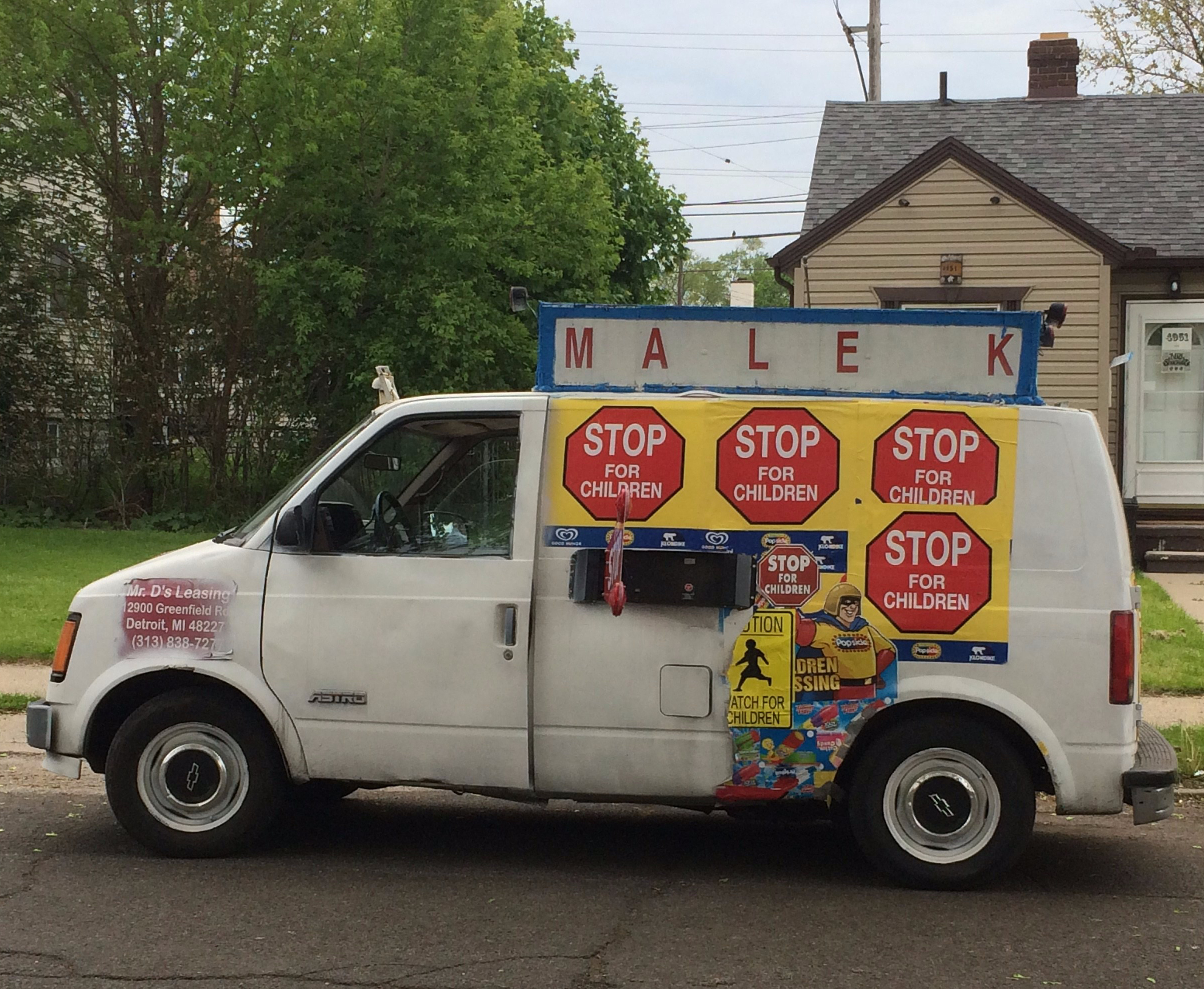
  • Maybe you can frequent a gas station or an ice cream truck where you can get to know a fellow sojourner just trying to make it in the world.
  • Maybe you invite someone new over.
  • Maybe you make that donation.
  • Maybe you share a perspective on social media that might make others think differently.
  • Maybe you start within–identifying a fear, letting go of bitterness, or choosing to forgive.

Who knows how scooching over might look for you.  Who knows what gift you bring, or how it might be fit to honor another?IMG_6942

I played my drum for Him, I played my best for Him,

pa rum pum pum pum, rum pum pum pum, rum pum, pum, pum

Whatever you do, do it wholeheartedly.  Even if it is small and insignificant.  Make it your best offering.IMG_5426

Then He smiled at me, pa rum pum pum pum
Me and my drum.

Relish in that smile.  The smile of helping someone out when they needed it most.  Showing up when it was difficult.  Offering when you felt like you had nothing.  Or maybe you are weary from many offerings that never feel like enough.  Pause.

Receive that joy.

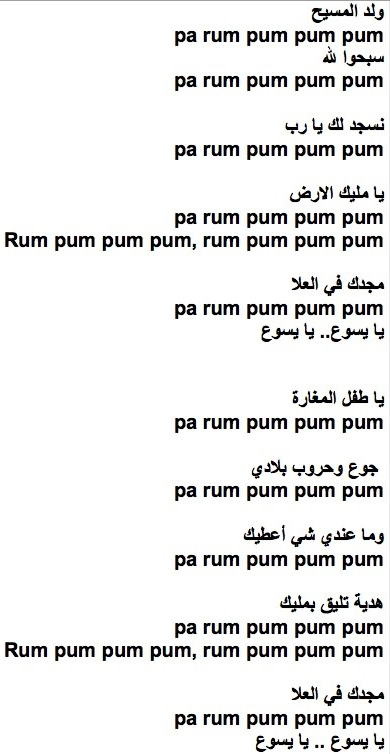
Recently, I heard an Arabic version of The Little Drummer Boy.  It was my invitation to learn some new Arabic words and practice rudimentary reading skills.  What I found was a treasured perspective I wasn’t anticipating.

Drummer Boy Arabic

With the backdrop of endless unrest in Palestine–the homeland of the Messiah and the singer–Vivian Bishara‘s lyrics of worshiping the King but having no worthy gift to bring becomes so real.  Regardless of our politics, war, hunger, and poverty are very real aspects of the world the Messiah came into–and the reason for the season today.  Emmanuel–God with us–in our messy, complex, torn up places.  Let’s come, and see, and lay down our gifts, or our lives, or both. To honor life.

To honor a Life-giving King.

… When we come.IMG_0097


When Politics are Personal: Joining Strong Beautiful People through Challenging Life Transitions

I recently wrote a post about how politics scare me, but, as a language and culture teacher, a language and culture learner, a mom, a cross-cultural neighbor, and a daughter of immigrants, I mustered up a small amount of courage to share some of my perspective on immigrants and refugee issues.  I’m not trying to take a strong political stance, but I do love the people on my path and the relationships that have enriched my life.

IMG_0695

I’ve learned that issues become much less political as they become more personal–when issues have names, faces, stories, and favorite foods.

5 observations about strong people and challenging life transitions:

  1. Leaving home is just plain hard.  My little family of 5 recently relocated after 17 years in our beloved town of Dearborn, MI.  Same language.  Same country.  No emergency. But it was SOOO HARD. Even now my heart tears and my eyes tear up for what we left behind.  Whenever things get challenging in this transition, I think of my brave Syrian Kurdish refugee friend who has relocated with her family 3 times, navigating in 4 languages–Arabic, Kurdish, Turkish, and English, with at least 2 distinct scripts to learn.  Have you ever tried to read the electric bill in a new language–deciphering the issue date, the due date, and the past due date?  Would you be able to tell the difference between tricky junk mail and important official letters written in a script that is oriented in the opposite direction than you’re used to?fullsizeoutput_28cf.jpeg
  2. We all need a little help at times in order to succeed.  In our cross-country move there were countless people who came alongside us in different ways–with food, with gentle reminders about change-of-address forms, with time and muscle to help us carry stuff.  We put our all into our move.  We calculated it for years.  But regardless, it was just bigger than us.

I will never forget the faces of those who have shown up in my difficult times and transitions of life.  Those people have a special place in my life journey.  Have you ever had the privilege of walking alongside someone in their unique ICU experience?  My secret honors include explaining to my English Language class full of moms the important distinction between the Spanish word molestar, which means to bother, and the English word molest, a very different meaning than bother (especially when Google translate has led them astray).  And I’ll forever cherish the joy of being one Muslim friend’s first experience in an American woman’s home.

img_6575.jpg

3. It takes courage and intentionality to show up, everyday.  I have a rule that I have applied as a mom, teacher, and learning coach: when it comes to helping others learn something new, I will only work as hard as they do.  Granted, part of my job is to teach motivation, but if a toddler learning to clean up, puts away two toys, then so will I.  If she puts away 10, I’ll show up for 10.  Fifteen women who show up for my English Language class two mornings a week.  It’s free for them to attend.  Some show up with a baby or two in tow.  Some work 12-hour shifts at Walmart on the loading dock and show up to class sporadically. I have one student who shows up with a smile, a pencil, and a notebook–even though she doesn’t know how to read or write in any language.  They show up with gratitude and grit, ready to take on their new world.  It is my great privilege to show up with them in some small way.

IMG_0070

4. My refugee and immigrant friends want the same things I want.  Most of the beautiful people on my path are other women and moms like me.  They want good, safe, happy lives for their children.  They want to contribute to their community.  They want to pay their bills and take good care of their families.  They get emotional around special holidays away from special relatives.  There is always a little bit of grief in their joy when a baby is born who may never get to meet their grandparents or uncles or cousins.  I’m amazed at the simple yet heartfelt constructions my very beginning students communicate with their limited English.  I know that they have experienced loss, that they long for their mothers’ cooking, and that they struggle with their kids spending too much time on their devices.  I have so much respect for their courage and humility to succeed in a new and strange environment. They inspire me daily to dare greatly.

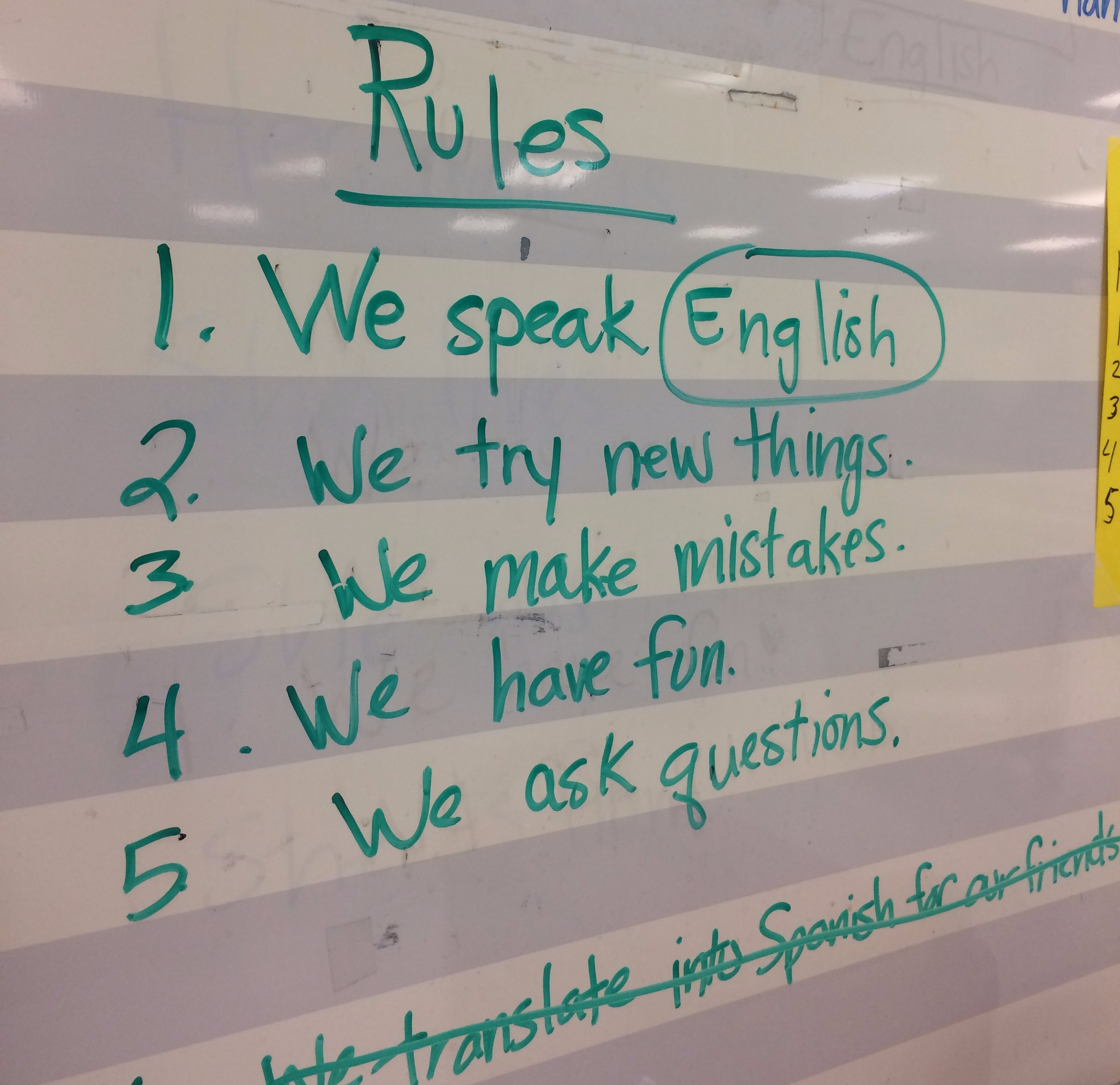
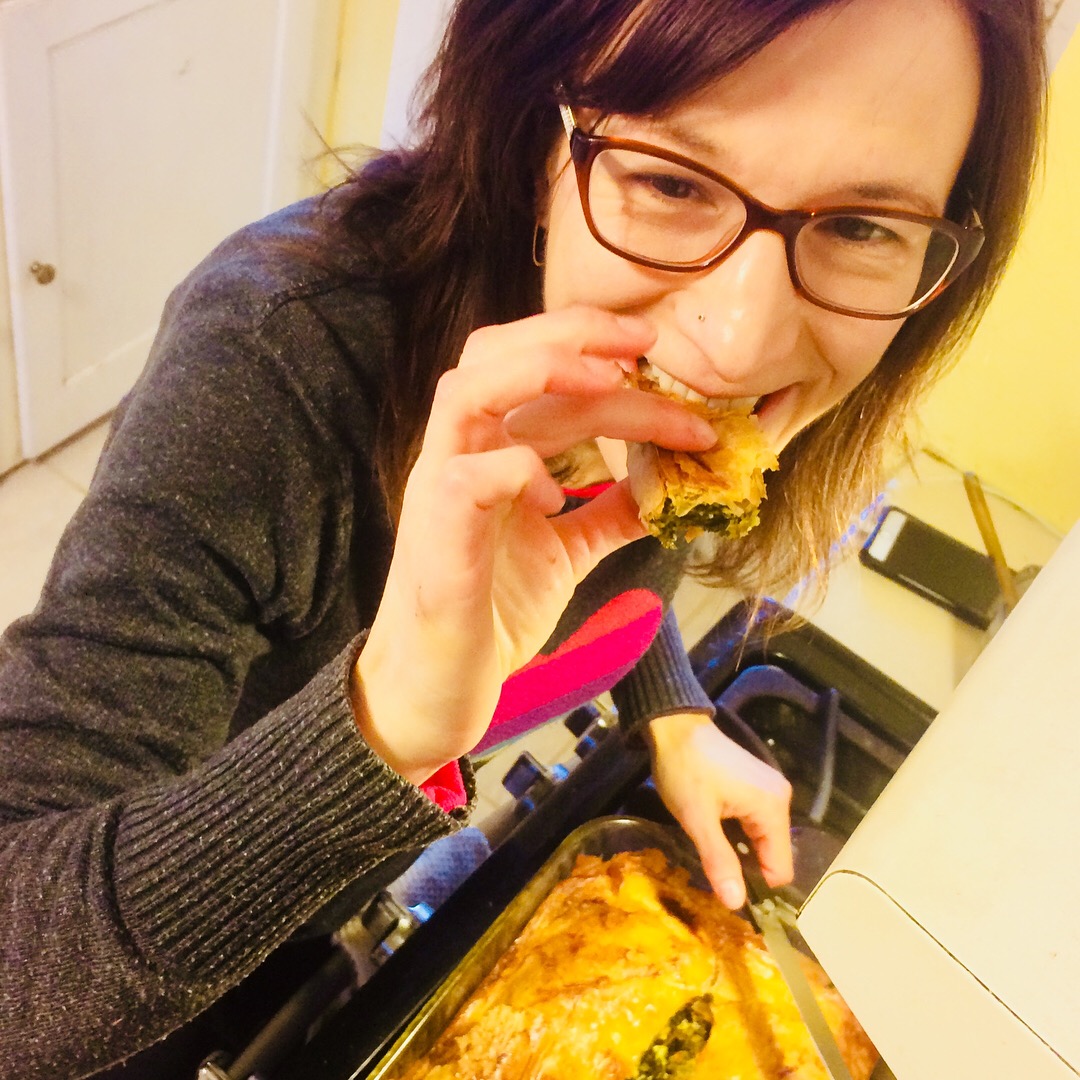
fullsizeoutput_9e05. Families strategize for success.  While I mostly spend time with women, I know that families are doing their best together.  I believe wholeheartedly that my husband deserves his own diploma when I graduated with my MA after 5 1/2 years of intensive studying and juggling.  He showed up with me and for me.  I am also keenly aware that for every married mom who shows up to learn English in my class, there are noble husbands who work tirelessly at blue collar jobs with limited English skills so that their wives can learn English, navigate the needs of their households, and maybe even plan for college.img_4690.jpgMy current adult ESL class is in an elementary school cafeteria.  It’s chaotic and interruptible.  Kids, teachers, administrators, and lunch room staff are always passing through. But we have rules–we ask great questions and we build community together.  We share music and we laugh hard–especially when Lulu is present, because every class needs a class clown.  My life is forever enriched.  I know what it is to sip yerba mate through a special straw, and savor Yemeni sabayah.  And though I have yet to try mofongo, I can’t wait to share my spanakopita recipe with my students.  I love being a part of their safe place–to learn, to take risks, to make mistakes and to grow.  They are courageous and beautiful women.  They show up.  And all our lives are richer for it.IMG_6318


An Unintended “We”

We the People of the United States, in order to form a more perfect Union, establish Justice, insure domestic Tranquility… promote the general Welfare, and secure the Blessings of Liberty to ourselves and our Posterity… 

Preamble to the Constitution of the United States

I can usually spot negative and hate speech coming from one group against another by the signature word they. “They don’t belong here.” “They do things differently.” “Why do they ________ like that?”

For Spring Break my Greek Immigrant parents came from sunny Colorado to visit my home in soggy Michigan. They did all the fun spoiling that any Yiayia and Papou would do with their grandkids. Amidst all the excitement, I invited my parents to come with me to spend some time with Zuzu, my Kurdish-Syrian New American friend. I had met her last October, at a free community event sponsored by Sabeel Media at the local library, discussing the responsibility of the media to share the experiences and needs of refugees. That event inspired me to scooch over, and make a little room in my life for the refugee crisis that faces us all as human beings.  I am regularly challenged by the command of Jesus the Messiah to love God with all my heart, soul, mind and strength; and to love my neighbors as myself. I have been visiting with Zuzu weekly for the last six months and she has taught me so much about friendship and hardship and Arabic and Kurdish. In turn, I have taught her about American systems, and phone systems, and English words. She calls me her teacher, but I call her my friend. Through it all we have become tied to each other.

There is so much political rhetoric for and against the topic of refugees, but to actually sit and sip tea with a neighbor who happens to be one seemed like a novel idea.

My parents were eager to meet Zuzu and her family. There is so much political rhetoric for and against the topic of refugees, but to actually sit and sip tea with a neighbor who happens to fit that category seemed like an interesting and novel idea. Before our visit, I prepped my parents on who to shake hands with or not shake hands with, where to put shoes, and how to sit on low couches—even with my dad’s recently replaced knees.fullsizeoutput_cc5

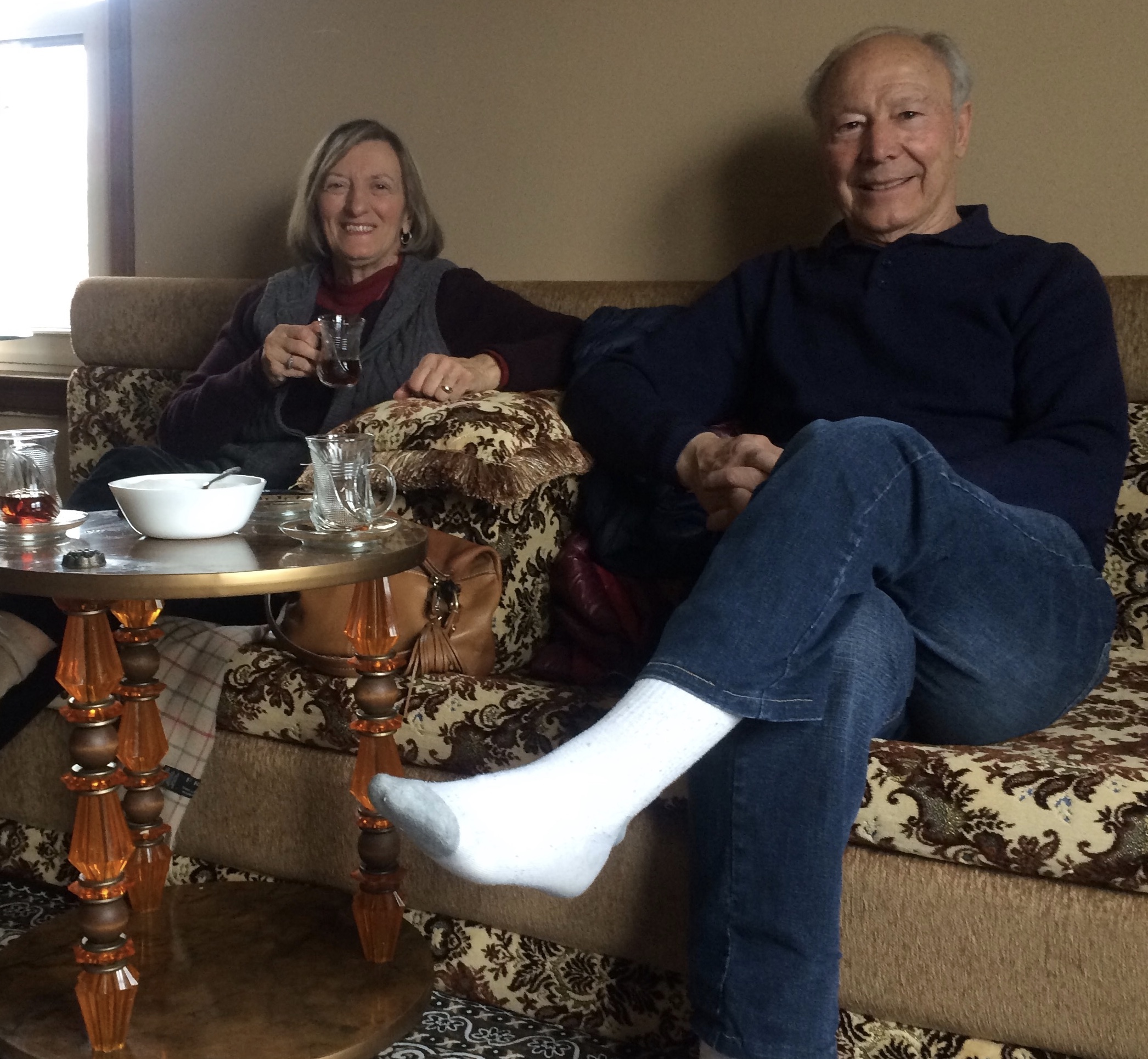
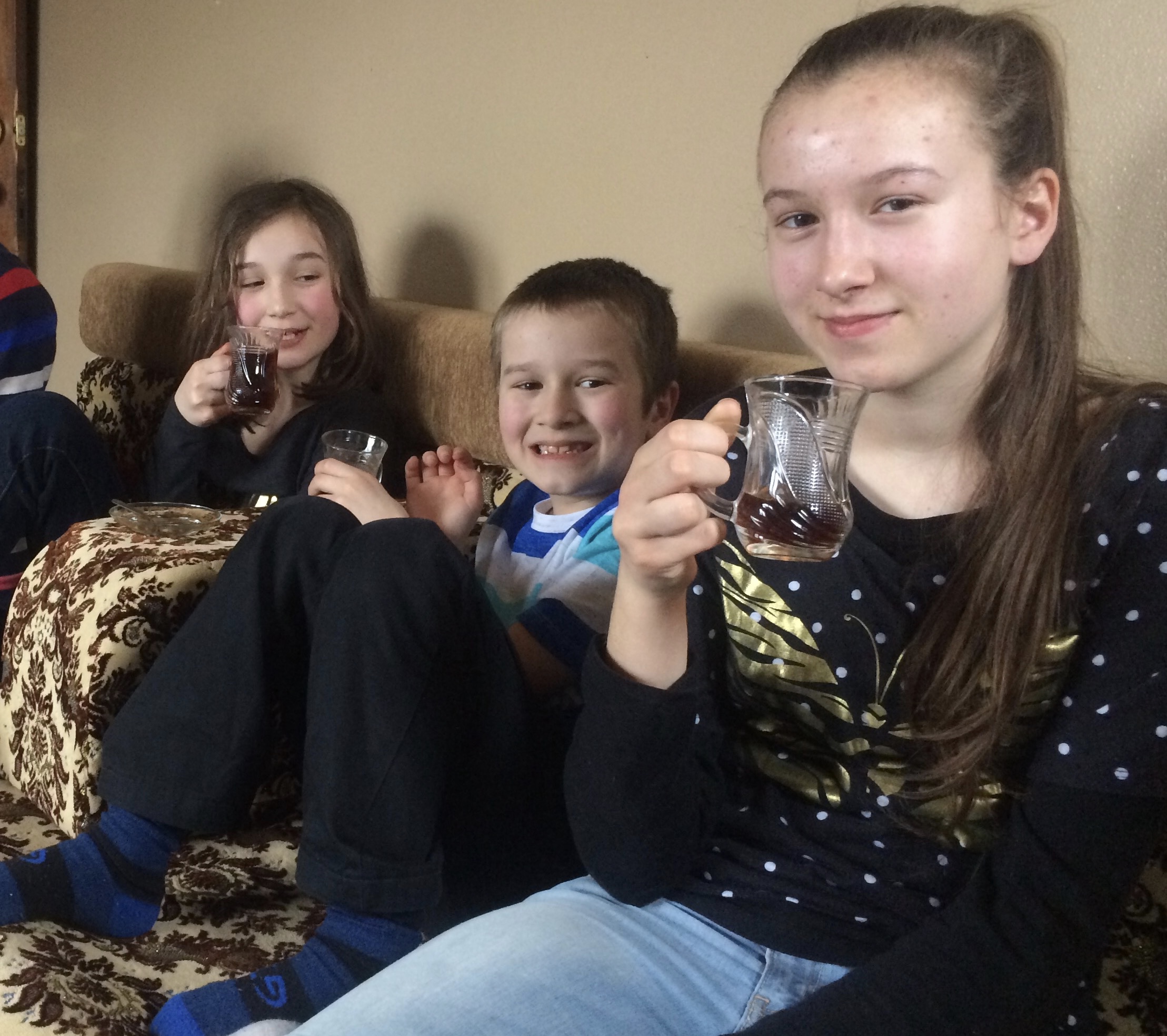
Zuzu warmly opened her modest upper flat to my parents and my three kids on a rainy March afternoon. We sipped little cups of rich black tea with as much sugar as my kids wanted. We touched on topics of politics, dictators, and dialects as we observed Kurdish television rattling on in the background. We shared a lot in common. Our little visit brought back some nostalgic memories for my mom, of the way visits used to be for her as a child growing up in a Greek immigrant community, where people shared simple but special moments together in each other’s homes. And the TV rattling in the background was normal for my dad—only his gets all the best Greek news stations.

Version 3There was a pause in our conversation, which gave Zuzu a moment to form a question in English. She asked my father if he left Greece because he was a refugee. He shook his head “No,” but then proceeded to explain in short sentences that his Greek village was ravaged in World War II, and that his parents were killed. Years later, he immigrated to the U.S. in search of a better life. The look on Zuzu’s face was full of compassion and understanding as she responded to the look of great loss on my dad’s face. Different generations. Different countries. Different wars. Different dictators. But for a moment, Zuzu and my dad were ushered into the same horrible club of loss, tragedy and destruction by war. It’s a large club that no one wants to join, but many are forced into its membership. As I sat and observed this unintended “we” moment between my father and Zuzu, I said a silent prayer for her young children. I am a product of my dad’s hope for a better life in a new land. Maybe our family gives Zuzu perspective on what things might look like for her young children as they grow up to call this new land their home. At least for now. I know deep down, Zuzu really hopes to take her children back to her home country of Syria in better times, Inshallah, God-willing.
As we said our good-byes, I thanked God for this incredible moment to share with my family and my friend. We were blessed. We enjoyed each other’s company. Our human hearts beat the same, and by unintended circumstances, we had more in common than we imagined. We, the people, who long for justice and tranquility in a more perfect Union.

We had more in common than we imagined. We, the people, who long for justice and tranquility in a more perfect Union.

Published in the Yemeni American News, May, 2017

A Thrill of Hope: Adventures in Scooching Over

(Adapted from the Yemeni American News, December, 2016 publication)

“Do not be afraid. I bring you good news that will cause great joy for all the people…” ~Angel of God~

When the world around me seemingly swirls with hatred, anger and fear, and my heart is heavy for the hurting, my coping mechanism is to reminisce on stories of hope. In my profession of language teaching, motivation is a key element for success. Motivation in life, as in language learning, contains two essential ingredients: 1. You have to think you can do something: hope 2. You have to think that it matters: need. In November I was reticent to click send on my article, Scooching Over, because I knew that if I made my thoughts public, my own words would move me to action, and I wasn’t sure I had the capacity to scooch over for a new friend in my daily life. The last thing I want to do in this refugee crisis is talk about doing something and then do nothing. The need was clear: I believed wholeheartedly that my small action to make a difference in one refugee’s life mattered; but I wasn’t sure I could actually do something about it on my own. That’s where hope is bigger than me. It requires me to believe that I can be involved in great and impossible things.

slide2

After taking a moment in my hectic day to pause and pray, I called my New American friend that I have endearingly nicknamed Zuzu. Zuzu and I had connected at the Sabeel Media Event in October, where she had expressed that she needed help finding a preschool for her son. I had already called at least eight preschool locations in her zip code before I got on the phone with Zuzu. I offered to come over the next day, take her to visit a preschool, and teach her some English. To my surprise, she told me NOT to come. She said that she had already found a preschool, that her family was moving to a better location, and that she was currently too busy for me to come visit her. As it turned out, there was no room in her week for me.   She didn’t need my charity to survive, which made me even more determined to get to know this highly motivated woman.

When things settled for Zuzu, I came by to see her new place. In her intermediate English she reported that she had signed up for English classes at the local college, she was studying for her driver’s permit, and she was in walking distance from most of the places she needed to get to each week. She has been in the U.S. since April and is determined to settle her family here. Zuzu’s vision is bigger than she is. Her hope is deep. Her potential is great. Her work is humble. She walks her in-laws to the doctor and her son to preschool; she cooks and cleans for her household of six. At night when everything is quiet, she studies English and listens to audio messages I leave for her to practice each week. Zuzu doesn’t want to live indefinitely off of the kindness of others. On the contrary, she wants to be an agent of care and change and assistance to others. She also would like to go home if she could. But she can’t. So her plan is to bloom where she has currently been transplanted—right here in they Detroit Metro Area, MI, USA.

|Her plan is to bloom where she has currently been transplanted|

 From our visits together I have learned that Zuzu is Syrian Kurdish. Her hope is seen in the languages she wants her kids to know: English of course, so they can thrive in their new community. Kurdish of course, because that is the language of heart and home. Arabic of course, because you can’t live in Syria and not know Arabic. She is preparing her son and daughter to function in this new world, but also to be ready to return to her beloved home country…someday, Inshallah, God-willing.

Sitting on the floor of her upper flat on soft blankets against big couch pillows, sipping warm, sweet instant coffee with milk, my first step in our mini English lessons, was to identify her goals for learning English: 1. Help her mother and father-in-law with their medical prescriptions and paperwork 2. Help her kids learn English. 3. Go to college 4. Talk about travel and places to visit 5. Tell her personal history. Zuzu believes that learning English matters. She also clearly believes she can do it. Unless you’ve ever worked with someone that motivated to learn something, it’s difficult to describe how exhilarating it is. Her need is clear. Her desire is clear. She has hope for her future that is bigger than she is. And I have the privilege of joining her venture.

|Together our hearts break for the displaced people of her country.|

 As a writer, I want to carefully handle the stories entrusted to me. This past week, sipping our coffee, I pulled out the Yemeni American Newspaper and explained to Zuzu that she fullsizeoutput_9e0
had inspired the article I wrote last month. I told her that I follow the teachings of Jesus the Messiah who says we are to love one another. His heart is for the orphans, the widows, and all those in need. As His follower, I offer what little I have with big hope. After all, the good news of great joy this Christmas season is for all people.

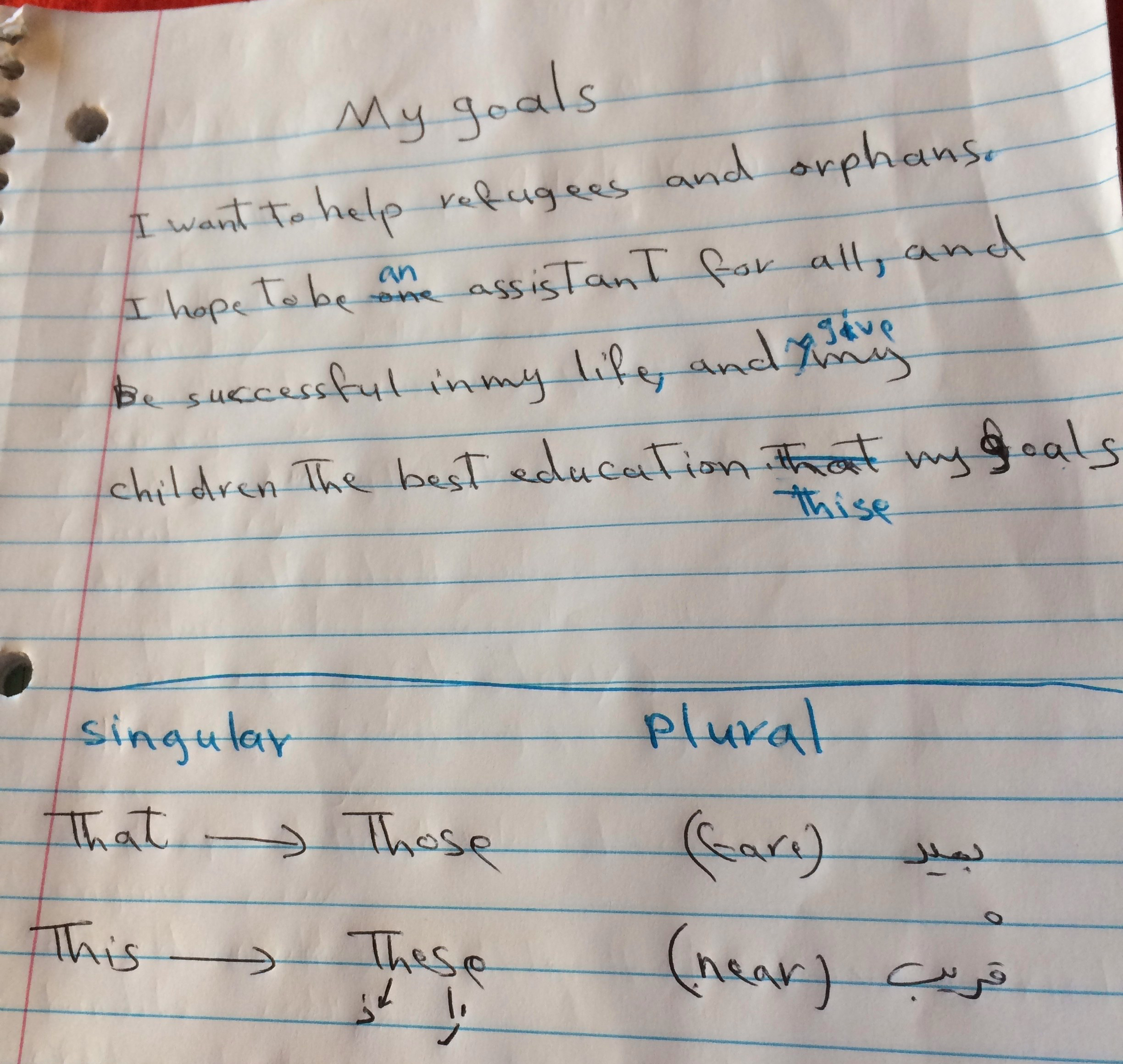
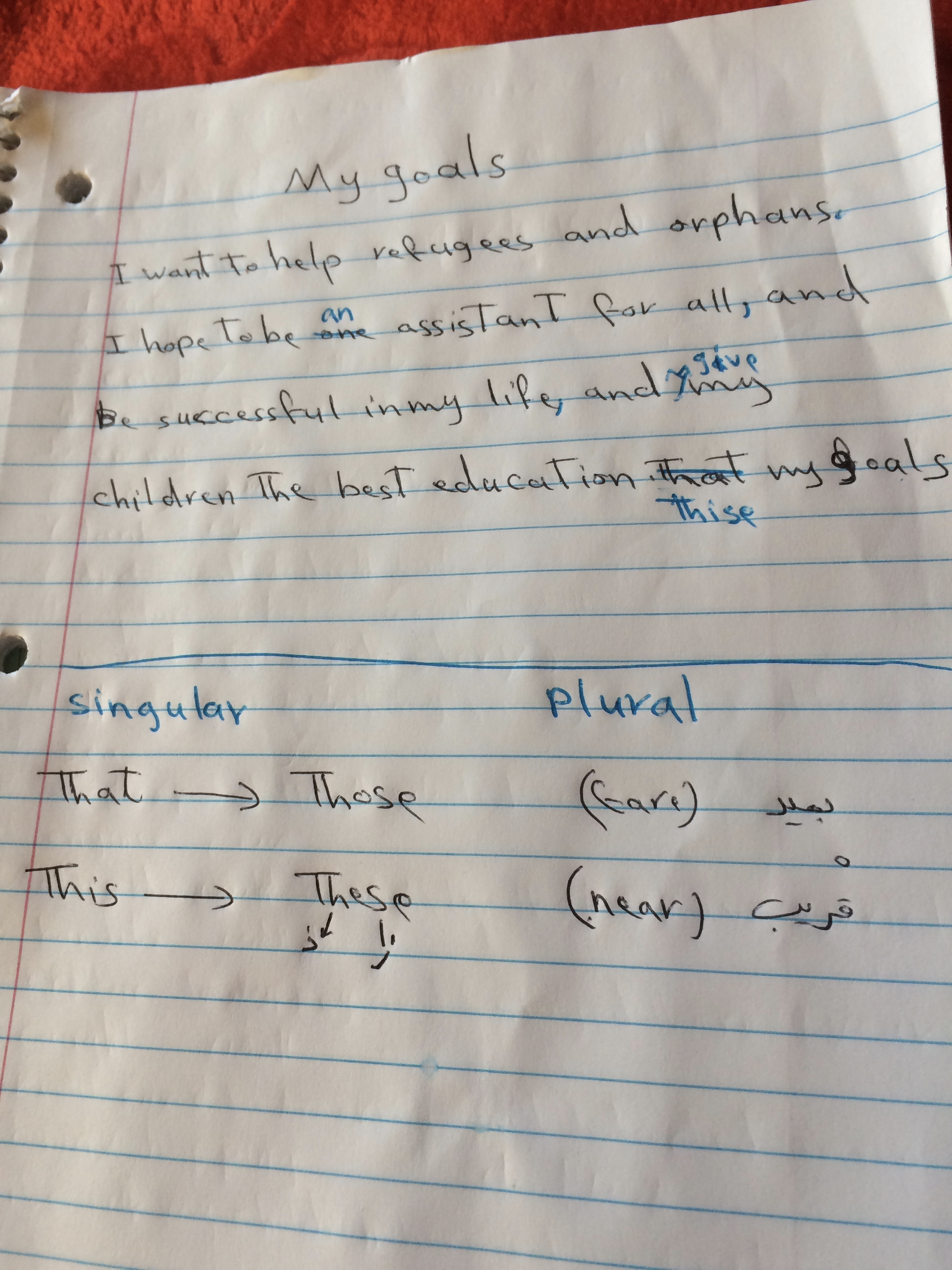
Zuzu shared with me another goal statement she had crafted late one night: I want to help refugees and orphans. I hope to be one assistant for all.  And be successful in my life and my children the best education. That my goals. Clearly, Zuzu and I share a vision of helping those in need. Together our hearts break for the displaced people of her country. I asked Zuzu if I could publically share her beautifully articulated goals because they inspired me, and I think they would inspire others. She agreed.

As Zuzu and I both scooch over each week to make room for each other, we hold on to the thrill of hope. My prayer is that all of us would experience a little of the impossible in our daily lives; that we would together find a hope that is bigger than the determination of any one human being—a collective and contagious courage. My prayer is for many more to get out of harm’s way and be welcomed into a safer place where hope can be nurtured, and that they can experience the good news of great joy that is for all people.

Long lay the world in sin and error pining, 

Till He appeared, and the soul felt its worth.

The thrill of hope, The weary world rejoices…

~O Holy Night~

Scooching Over

(Published in the Yemeni American News, November, 2016)

Give me your tired, your poor, your huddled masses yearning to breathe free.  Emma Lazarus

The Preferred Aisle Seat

I have never been known for my punctuality. In fact, I characteristically run late. Often times it’s because I get lost trying to find places, or maybe it’s because I tend to be on Greek time, which means I’m not technically late; it just allows me a half-hour margin for arrival. At my church there are rows of seats for people to choose from as they enter the place of worship. I’m always grateful when people scoot in towards the middle seats, so that us late arrivers can slip into the aisle seats, unnoticed. I prefer to avoid the awkward attention of navigating my way through a maze of knees and handbags after the service has begun to settle into the middle. Sometimes at abundantly populated special events, the pastor up front will ask everyone to scoot in a little to make room for more people to slip into the aisle seats. I know how it feels to be scooted in for.

Lately, though, I have been on a fairly long stretch of timely arrivals, which means I have my pick of seats at church. Admittedly, I tend to choose a preferred aisle seat.  I like having a bit of space on one end between me and other people that I don’t know so well. I like my space, my preferences, and my little comforts.

Joining the Response to New Americans

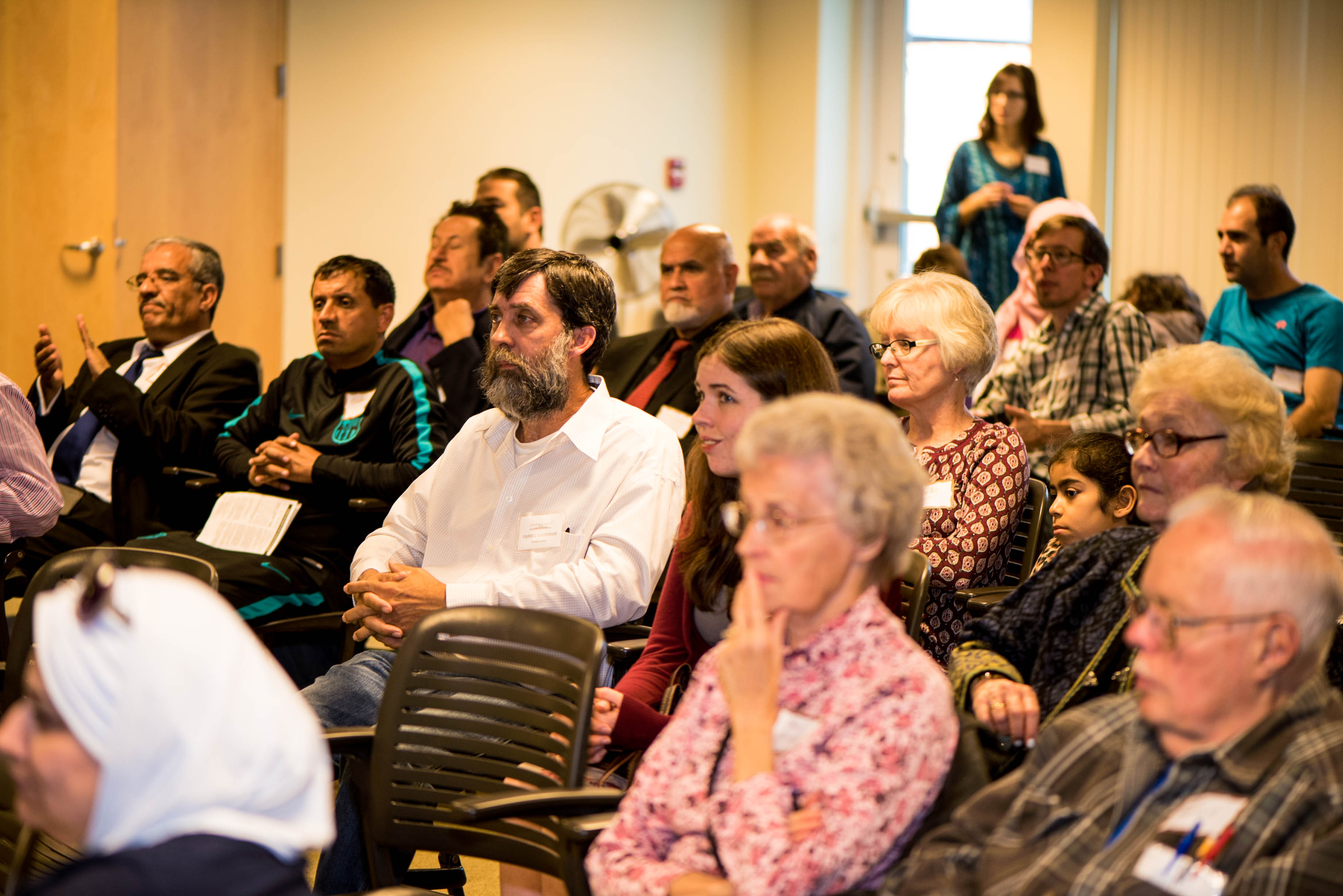
Last month I attended a free community event sponsored by Sabeel Media at the local library, discussing the response and the responsibility of the media to share the experiences and needs of refugees. One of the special presenters, Shane Lakatos of the Social Services for the Arab Community (SSFAC) in Toledo, challenged everyone at the event to think about the fear in our own hearts. We fear people we don’t know. And in fear, we tend to think the worst of them. Peter Twele, another special presenter and author of the book, Rubbing Shoulders in Yemen, emphasized that refugee families relocating simply need a friend if they are to successfully assimilate in a new culture. Not only have they left homes, families and jobs, they’ve lost neighborhoods, communities and connections. They need to build a new community of relationships.

So as I stood in the back of the Sabeel Media event, having arrived a little late, I started to think of my own response to the refugees joining my community.

sabeel-g-in-backSo as I stood in the back of the Sabeel Media event, having arrived a little late, I started to think of my own response to the refugees joining my community. I can donate to the cause. I can pray for those who suffer. I can speak out for the needs of these new Americans. I can even volunteer for an event of handing out free backpacks to refugee kids starting school in a new country. As I was pondering my action points, I scanned the room of attendees and my eyes fell on a beautiful young woman dressed in a bright pink sweater with a coordinated floral scarf covering her head. I was surprised to realize that I knew her, and not only that, but that I had been thinking about her. I knew her by name. I had given backpacks to her kids at a volunteer event in September.
Scooching Over, My Point of Decision

I greeted her with quiet kisses so not as to disrupt the program, and continued to listen to the needs amidst the crisis. The needs are dire. The search for hope is essential for new Americans coming into our country. The presenters’ words rang in my ears, of our own fears, and of the refugees’ need for friendship and connection with such limited resources… What was I going to do about it? But what about my crazy American schedule? Do I have room in my life for a needy new friend? Not really. There’s work, prior commitments, grad school, kids, family.

This is a crisis we are all facing. It doesn’t just belong to some people and not others.  We all need to scooch over and make room for one more in our lives.

But this is a crisis we are all facing. It doesn’t just belong to some people and not others. We all need to scoot in, scooch over, squeeze closer together, and make room for one more in our lives. My little bit of comfort in my “preferred aisle seat” isn’t a lot to give up, considering the woman I’m inviting to sit next to me really wants to settle her young family after fleeing devastation and living in temporary housing for over a year. She has her dignity. She doesn’t just want to be helped. She wants to go to school, get a job, help her kids learn English and assimilate into her new community. She’s ready to work hard; she just needs some help doing it. She’s one person, one name, one face. She is just one of the tired and the poor in the huddled masses, yearning to breathe free. She’s one woman I could call a friend. Who knows, I might end up being the needy one in our relationship and discover that my scooting over to fit one more into my life was actually to my benefit. I’ve had that happen before.

Version 2

When I think about all the potential things we perceive a refugee to be: a foreigner among us, a neighbor, an enemy to fear, a widow or an orphan, or someone lost and needy…I can’t help but think of what Jesus the Messiah has to say about all of them. He says to love them. Love your neighbor as yourself. Love your enemy. Look after the widow, the orphan, the lost, the foreigner among you. Jesus the Messiah chose to love me without condition and with a love so compelling that I can’t help but be changed by it. Calling one young woman this week to make time to help her find a preschool for her son, sip some tea, and help her learn English is something I can do. I can be inconvenienced in that way. I can scoot over and make a little room in my world for one more.

Religion that God our Father accepts as pure and faultless is this: to look after orphans and widows in their distress and to keep oneself from being polluted by the world.   St. James