Funnel your passion and outrage into specific, constructive actions that will change things for the better. Don’t just get mad; change the world. T. Anderson, Speak Up for the Poor
A History of Choices
Narrowly escaping abortion. Nearly executed by Nazis. Orphaned at the age of two. Immigrating to a new land filled with new hopes and new possibilities. During this current strange and tense political climate—Women’s Marches, Muslim bans, extreme vetting, trolling, and fear mongering—I have been reflecting on the journey that has led my dad to celebrate his 75th birthday just last month. In a heated climate of pro-life and pro-choice, I’m thankful for life. I also realize that I am a product of other people’s choices. I am a product of my grandparents’ decision not to abort my father, by night, in secret, outside a small village in Greece in the 1940s. I had heard the story countless times of my grandmother’s decision not to eliminate the unexpected pregnancy that was my father, long before I ever comprehended what abortion meant. Then, as a toddler, my dad barely escaped Nazi execution. His parents didn’t though. He was orphaned at that time, and were it not for the compassion of one Nazi soldier who didn’t have the heart to open fire on 13 kids hiding in a basement, my dad wouldn’t have survived. I am a result of that soldier’s compassion.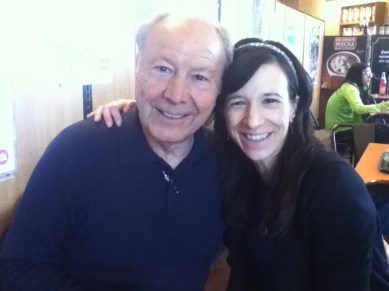
As a young immigrant to the U.S. from the Old Country of Greece, my dad, with my mom, had that hard working, unconquerable, Greek, immigrant spirit. My dad worked nights and weekends, and he took on extra jobs to pursue the dream that education in this country would lead to more opportunities for his kids than he or my mom had. I am the product of their choice to believe in the American dream.
Living intentionally cross-culturally in a diverse community for 16 years, I have learned that it is best to approach new and complex situations as a learner. Since the Women’s Marches, I have been carefully reading posts and counter posts in Ping-Pong style about women who marched, women who didn’t, women who wished they did, women who were angry, women who didn’t want to get involved… My heart swelled with the pride for some of those who marched. I also understood why some didn’t. From those who chronicled their marches, I learned to value the privileges of choice we have today, because others fought for them in a previous era.
When he would ask 12-year-old girls, “What’s your dream?” they had no answer. No one had ever taught them to imagine an alternative to forced child-marriage.
The Privilege of Dreaming
My kids are privileged with choice. Since they could to talk, my kids have dreamt about what they want to be when they grow up. It was never an option for them not to dream about their futures. They can even change their minds—archaeologist one week, art teacher the next.
 “What’s your dream?” is the question Troy Anderson, President of Speak Up for the Poor, asks young girls from poor villages in Bangladesh whose options are marriage at a young age, or being sold into prostitution. When he would ask 12-year-old girls that question, they had no answer. No one had ever taught them to imagine an alternative to forced child-marriage. Anderson realized that for things to change, girls needed to dream. As the girls go through the Speak Up for the Poor program, they learn to make a plan to make their dreams of becoming a nurse, or a business owner, or a teacher come true. These girls dare to fight societal norms to realize a better life.
Changing the World
From the Women’s Marches I’ve learned that many have sacrificed to make things better for another generation and another group of people. When my kids grumble about doing their homework, I tell them stories about Malala—a Pakistani girl whose choice of going to school was taken from her. She fought back and inspired the world. Sometimes my kids roll their eyes at me—not another story! But, crazy mom that I am, I want my kids to appreciate their privileges, to work hard for what they believe in, and to have that dare-to-dream-in-the-face-of-adversity kind of spirit.
The choices we make can have global impact. This is my privilege, to help my kids understand that they, too, are the product of other people’s choices. Who could imagine the life-giving impact of one Nazi soldier’s choice back in 1944 in a small Greek village? My kids will hopefully never have to face gunshots on the school bus like Malala did, but they can choose to promote peace on the playground, and stand up against a friend being bullied. We are all connected to a greater historical context, and the choices we make can change the world.
(Published in the Yemeni American News, March, 2017)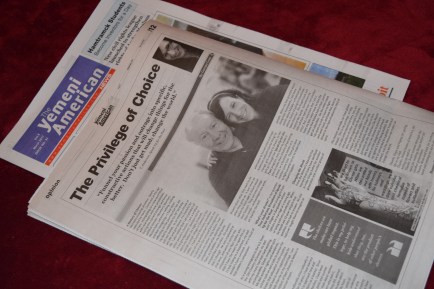

 On My Mind