Philoxenia: Greek-Rooted Reflections on the Art of Welcome & World Refugee Day 2025

* My Signature Blend: As a Language & Culture Empowerment Specialist, I weave stories in Diaspora spaces. How to consume my words: They pair well with a comfort beverage and a reflective space. They are crafted with wholesome, layered complexity, freshly selected thoughtfulness, rhythmic repetitions, punctuated with a unique blend of precious perspective found in diverse and often marginalized corners of the globe and of human hearts.  Each ingredient is prayed through, wrestled with, & marinated in hope. I invite you to savor my signature blend of detail like a delicately prepared dish made for you to taste and share. I pray that it may satisfy the souls of those who choose to break bread with me. Welcome!
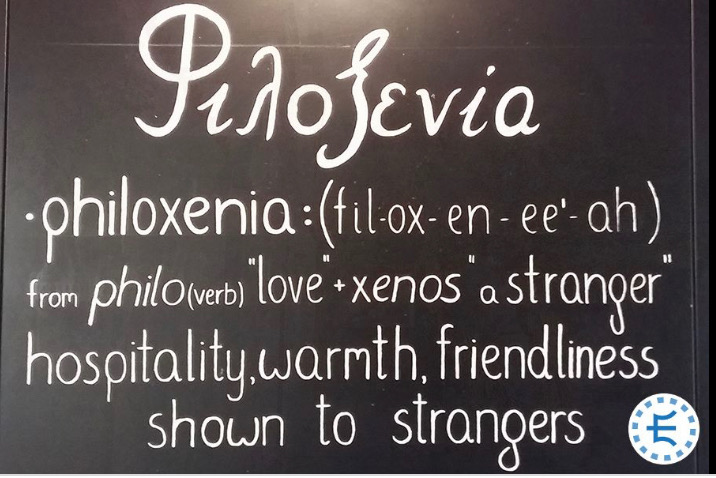
Philo—love;  xenos—stranger, foreigner, or guest.  

Philoxenia is a brilliant Greek word that has no synonym in English.  My proud Greek father will tell you there are a litany of words borrowed from the Greek because the ancient language excels in nuance and precision.

Philoxenia embodies the profound and ancient Greek concept of hospitality. An important cultural and moral value in Greek culture, it emphasizes generosity and welcome towards visitors, particularly those who are from foreign lands.

Principle #1: Greeks not only excel at nuanced language, but also at the nuances of hosting others. 

I’ve lived among overwhelmingly amazing Greek hosts my whole life.  Cultivated in diaspora—on the fringes of my Greek-immigrant community, I never dared to live up to the quality of hosting that has lived on in generations of Greek homes and legends since the beginning of time.

Principle #2: A good Greek hostess always remembers her guests by what they like and dislike.  

I married a xeno. My non-Greek husband was first welcomed into my extended Greek family with a message that pre-circulated his arrival at every Greek dinner table: he will not eat tomatoes. Noted. Everyone knew his waywardness with village salads—that he more than made up for with eager seconds on every other homemade delight.
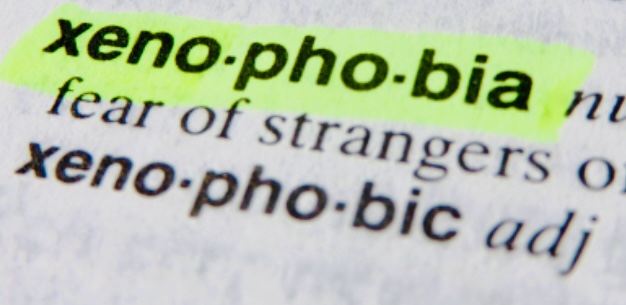
Phobia—an intense, irrational fear. Xenophobia is the fear or hatred of strangers, and quite literally the opposite of philoxenia.

Xenophobia is a present reality for so many foreigners who flee from one place to another. There are messages of hatred and distrust that pre-circulate their arrival before they ever have a chance to come to the table.

World Refugee Day Preparations

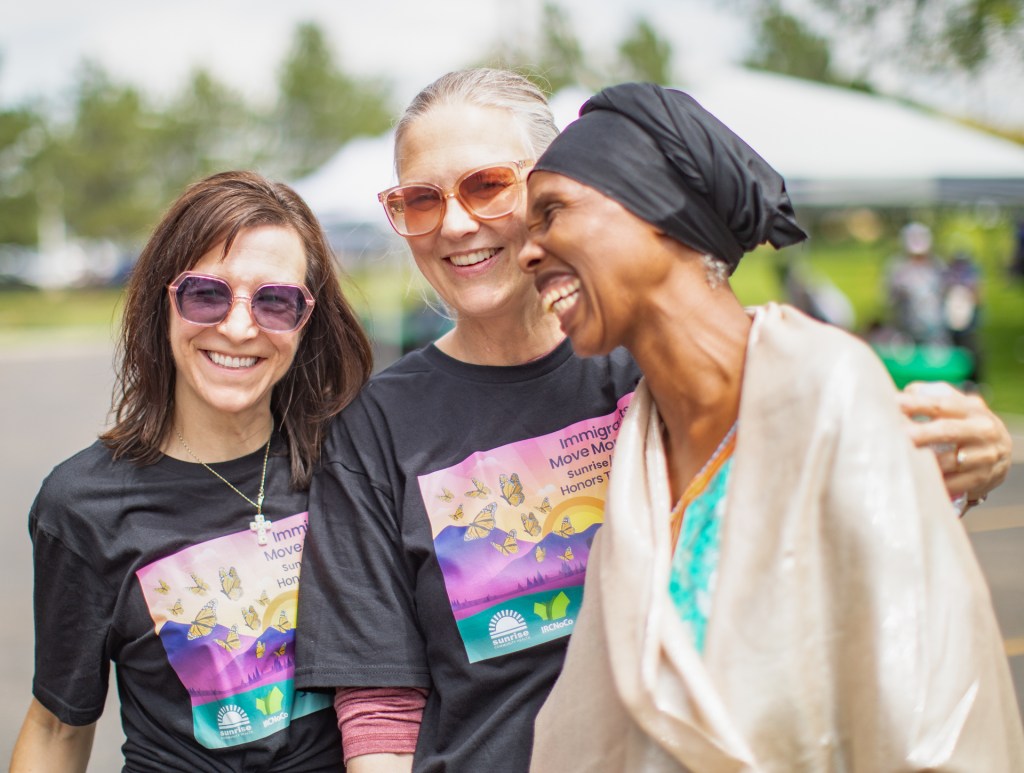
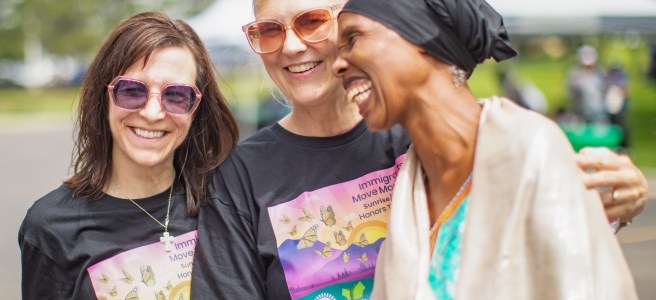
As an Empowerment Coordinator at our local Immigrant and Refugee Center, I was appointed by our strategic and fun-loving Mexican Directora to be the hostess of our World Refugee Day event. We wanted to host a party for our clients—a day to really celebrate them and prepare a place for them to feel at home. Our clients come from a myriad of nations that are currently on a travel ban list in 2025. Others face insurmountable walls and seek temporary protections from life-threatening dangers.  

I didn’t realize I possessed any of the hostessing prowess of my ancestors until my boss invited me into that role. My goal? To make our clients from every language group feel welcome and that this event was for them.   

Applying Greek Hostessing Principle #1: The best way to express safe, welcoming spaces for everyone was to start with the nuanced details of good music, carefully selected cuisine, and familiar faces.

Applying Greek Hostessing Principle #2: I made my list of what I knew people liked and didn’t like from previous mental notes: 

  • Halal and vegetarian food markers for our Muslim friends
  • A carefully selected variety of cultural music that moves people to dance or sing or smile
  • A space where the children feel free to dance and play.

Will my Eritrean friends feel like this event is for them?  

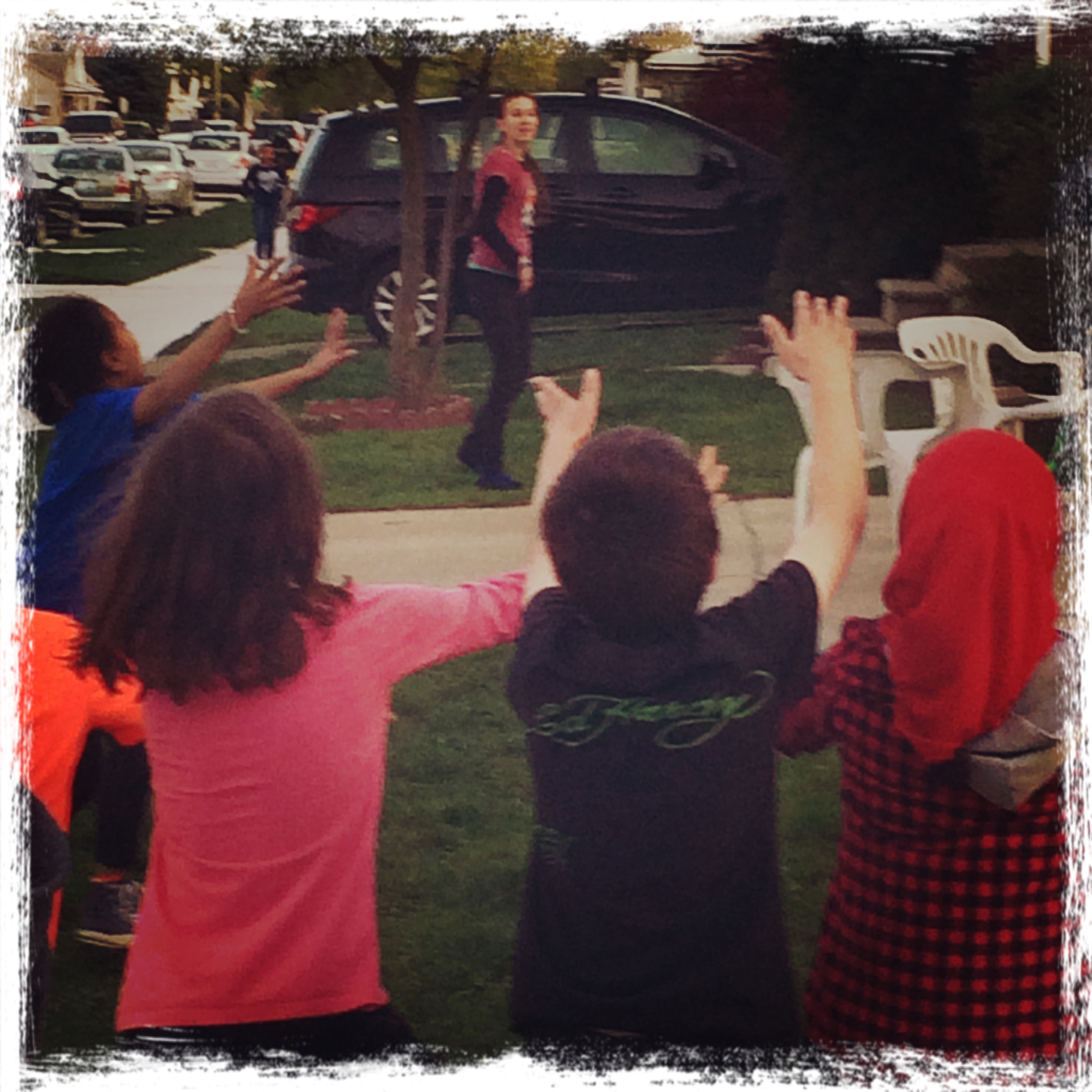
The unique sounds of ancient Eritrean instruments and rhythms were first to burst forth from the borrowed sound system.  With a glint in her eye, one of my regular Eritrean clients stepped forward and then back.  As I moved in to greet her, I discovered myself joining her dance.  Tiny steps forward and tiny steps back.  Then shoulder shrugs and head leans. I wasn’t in it for mastery; I simply received the invitation to join something wonderful.  Before I knew it many more familiar faces appeared on either side of me.  Women and their babies I had often sipped tea and broke bread—hembasha bread—with. My Eritrean friends gleamed as they savored a small feeling of home in a culture so far from it. 

Will my Rohingya, Somali, and other Muslim friends have food to eat, and know it’s for them?

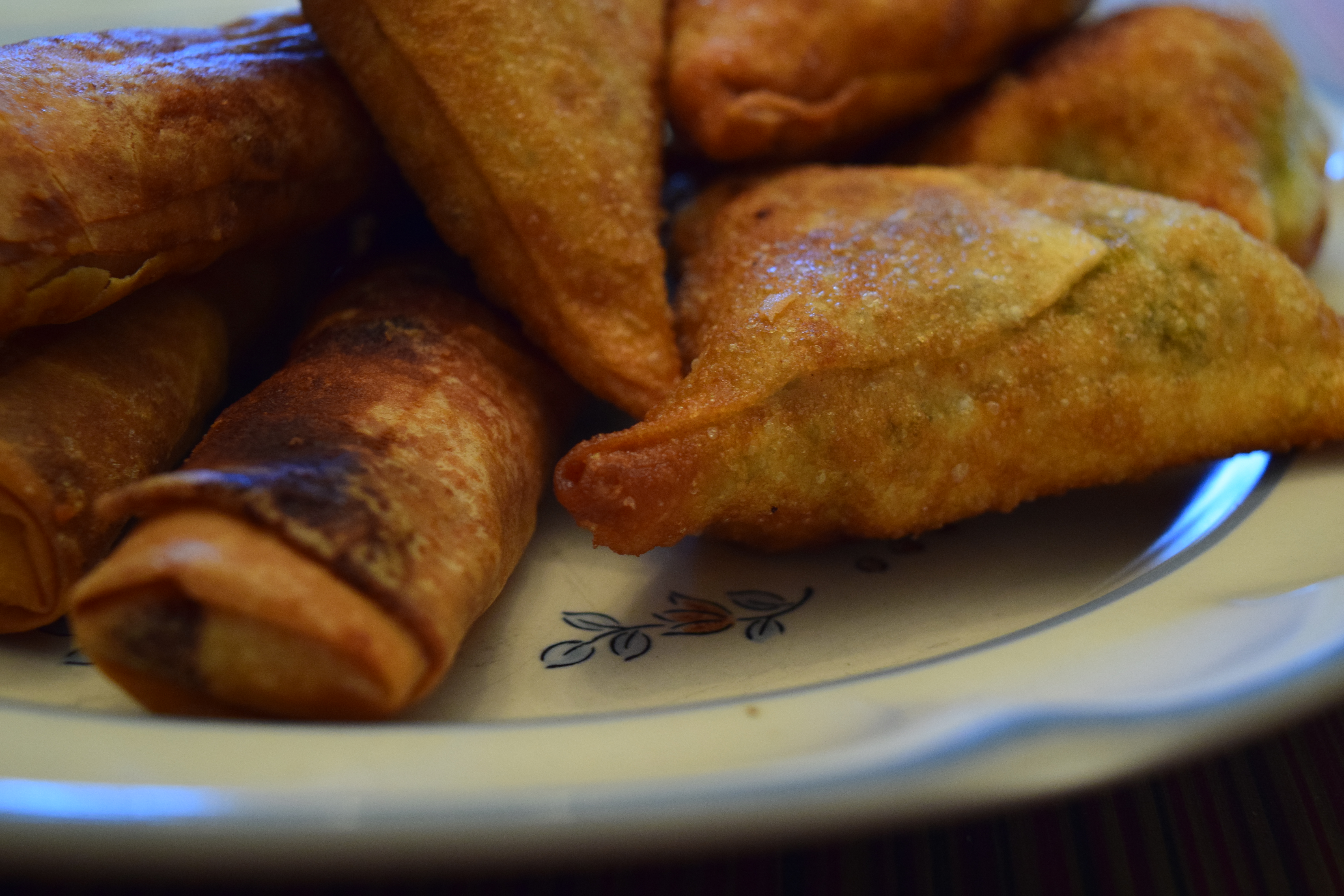
I handed over the halal and vegetarian labels that I had carefully prepared to our Somali intern. She was delighted as we discussed the importance of our Muslim guests knowing that food was thoughtfully prepared with them in mind. We had even figured out a way to hire one of our local Rohingya chefs to make 300 spicy, halal meat and potato sambusas for our event.  I found myself doing a little Eritrean-inspired shoulder shrug happy dance as I bit into one.

How can I support my brave Haitian friend in her big stage performance? 

I gave my beautiful friend a warm introduction as she courageously climbed the stairs of the 4-foot stage anticipating her solo in Haitian Creole. I explained to the gathering crowd that her song expressed a prayer for her beloved Haiti.  She rose up—her voice, her body, her words—as did the Haitians in the crowd, with their cameras and connection to their language, their homeland, and the words of her song. Another dear Haitian friend spontaneously leapt onto the stage, grabbing the singer by the hand and twisting her in his arms while she boldly belted out her tune. I felt honored to share in that brief moment with the singer—and to witness the spark in her spontaneous dance partner’s eyes that joyfully lit up his whole face.

Our staff, volunteers, and community partners extended invitations. People ate well and danced well and smiled as their little ones played. We worked hard to serve each other well. It wasn’t just about Eritrean music, Somali friends, Rohingya cuisine, Haitian inspiration, and our interactive Mexican mercadito.  It was about sharing moments of connection among friends in community. It just happened that our community is gloriously diverse in all its expressions. 
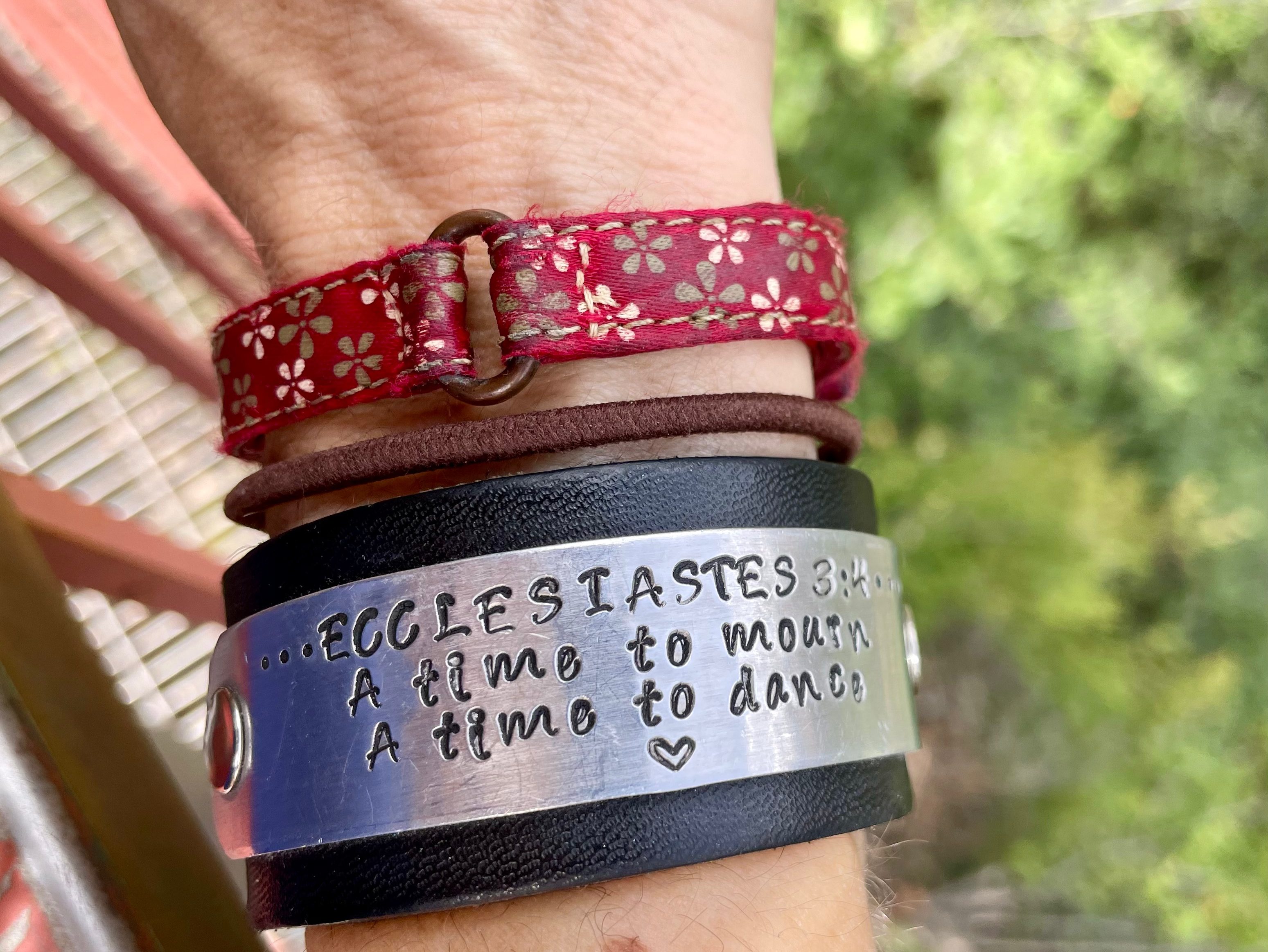
~There is a time to mourn and a time to dance.~

Flourishing and struggling are not strangers—to love is to grieve and to welcome the stranger and walk alongside them on their journey means we also see the challenges they’re up against. We took the time to dance with friends from a myriad of ethnolinguistic groups.  A few days later we mourned the realities of how much harder it will be for them to live and work and flourish in this country they are trying so hard to call home.

Inflammation occurs in the body when one part becomes reddened, hot, swollen, and painful as a reaction to an injury or infection.

Our world is inflamed. Conflicts are harder to resolve peaceably. Bodies are increasingly broken. Homes, communities, and families are forcibly uprooted and displaced. Rubble and bombs inflame the earth. The casualties tend to be the ones who are already the most vulnerable. Everything around the xenos feels more inflamed. 

When we know what is inflamed, we can pay attention to it.  Then we can diagnose it and move forward as healers in hurting spaces. Until then, we mourn. My deep faith compels me to mourn with those who mourn, and to acknowledge the inflammation around the bodies, minds, and spirits of those who are vulnerable.

But we also dance. We danced that day because most days at our Immigrant and Refugee Center we face challenges. We dance to share in each other’s joy and release some of our pain. The privilege of the dance is also the honor to hold another’s grief—that is what makes the dance so beholden.  
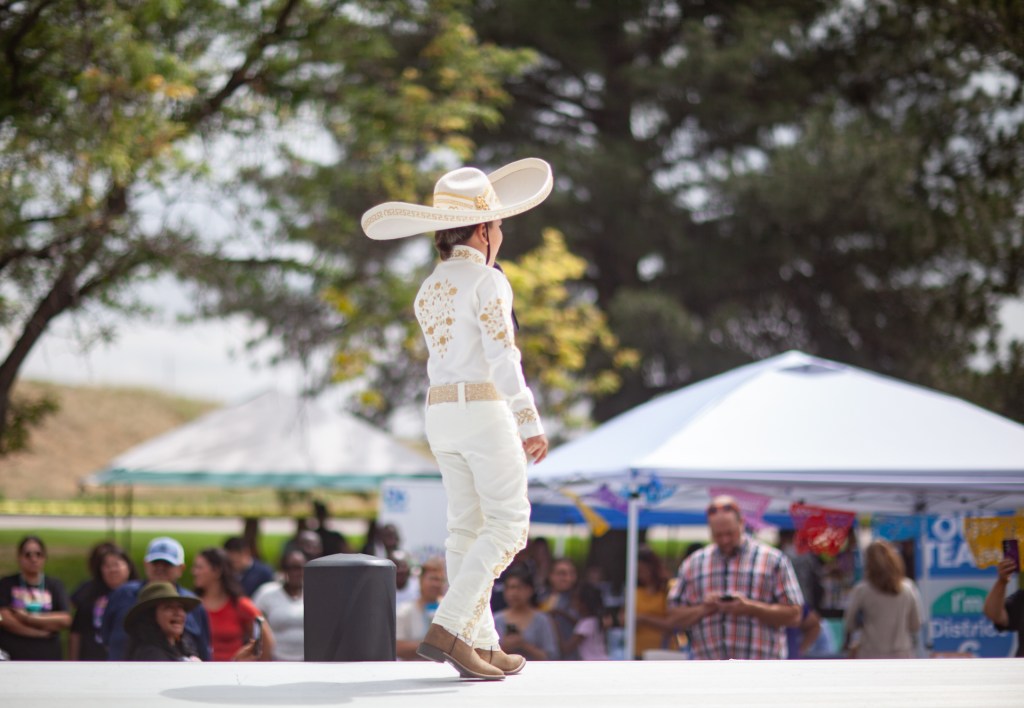
We celebrate philoxenia because xenophobia is palpable.  

I had a new sense of my Greek-rootedness—cultivated in a beloved diaspora community. In our small corner of the world that welcomes foreigners as honored guests, philoxenia abounds. As I marinate on the manifold experience of World Refugee Day 2025, I realize that I was the strange one being generously welcomed into the joy-filled spaces among friendly faces of our wonderfully diverse community. 

Let us be relentlessly hopeful as we receive the sacred invitations of a loving God to His attentive children. Welcome! Walk with me. Join the unforced rhythms of my grace—the treasures and the smiles and the symphonic beauty of it all. Philoxenia—you are welcome here, with me—in welcoming others.
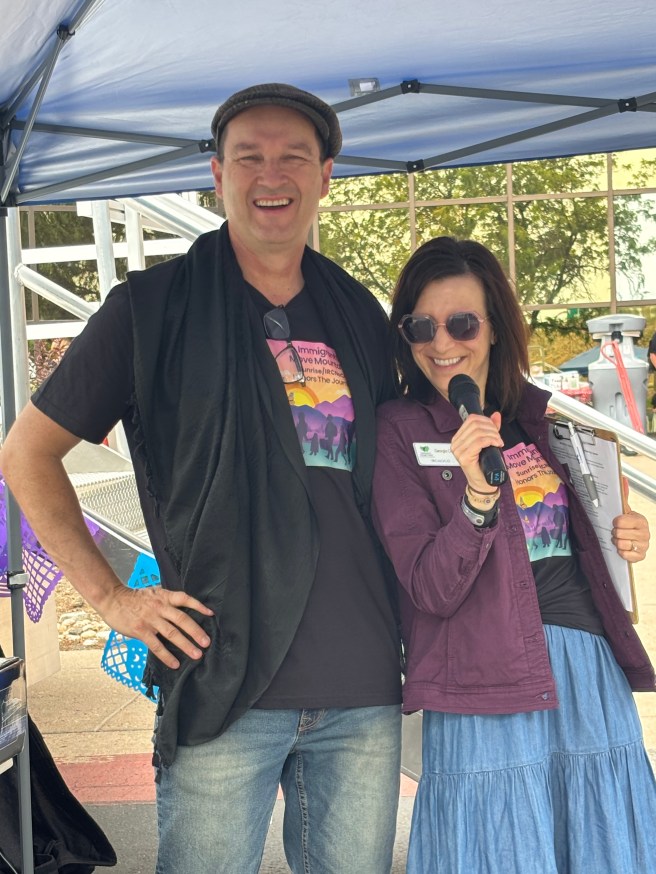
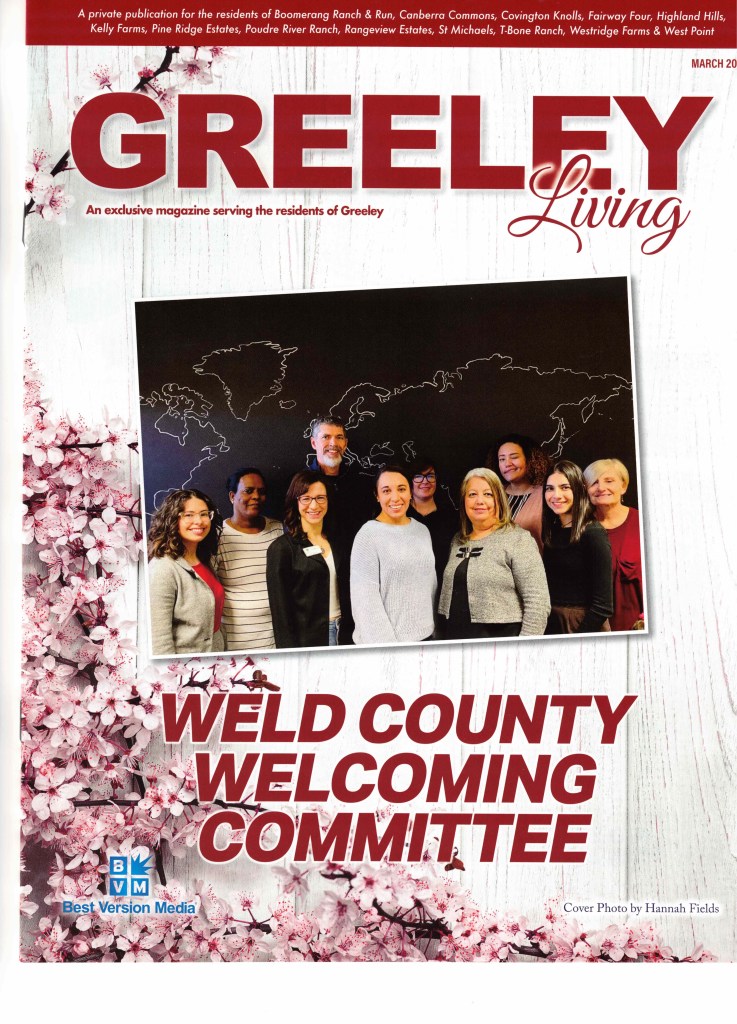
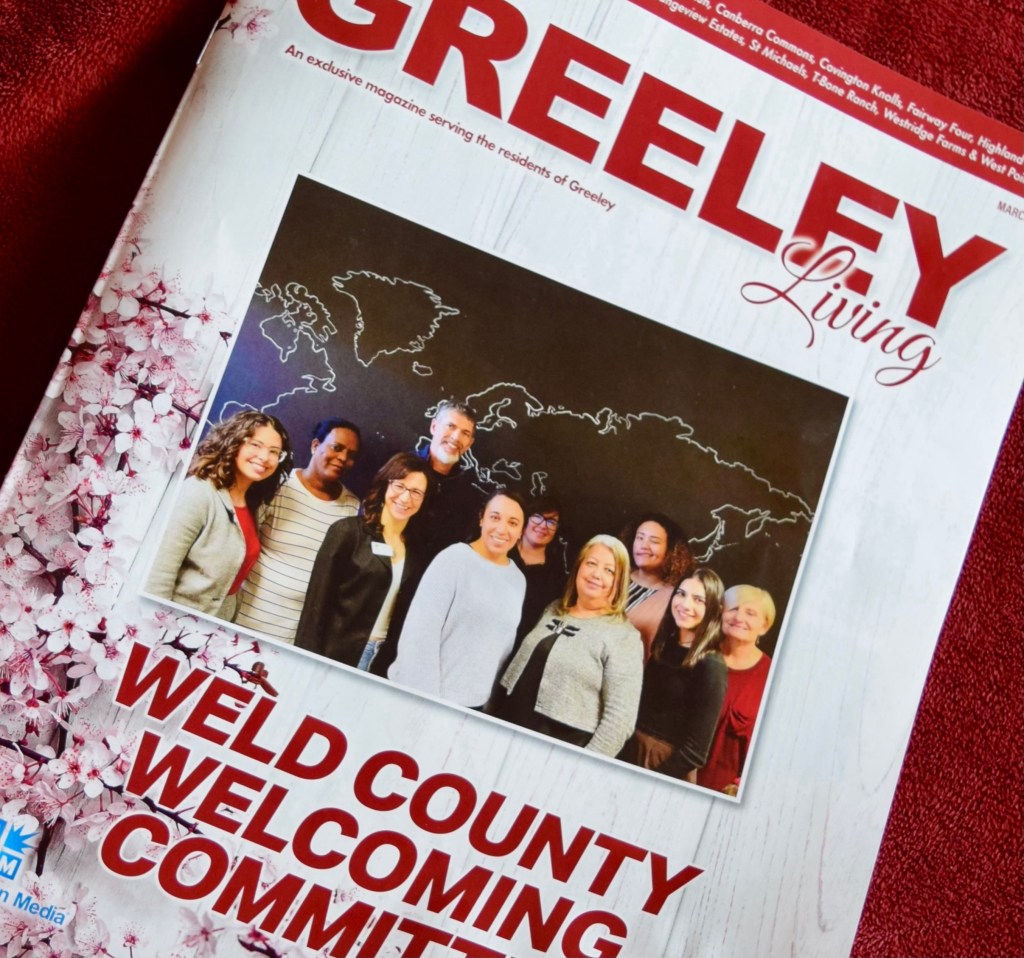
Weld County Welcoming Committee

I’m grateful for the invitation to do an interview with Greeley Living Magazine for the March 2023 issue. I love being a part of my diverse community!

Empower – Connect – Advocate

Located on 8th Avenue, the Immigrant and Refugee Center of Northern Colorado (IRCNOCO) has been serving the community since 2017, when the Immigrant and Refugee Center of Northern Colorado began as a combined operation between Right to Read of Weld County and the Global Refugee Center. Rather than providing English language training to some clients and Community Navigation services to others, becoming one, larger organization meant that they could be reaching more of our clients’ needs by making their services into one efficient, effective process in one location.

Explains IRCNOCO Community Navigator, Georgia Coats, “The driving force behind our mission is successful integration where immigrants and refugees have a place to resettle and call home—a place to thrive and a place where healthy integration means that they feel like they belong and have good things to give and receive in community.”

Some of the services they provide include individualized case management and employment support for refugee clients, translation of relevant documents and information into various languages for their clients and families, assisting community members through the process of becoming United States Citizens through Citizenship classes and interview preparation sessions, and providing resources such as tablets and hotspots to help facilitate digital literacy. They also have a variety of educational courses for their clients, including a “Little Learners” program for preschoolers, and a Women’s’ Empowerment group. 

A daughter of Greek immigrants herself, this organization is near and dear to Georgia Coats’ heart. “I have always lived in diverse communities where multiple languages and cultures have enriched my life. I was born into a Greek Immigrant community in Denver and have lived among various diverse groups of immigrants and refugees ever since. I have a BA in Spanish and Bilingual Education from UNC, and an MA in Language Learning & Linguistics from Wayne State University in Detroit. My husband and I lived in Dearborn, Michigan, where we worked in an Arabic-speaking Muslim community for 17 years.”

In 2018, the Coats family, now grown to five members, returned to Colorado and settled in Greeley. “Though we still grieve the loss of easy access to falafel, waffles are an important staple for Saturday morning breakfast. I’ve been a language learner my whole life—starting with Greek, then Spanish, then dabbling in Arabic. I’ve learned some things more successfully than others—but my lack of success in some language learning contexts has made me a more compassionate language instructor and language learning coach. In addition to my parttime work at IRCNOCO, my husband and I also work with another nonprofit that focuses on ethnolinguistic communities worldwide.”

Women’s Empowerment

Georgia joined the IRCNOCO mission in 2020 as a Community Navigator, a big change from teaching English. “Teaching was a place where I could work out of my strengths. Being a Community Navigator, however, takes all my language and culture skills but also challenges me to take a more vulnerable posture of humility.”

In 2020, she also began to gather women together at the center for the Women’s Empowerment Group. “We have grown into a small group of tenacious women from six different countries who seek to lift each other up towards our goals and dreams and be supportive of each other’s journeys. We believe that girls with dreams become women of vision.”   

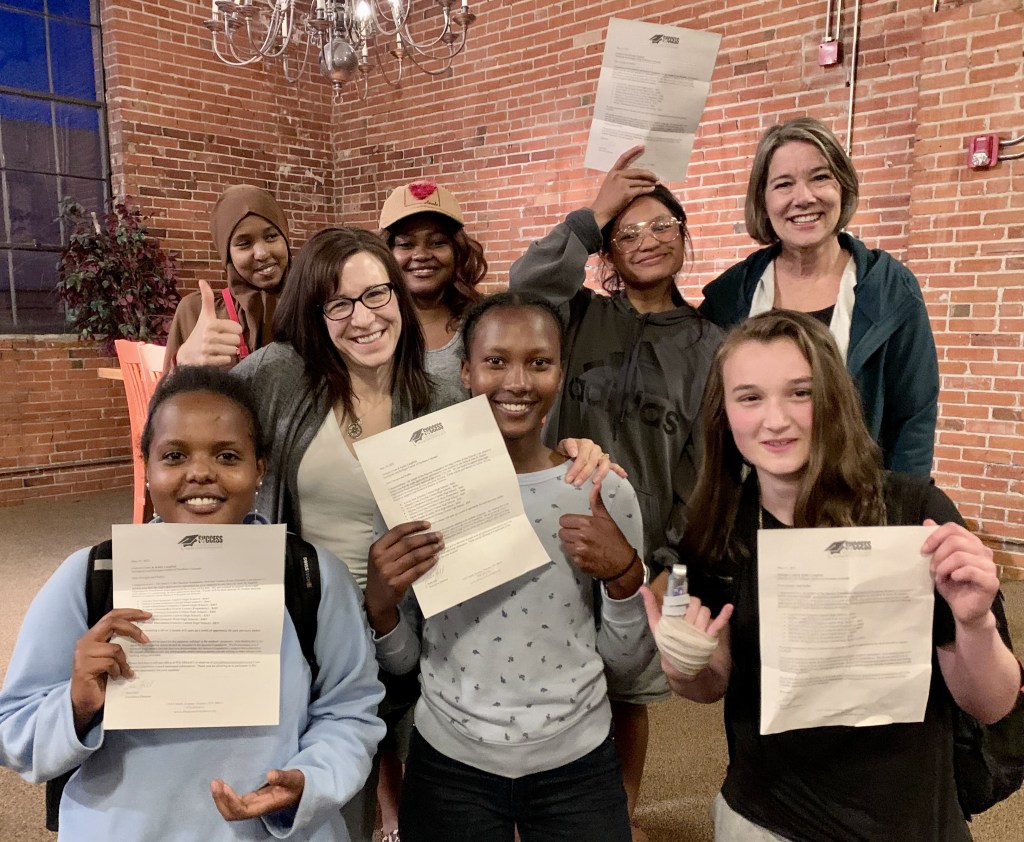
They’ve seen that same support in the larger Greeley community as well. “An outpouring of serving with my local church and working part time at the IRCNOCO has led me into a beautiful community cross-section called Zoe’s Study Buddies,” says Georgia. Study Buddies started as a group of high school kids from refugee backgrounds asking for one-to-one academic tutoring. Many of these teens come from the families that they serve at the IRCNOCO.

“My colleague, Kathy, and my neighbor Emma, and I began to respond to this need for tutoring in various ways.  We now have 8-12 highly motivated teens from at least 6 different language groups who receive academic support and a warm beverage on Tuesday nights at Zoe’s Café in downtown Greeley!  We’ve become more than a tutoring group, though, we’re more like a big, bustling family of teens, tutors, drivers, and a growing sense of belonging.”

Mohamed and the Thanksgiving Turkeys

And this community support goes both ways. “Our clients at IRCNOCO are often very grateful for the services we provide and find ways to be generous with us when they have the opportunity,” she says. Recently, they saw this when a client named Mohammed came in the week before Thanksgiving wanting to gift IRCNOCO Office Manager, Tony, with three large frozen turkeys. Mohammed, who doesn’t celebrate Thanksgiving, works at a meat processing facility and his workplace gave him the turkeys as a holiday bonus. He was eager to share his bonus with his friends and immediately thought of some of his American friends who might appreciate such a gift.  

When he showed up at the IRCNOCO with his abundant supply of frozen poultry, they had to act fast to keep his gift from going to waste. “Tony asked if there was a way I could take them home to keep them frozen so they wouldn’t spoil. I quickly called my husband, who came by the center to temporarily store the birds in our freezer.”

The next challenge was what to do with the turkeys, as most people had already gotten theirs! Thankfully, they were able to find families to give them to using their networks at church. “I felt like I was in just the right place at just the right time—to receive the turkeys from Mohammed via Tony, send them to the deep freezer with my husband, and then have the privilege of giving two of them to these other community members. Giving and receiving is a crucial part of healthy community and belonging,” Georgia concluded.

When asked about what she loves most about IRCNOCO, Georgia said, “I love the idea that people moved westward and into this High Plains area of Colorado in search of something better for their lives.  It takes a courageous spirit to leave the familiar and explore new frontiers; and I see that kind of passion for discovery and innovation woven into the culture of our community. Similarly, the newcomers looking to resettle here from places like Burma, Somalia, and other parts of Africa, Asia, and South America are seeking the promise of a better life and a safe place for their families to belong and thrive.” 

In parting, Georgia had this call to action for readers. “As a community, we have the unique opportunity to continue to nurture that spirit of new frontiers for these diverse populations. As they are able to successfully integrate here, they deepen and enrich our culture that is unique to Greeley and this High Plains area. I hope to see more and more of us on the ‘welcoming committee’ for those who want to call Weld County their home.”

NY2020: Feeling Small

D1CAD816-B662-49A9-8C00-E04D0F43A1B2_4_5005_c

Dear Dr. Martin Luther King Jr.,

I’m feeling pretty small.  Things are kind of crazy at the onset of 2020.  Injustice. Intolerance. Mean words. In 2020 people are angry and feel like they have the right to take it out on others.

I used to feel bad for the time in the history that you had to face.  I was content to just be inspired by your legacy, that even though we face the difficulties of today and tomorrow, we can still have a dream… that this nation will rise up and live out the true meaning of its creed… that all humans are created equal.

Your dreams and accomplishments made me thankful for how you made our nation a better place for everyone to live peacefully and safely.

What Went Wrong?

I’m not sure what went wrong, or if I just opened my eyes a little bit wider.  When I read, in 2020, your convicting words against racism, I feel like I could never live up to your standards.  I’ve never been discriminated by the color of my skin as you have.  I’ve never been as outspoken as you are.

You are our civil rights hero.  And we celebrate that.

But, in order to even fathom your dreams in this new decade, I’m realizing that it’s not always about being big and strong and fiercely outspoken.  It’s not about excusing myself from an impossible calling for more gifted people.

It’s about the small stuff. 

It’s about scooching over to make room on my bench for one more weary human to sit.  It’s about knowing my neighbor, looking into her determined eyes and seeing her very great smile of grit and gratitude.  It’s about being so amazed by the content of her character that I have nothing but respect for her.  It’s about sharing our humanity.

You see, I have some amazing friends.  And they have been judged by their ethnicity, religion, immigration status, and the color of their skin.  They have faced and overcome tremendous odds to get where they are today.  And they still have So. Far. To. Go.

CAE74C1D-AAAF-4964-AF9E-90FF4AE84FC5

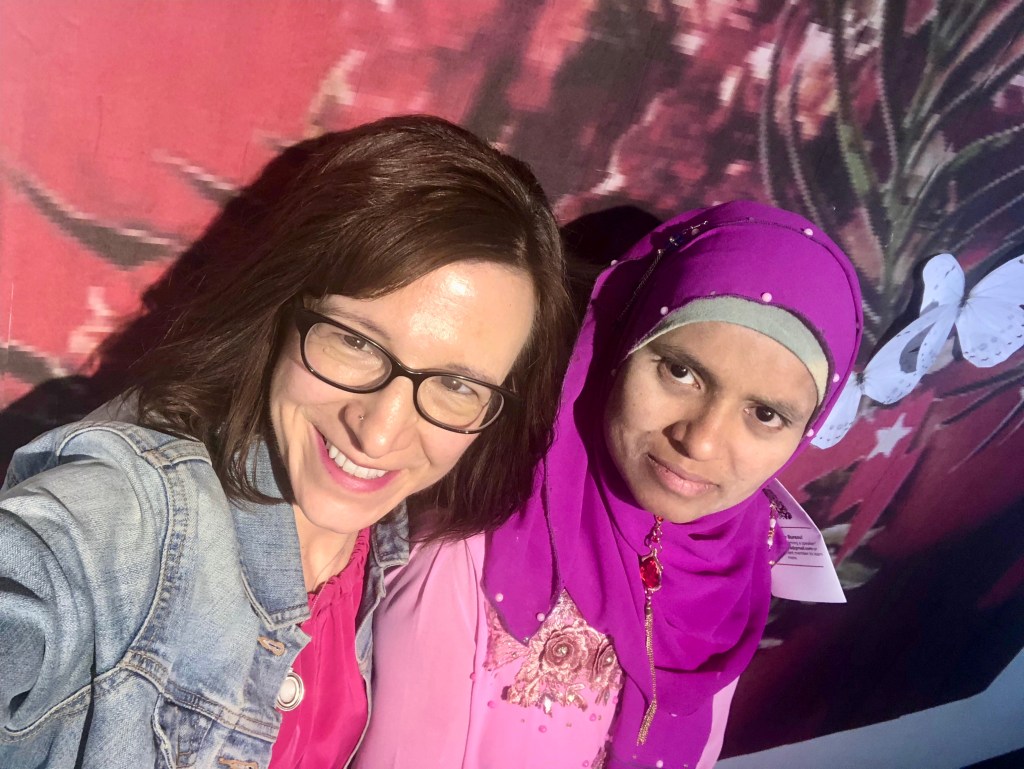
Pompa had been in this country for 9 years before she realized her husband had filed no immigration paperwork for her.  So, when he filed for a divorce, he figured she would have to disappear back into the bustle of Bangladesh.  With nothing.

He didn’t account for her courage, her fortitude.  Or for her faith in the God of the impossible.  He didn’t account for the kindness of others—both Muslim and Christian—who provided for her legal fees and her housing needs.  He didn’t imagine she had anything to offer that would inspire the faith and courage of others.  He was so wrong.

959F1B1A-6077-4517-A47A-E5F7DAED140A

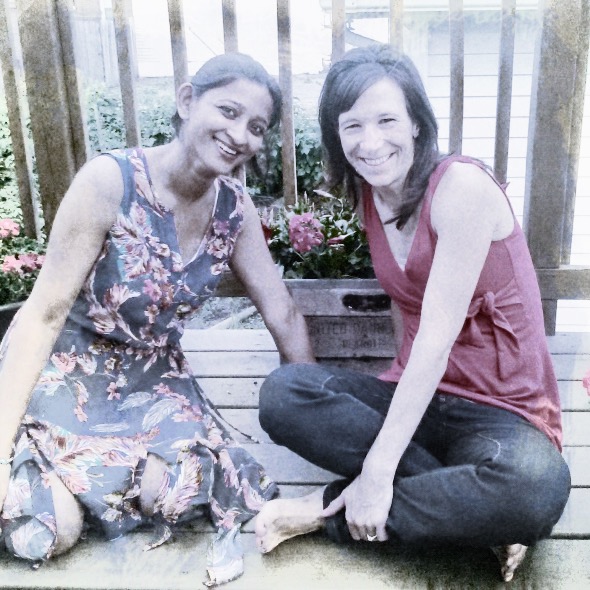
And Zuzu.  She has never let her refugee status conquer or even dampen her spirit.  Instead, she embraced the opportunity of a fresh start in a new country.  As a mother of 3, she also manages the family finances and cares for her aging in-laws while pursuing her education in her 4th language.  Her husband also works tirelessly so she can go to school and together they can achieve in this country what hasn’t been possible for them back in war-torn Syria.

Screen Shot 2020-01-20 at 11.41.38 AM

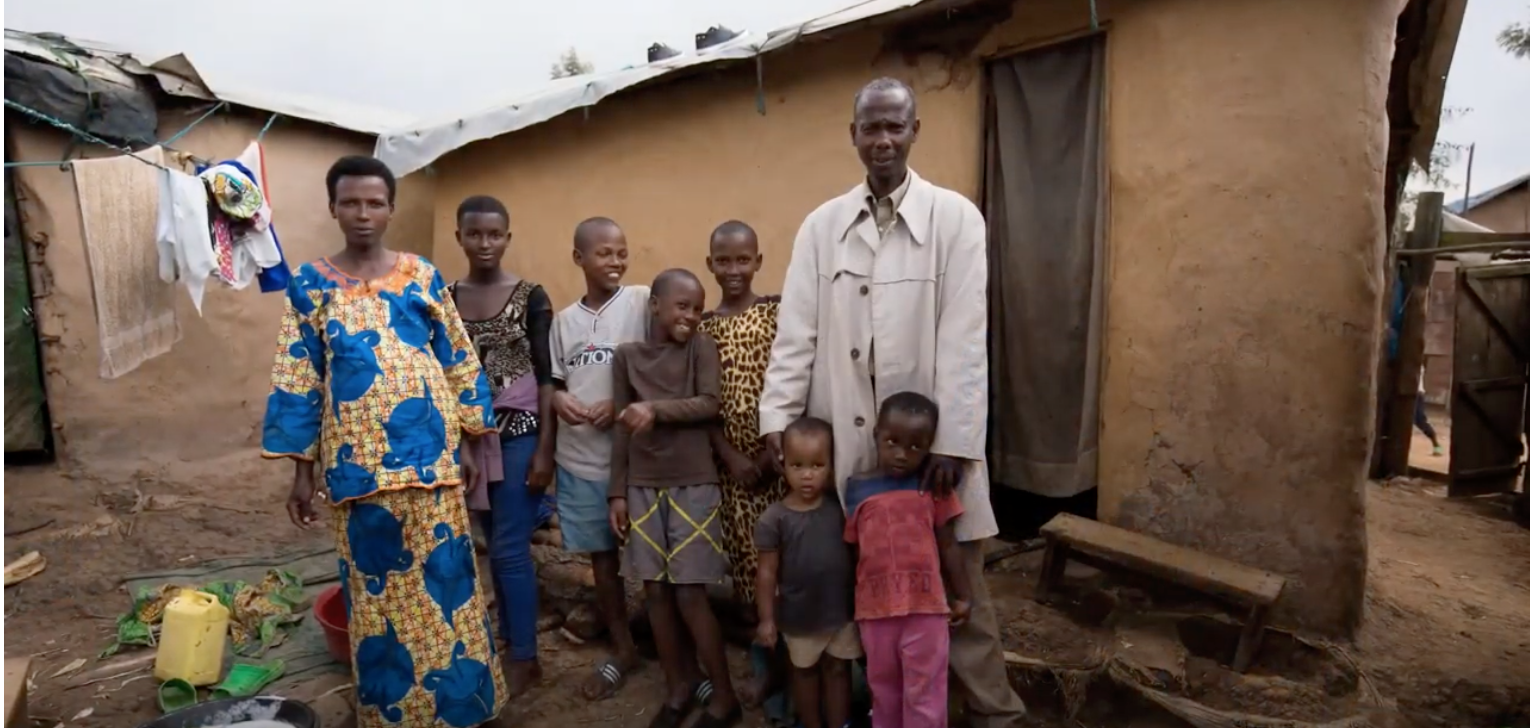
My newest neighbor is a Gentle Soul with the brightest smile I have ever seen.  She met and married her husband and gave birth to their 10 kids in a refugee camp in Rwanda.  Now, as a widow, she braves a strange new community as a single mom with NO English language.  She works nights at a meat packing plant and relies on the kindness of others, her deep faith, and the services our great country has to offer to help her kids thrive.

I feel so small. 

I have so little to offer.  But I also know that every little offering is something.  I have held hands in prayer with Pompa.  I have celebrated Zuzu’s achievements over little cups of tea.  And I have connected deeply—mother to mother, woman to woman, human to human—far beyond words with my Gentle-Souled neighbor.

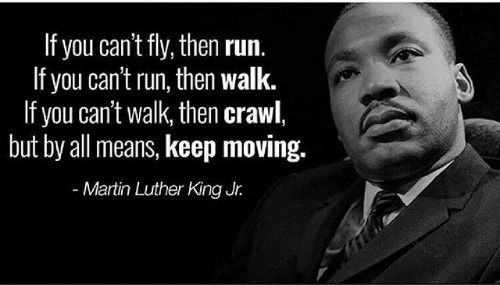
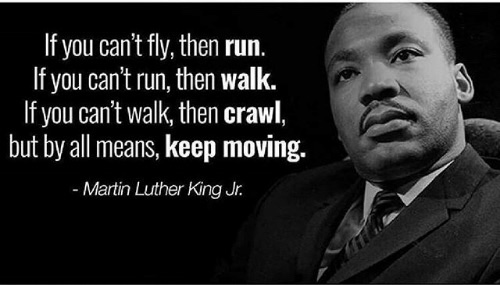
Dr. King, thank you for these words:

If you can’t fly then run, if you can’t run then walk, if you can’t walk then crawl, but whatever you do you have to keep moving forward.

I can’t tell you how relieved I am that you actually said this.  I have seen my three beautiful friends move forward and cross insurmountable barriers with hope and grit.  My friends have been incredibly patient and grateful and gracious.  They have taught me to never waste a moment—to live, to learn, to move forward, to love others, to dare greatly.  They have shown me equality in our pursuits of happiness.

I feel so small in a big, scary 2020 world.  But, I’m learning that I can do the small stuff.  I can move forward, even if my steps feel ever so insignificant.  I can scooch over.  I can give my neighbor’s kids a ride home from school.  I can help her understand the electric bill.

I can take on small… I could even be great at the small things.

If I cannot do great things, I can do small things in a great way.  -MLK, Jr.

Dr. King, did you really ever start out small?

Smiling Eyes and New Perspectives

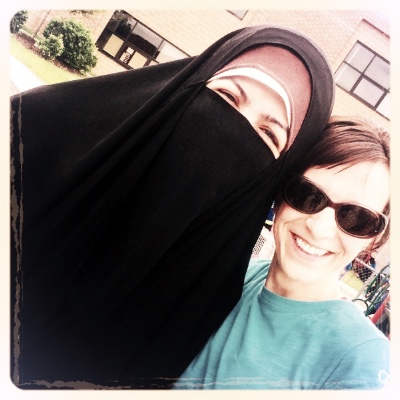
My sweet friend… she smiles with her eyes and covers her face, while I flash my grin and cover my eyes.

884d6e52-31c1-454e-8a10-6bf9df922bc6

I had the privilege of being the first American/non-Muslim to invite this dear Muslim woman from the Gulf into my home recently. Amidst chasing her 1 year old, we talked for hours about faith, dreams, cancer, raising kids, and the niqab–the face-covering she wears in public. With her gentle demeanor, she explained the courage it takes to wear the niqab, and the assumptions people automatically have.

One time when she was in the park with her kids, a group of young students were fearful, calling her a zombie. She bravely asked their teacher if she could talk to the students. With no men present, she lifted the niqab and introduced herself.

I felt so blessed by her heart and willingness to cross barriers to share a sliver of her life with me❣️  

When we cross barriers and get to know people who are different from us, it broadens our perspectives and enriches our lives .

One perspective on head coverings, with a hip hop feminism flare is this song:

Hijabi

by Mona Haydar. It provides a young Muslim woman’s perspective on her hijab (head covering) in English.

🎶All around the world
Love women every shading
Be so liberated…
I still wrap my hijab
Wrap my hijab
Wrap my hijab
Wrap, wrap my hijab 🎶

I love how culturally situated songs give us a perspective, and a beat, we may not have otherwise considered.

And here are some other helpful definitions of Islamic headwear.


Defining “Neighbor”

I first met Maude* when my toddlers began to waddle northward towards her house.  She was tall and gaunt with a sensible silvery bowl cut.  Even when she was being friendly, she had a naturally sharp tone behind most of her curt comments.

IMG_6649

We intentionally moved into the neighborhood for the richness of its cultural, linguistic, and religious diversity.  We wanted to take to heart the command of Jesus the Messiah—to love God with all our hearts, and to love our neighbors as ourselves.

When a wealthy young man challenged Jesus to define neighbor, he responded with a beautiful story of a compassionate Samaritan man who met a Jewish man along his path in a moment of desperate need.  The Samaritan had to cross cultural and religious boundaries, and face the prejudices of the day to help.  It also cost him time, effort, and money to bring comfort, healing and blessing to the wounded man.

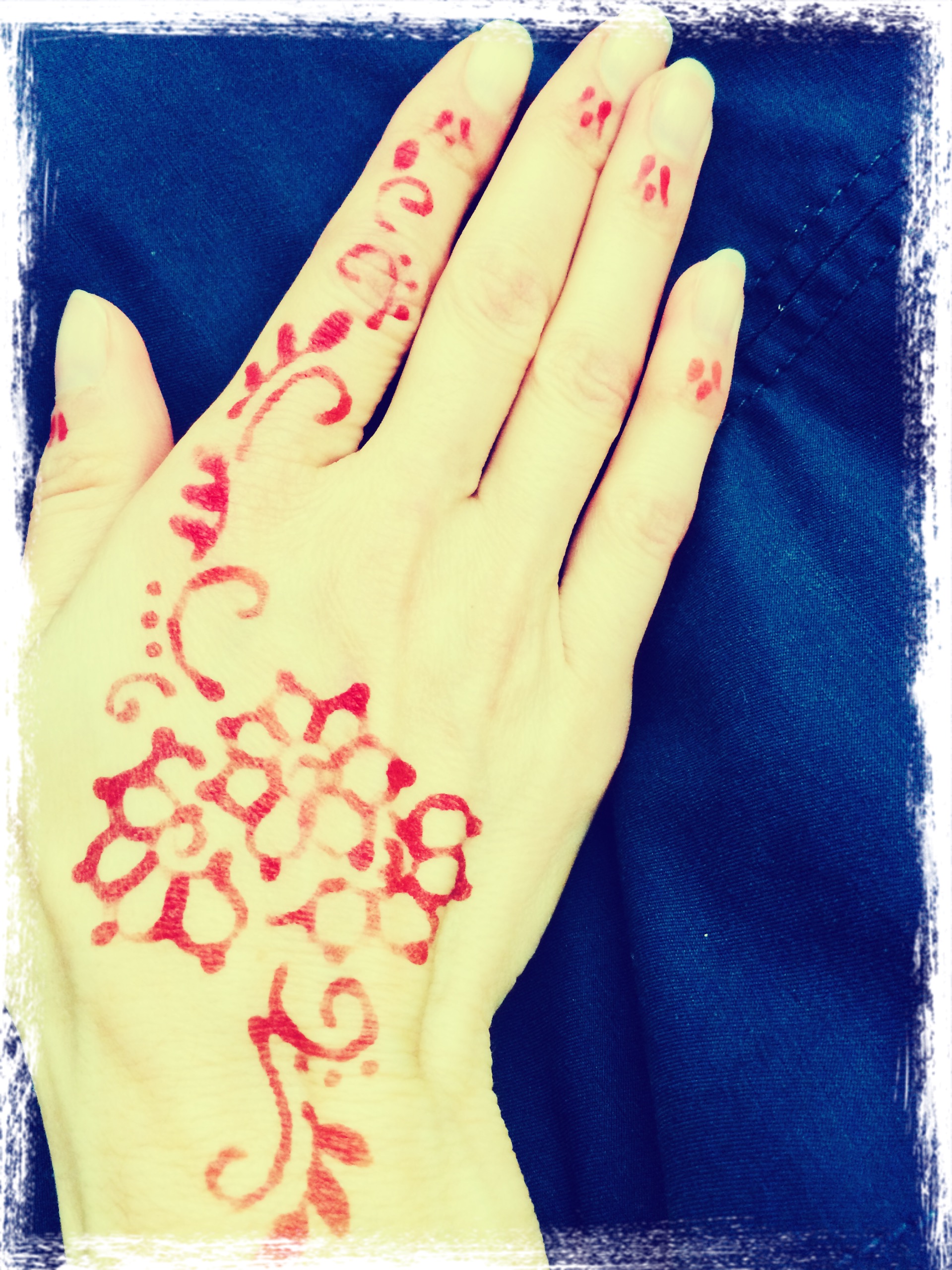
Our family has a lot to learn from Jesus’ story and expectation of loving our neighbors.  We have been challenged to cross over boundaries and enjoy the adventure of diverse neighborly relationships.  The challenge and the joy are mutual.  Our kids have grown up alongside our Arab Muslim neighbors and we have shared life together—the ice cream truck, henna, pass-the-plate wars, front yard games, and even the great flood of 2014.

IMG_6650

#lovingmyneighbors

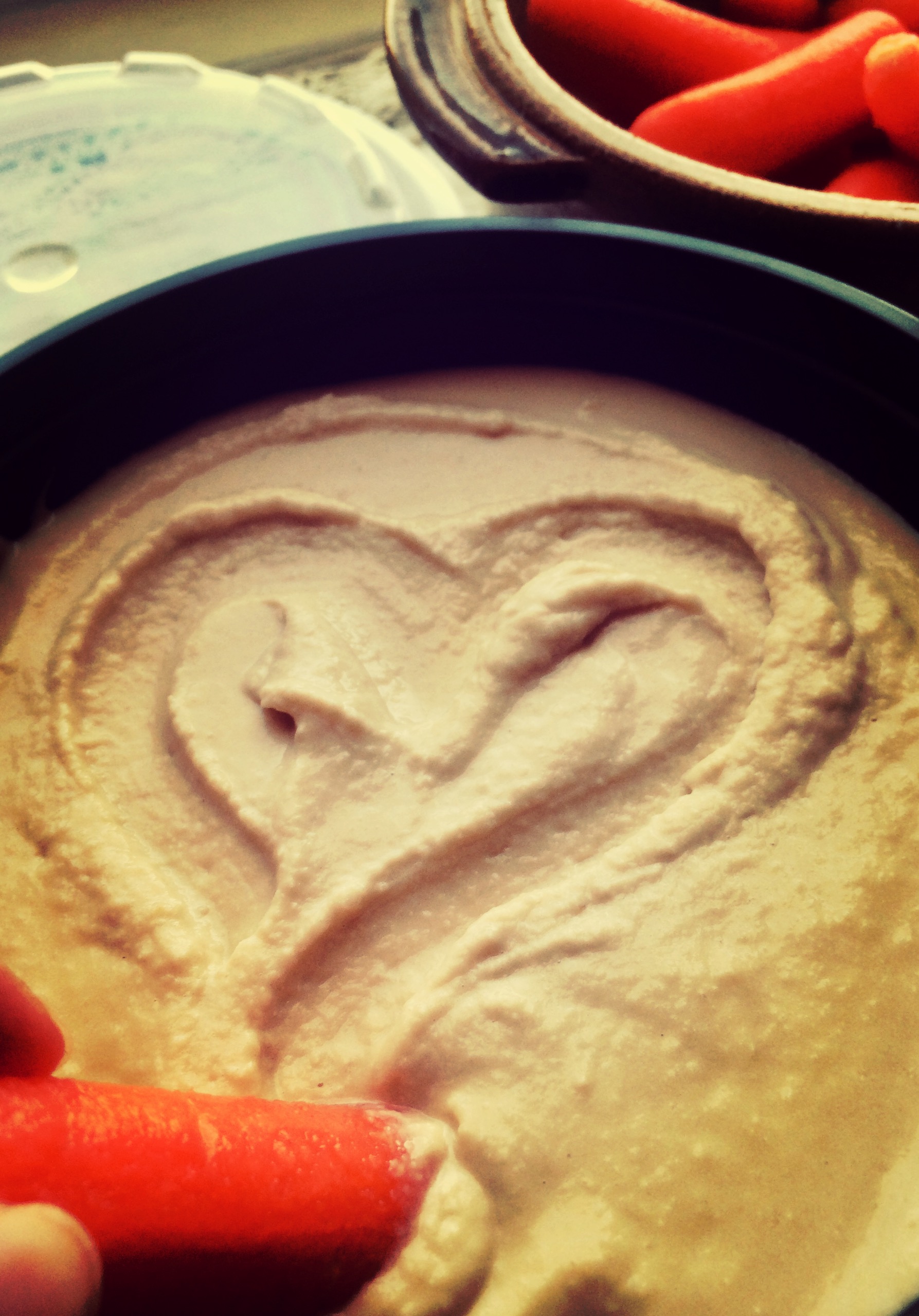
Arab hospitality is a thing.  Kindness expressed through great food is a debt we can never repay.  On our south side there is the Lebanese widow of four grown children.  She makes great hummus and has a very cute puppy.  Next to her is a young Yemeni family, a sweet elderly retired Iraqi educator, and a Palestinian family.

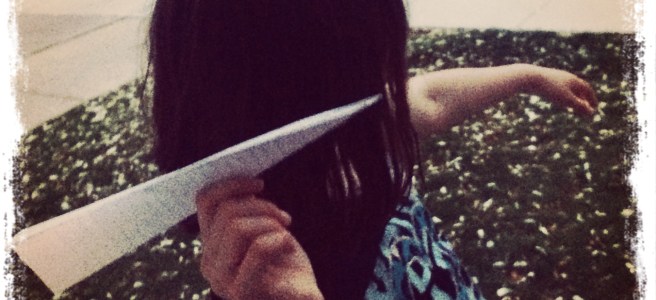
IMG_5346To our north are a few more Yemeni families who throw great girl parties and provide my kids with an endless supply of sweet treats, especially during Ramadan. Next to them is Hussein, the paper airplane guy, and his sister Latifeh, working professionals who live with their elderly parents.
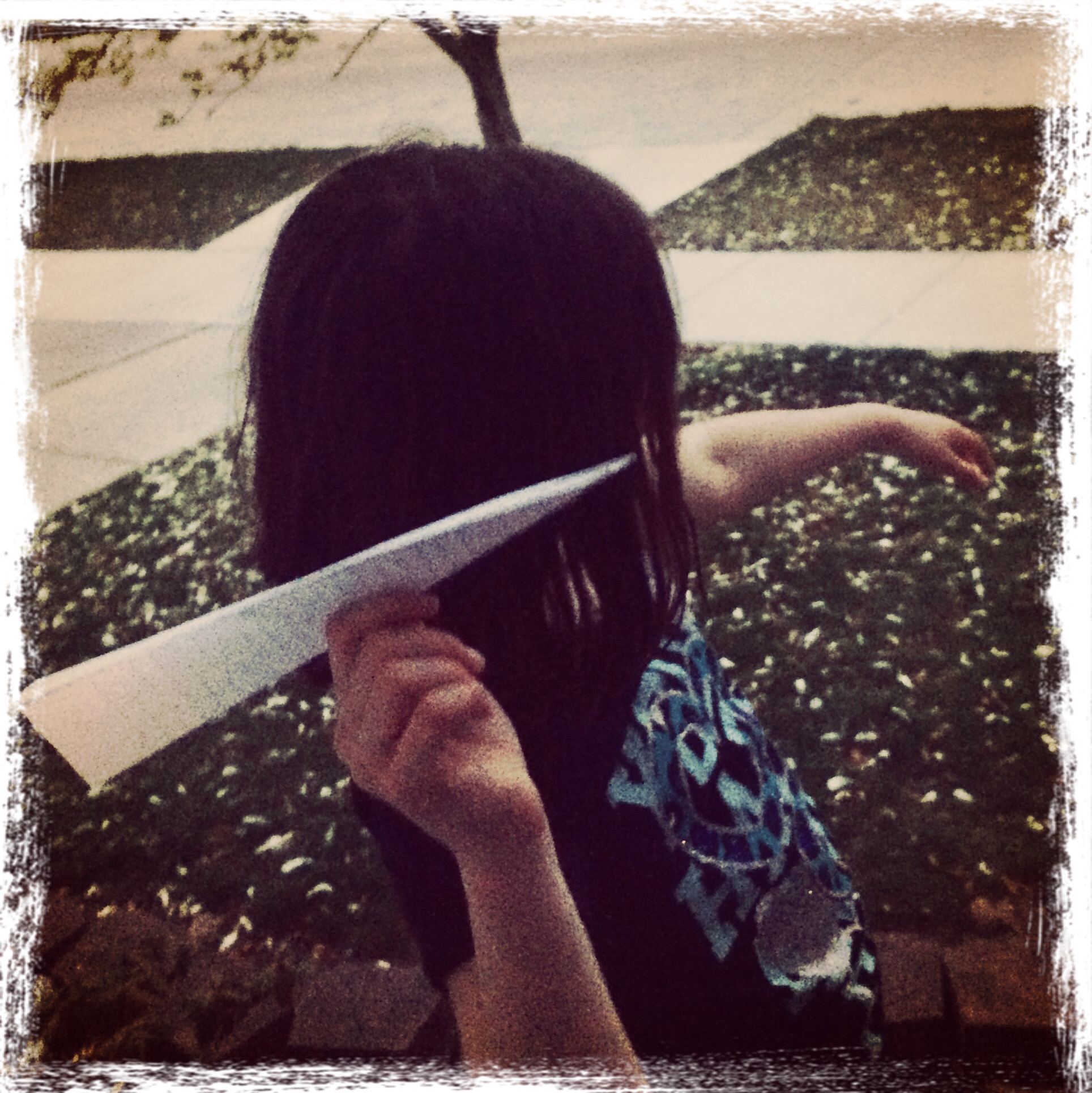
And Maude.

Our kids knew Maude as the one who lived next to paper airplane guy, since he revolutionized our world with his simple craftsmanship of paper pleasure.  They clearly knew to avoid Maude’s house.  She didn’t have patience for noisy flocks of neighborhood kids. Through our outdoor springtime encounters I learned that Maude had a lot of brokenness and sorrow in her life. She had a soft heart protected by a tough exterior.  I tried to listen compassionately while always keeping one eye on the kids, the street, the ball, and the cars going by.

But what came next caught me off guard.

In her quiet quick undertone, she expressed how glad she was, that even though we had noisy toddlers, at least weren’t ARABS.

What??!!!

It slipped out so fast that I did what I tend to do in awkward conversations—I second-guessed what I really heard. It was often in that mommy-distracted place that Maude slipped in a few more of her opinions about our Middle Eastern neighbors.

Always one-liners.

Me always wishing I had a great comeback.

Years passed.  Kids grew. Maude got older and frailer.  I noticed Maude walking alone, a lot.  As a fellow walker, sometimes I joined her. She would uncharacteristically slip her arm into mine and ramble on and on.  She would oscillate from sweet melodic chitchat to swearing up and down. One morning I saw Maude wearing two different shoes.  Another time she had wandered down a street far from her normal route.  She looked lost.

Hussein happened to be home when I dropped Maude off at her house. Her dementia was getting worse.  Hussein, his sister Latifeh, and their parents took it upon themselves to keep a close eye on their aging and lonely next-door neighbor.

It was Hussein that would walk with her in the evenings up and down the block—matching her frail snail’s pace.

It was his parents who would have breakfast with her every morning.  They were the ones who found her after she had fallen, at the bottom of her staircase.

It was Latifeh who left work upon the emergency call from her parents describing Maude’s injuries.

Maude passed away shortly after that accident.

I had moved into the neighborhood to live out what Jesus taught. I thought I understood.  I thought I could be an example of a good neighbor. And we have been richly blessed by generous neighborly relationships.  But we have so much more to learn.

Hussein and his family exemplified day-to-day intentional care for Maude. Being inconvenienced for the welfare of another.  Advocating for the vulnerable.  Even loving someone with a blatant prejudice against “those people.”  Maude wasn’t the easiest person to love.  But Hussein, Latifeh, and their parents took the time to truly care for the needy, the lonely, and the lost along their path of life.

 Maude’s words still trouble me. 

What troubles me is that she is not alone in her racial one-liners.  There will always be more.  They will always feel like unexpected sucker punches.  Now is the time to devise my crafty, yet compassionate, comebacks.  To be ready to give an answer and to stand up for what is good and right and true.  How would Jesus do it?

I am open to suggestions.

And in the meantime, my neighbors have given me a lot to think about as I seek to understand the true definition of neighbor, the way Jesus the Messiah meant it.

IMG_6647

*Maude is a pseudonym.  Latifeh and Hussein are the real names of my neighbors who collaborated with me on this article. Thank you, habibti, for your beautiful stories.

This article was published in the Yemeni American News, June 2018


Scooching Over

(Published in the Yemeni American News, November, 2016)

Give me your tired, your poor, your huddled masses yearning to breathe free.  Emma Lazarus

The Preferred Aisle Seat

I have never been known for my punctuality. In fact, I characteristically run late. Often times it’s because I get lost trying to find places, or maybe it’s because I tend to be on Greek time, which means I’m not technically late; it just allows me a half-hour margin for arrival. At my church there are rows of seats for people to choose from as they enter the place of worship. I’m always grateful when people scoot in towards the middle seats, so that us late arrivers can slip into the aisle seats, unnoticed. I prefer to avoid the awkward attention of navigating my way through a maze of knees and handbags after the service has begun to settle into the middle. Sometimes at abundantly populated special events, the pastor up front will ask everyone to scoot in a little to make room for more people to slip into the aisle seats. I know how it feels to be scooted in for.

Lately, though, I have been on a fairly long stretch of timely arrivals, which means I have my pick of seats at church. Admittedly, I tend to choose a preferred aisle seat.  I like having a bit of space on one end between me and other people that I don’t know so well. I like my space, my preferences, and my little comforts.

Joining the Response to New Americans

Last month I attended a free community event sponsored by Sabeel Media at the local library, discussing the response and the responsibility of the media to share the experiences and needs of refugees. One of the special presenters, Shane Lakatos of the Social Services for the Arab Community (SSFAC) in Toledo, challenged everyone at the event to think about the fear in our own hearts. We fear people we don’t know. And in fear, we tend to think the worst of them. Peter Twele, another special presenter and author of the book, Rubbing Shoulders in Yemen, emphasized that refugee families relocating simply need a friend if they are to successfully assimilate in a new culture. Not only have they left homes, families and jobs, they’ve lost neighborhoods, communities and connections. They need to build a new community of relationships.

So as I stood in the back of the Sabeel Media event, having arrived a little late, I started to think of my own response to the refugees joining my community.

sabeel-g-in-backSo as I stood in the back of the Sabeel Media event, having arrived a little late, I started to think of my own response to the refugees joining my community. I can donate to the cause. I can pray for those who suffer. I can speak out for the needs of these new Americans. I can even volunteer for an event of handing out free backpacks to refugee kids starting school in a new country. As I was pondering my action points, I scanned the room of attendees and my eyes fell on a beautiful young woman dressed in a bright pink sweater with a coordinated floral scarf covering her head. I was surprised to realize that I knew her, and not only that, but that I had been thinking about her. I knew her by name. I had given backpacks to her kids at a volunteer event in September.
Scooching Over, My Point of Decision

I greeted her with quiet kisses so not as to disrupt the program, and continued to listen to the needs amidst the crisis. The needs are dire. The search for hope is essential for new Americans coming into our country. The presenters’ words rang in my ears, of our own fears, and of the refugees’ need for friendship and connection with such limited resources… What was I going to do about it? But what about my crazy American schedule? Do I have room in my life for a needy new friend? Not really. There’s work, prior commitments, grad school, kids, family.

This is a crisis we are all facing. It doesn’t just belong to some people and not others.  We all need to scooch over and make room for one more in our lives.

But this is a crisis we are all facing. It doesn’t just belong to some people and not others. We all need to scoot in, scooch over, squeeze closer together, and make room for one more in our lives. My little bit of comfort in my “preferred aisle seat” isn’t a lot to give up, considering the woman I’m inviting to sit next to me really wants to settle her young family after fleeing devastation and living in temporary housing for over a year. She has her dignity. She doesn’t just want to be helped. She wants to go to school, get a job, help her kids learn English and assimilate into her new community. She’s ready to work hard; she just needs some help doing it. She’s one person, one name, one face. She is just one of the tired and the poor in the huddled masses, yearning to breathe free. She’s one woman I could call a friend. Who knows, I might end up being the needy one in our relationship and discover that my scooting over to fit one more into my life was actually to my benefit. I’ve had that happen before.

Version 2

When I think about all the potential things we perceive a refugee to be: a foreigner among us, a neighbor, an enemy to fear, a widow or an orphan, or someone lost and needy…I can’t help but think of what Jesus the Messiah has to say about all of them. He says to love them. Love your neighbor as yourself. Love your enemy. Look after the widow, the orphan, the lost, the foreigner among you. Jesus the Messiah chose to love me without condition and with a love so compelling that I can’t help but be changed by it. Calling one young woman this week to make time to help her find a preschool for her son, sip some tea, and help her learn English is something I can do. I can be inconvenienced in that way. I can scoot over and make a little room in my world for one more.

Religion that God our Father accepts as pure and faultless is this: to look after orphans and widows in their distress and to keep oneself from being polluted by the world.   St. James

Paths Collided

My unlikely friendship with Fatima was destined to be.  Neither of us were looking for a fight—or a friendship—but we were open to God intervening in our daily lives…  (As published in the Yemeni American News, October, 2016)

Dented by Destiny

It was a normal fall school day for my three kids. I was a little late picking them up, so I was in a rush to get to their classes, collect all their things and usher them to the car. I wasn’t thinking about making a new friend, finding grace in unfortunate circumstances, or modeling the virtue of honoring your parents on that chilly afternoon. I just wanted to get out of an over-crowded parking lot and home to feed my kids a snack after their long day at school.

Relieved to be out of the parking lot, I accelerated down the side street to the stop sign. That was the moment I encountered Fatima. Fatima was a girl in her early 20s who picked her young cousins up from school on her way home from studying at the university library. I’d like to say that I figuratively “bumped” into Fatima and struck up a conversation. But instead, I rather literally bumped into the rear end of her car with the front end of mine.

Fatima reminded me a lot of myself in such situations—she didn’t remember the name of the street we were on. She was very apologetic for having been bumped into, and she was trusting of me and ready to take down my information and be on our way.

As a teen learning to drive, I learned fender-bender protocol from my dad, who always warned me to be cautious because people take advantage of situations like that. This encounter felt different, and I think both Fatima and I felt it. But, like me, Fatima’s father worried about his young, friendly, trusting-of-others daughter who had recently been taken advantage of in another fender-bender situation. So, it wasn’t surprising that when she called for her father’s advice, he was quick to say, “Call the police!”

Honor Your Father and Mother

Apologetically, Fatima asked me if I minded that she called the police. Considering the price of a ticket, I bit my lip, and then thought of my kids in the car watching my every kids-car-edited-bigmove. Fatima was honoring her father who only wanted to protect her. He had no idea what this situation was like. My dad would have counseled me the same. My husband would probably give our daughters that advice, too. I took a deep breath. I agreed that listening to her father’s advice was the best move. I silently prayed that maybe I wouldn’t get a ticket.
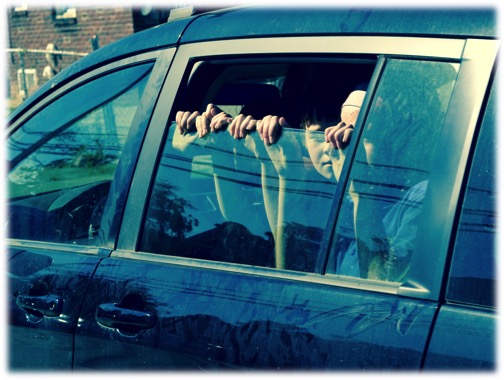
That was the best hour I’ve ever had waiting for an officer to arrive. Fatima and I discussed university life and libraries, I shared every snack in my purse with her cousins and my three kids, and all the kids ran races to the corner and back to pass the time.

The cop arrived and issued my ticket. I felt the tears coming, but tried not to make an emotional scene. I thanked him for doing his job and hugged Fatima good-bye. On the way home, my inquisitive oldest daughter wanted to know why Fatima had to call the police—voicing my own silent complaint. It was a good teachable moment to highlight the important principle for children to obey your parents, for this is right. It was a good choice for Fatima to make, even though it was not what I wanted her to do.

Since before the officer arrived we had exchanged phone numbers, I texted my new acquaintance after the incident, telling her I was glad to have met her and that I hoped everyone was okay. I prayed for her and pondered at why God would have our paths collide in this universe and where it could possibly go from there.

From Court to Coffee

The officer on the scene advised me to “contest” my ticket and wait for a court date. Since my run-ins with the justice system were thankfully pretty sparse, I had no idea that my new friend would be subpoenaed as well. I also had no idea how to answer all her questions when she called me right after she got her subpoena in the mail, “What do I wear to court? Where do I go? What do I say?”

On the Tuesday morning of my court date I managed to squeeze in substitute teaching for two Spanish classes at a local college before heading to contest my ticket. As I was racing (at the speed limit, of course) from the college to the court, Fatima called frantically for directions. Directions from me? Did she know that I get lost even at the mall? And that I celebrate every time I make it to Northville without a U-turn? I fumbled my way through giving her directions and we both managed to find our way to the court—PHEW!

Fatima and I sat next to each other on the hard wooden bench as we awaited my turn before a magistrate. An hour later I paid my ticket. It happened to be the exact amount I earned subbing for the Spanish classes that morning. Then Fatima and I headed off to Starbucks where we lost track of time, sharing our lives for the next two hours. What an amazing moment. I told her I believed that ours was a strange but divine encounter God had arranged for us, and she agreed. She said, “If I were older and wiser and Greek, I’d be you!” I agreed that even though our lives, cultures, and religions were so different, there was something so similar about her personality and mine. We talked faith and love and friendship and hardship. I felt in that moment that God’s kingdom had touched down in my little world.

As I headed home, high on my divine moment, I no longer wondered why the fender-bender, or the ticket. I felt like this encounter was inevitable. I was glad that Fatima chose to honor her father that day we met—otherwise we would have just exchanged information and been on our way. Waiting for the officer gave us time to get to know each other. Going to court gave us a reason to reunite. Three years later, we still get together for coffee and share life stories. Since the day our paths collided, I was drawn to Fatima’s kind and adventuresome spirit, the everyday-radical kind of living that opened us both up to our unique friendship.

Hijacking Radical

I appreciate the Muslims in my community who motivate me to be more courageous about my own expressions of faith through their everyday radical.  As we commemorate the horrendous 9-11 attacks, and as many contemplate Abraham’s tremendous trust in God’s perfect provision during the Eid of Sacrifice, I wonder, what would it look like if we were all a little more radicalized to show extreme love, drastic kindness, and fanatical forgiveness in a hurting world?  Thanks, everyone, for taking a moment out of your lives to consider my thoughts on radicalism.  (As published in the Yemeni American News, September, 2016).

Defining Radical Religious Practices

When I was in college my roommate and I had a hunger to learn more about our faith and live out what we believed, even when other people thought we were a little bit crazy. We wanted to be radical about what we believed. By radical I mean, we wanted to pray publically when others would have thought it awkward or inappropriate. We wanted to stand out in modesty and purity of heart when other girls we knew were choosing to wear smaller shorts and date lots of guys. We wanted to study our Holy Book, talk about what it says, and figure out how to live it out every day, even when others were more interested in talking about the latest drama on their favorite show. We didn’t want to judge others for their choices, we just wanted to stand out as committed, passionate, and sold out for what we believed in. That was my definition of radical. I wanted to study the teachings of Jesus the Messiah and then live them out as best I could in my context. He was radical in his day and I wanted to follow in his radical ways of kindness, love, peace, and purity in my day.

Today, if someone is radicalized, it means they have a religiously based motivation to terrorize others. The word radical has been hijacked! Why does being sold out for what one believes in have to involve hurting others? There are radicalized religious fanatics of every flavor—those who bomb abortion clinics, those who bomb twin towers, those who terrorize innocent village children… All those extreme beliefs are crimes against humanity, and they are so far from the loving heart of God.

Practicing Radical at the Gym
The other day I pushed myself to get to the gym rather than take a nap on the couch. I convinced myself that I would feel better after a good workout. It was hot and sticky and I grumbled in my T-shirt and capris as I anticipated getting even hotter running laps. When I walked into the rec center, I passed a modest Muslim woman working out hard in her hijab, covered from head to toe—and I thought I was hot! Motivated by her prayin gym framedcommitment to religious purity, even on a treadmill, I bounded with greater fervor up the stairs to the track. I was greeted by the sight of a man and his son pausing their workout to stop and pray eastward in the corner.  One of the things that I appreciate about living among Muslims in Dearborn, is that moments like these are “normal” occurrences at the gym.  They are also radical in my mind.  Radical by my first definition. Many devout Muslims in our community seek to live out their faith everyday, even when it seems uncomfortable, inconvenient, or just strange to those around them.

Inspired by these examples of radicalism to stand out at the gym, I decided, why not…I’m devoted to God, regardless of what others think… So, I waited my turn for the secluded prayer corner beside the track, and I knelt down and prayed. I wasn’t trying to show off or prove anything; I just wanted to take a moment out of my workout to connect to God in prayer. It was a demonstration of everyday radical. It was my small moment to take radical back from terrorism and reflect the heart of God.

Waging Peace
wage peace framedWhat would it look like if we were all a little more radicalized to show extreme love, drastic kindness, and fanatical forgiveness in a hurting and confused world?  What if we all paused to pray throughout our day more often?  One of my favorite bumper stickers challenges people to Wage Peace. What if we all practiced just a little of everyday radical by waging peace wherever we are?  Love, joy, peace, goodness, kindness…these are the fruit of the Spirit of God. These are fundamental virtues.  Maybe, then, we should all strive to be a bit more radical—and fundamentalists!
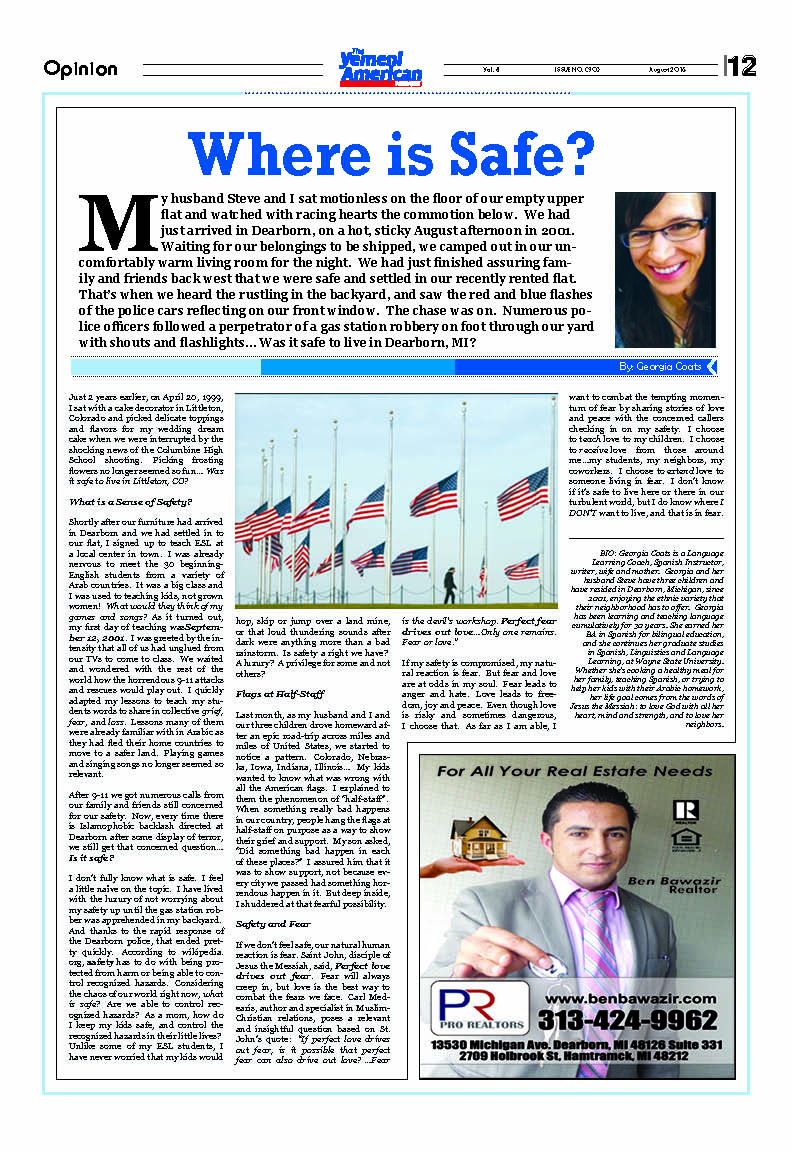


Where Is Safe?

(As published in the Yemeni American News, August, 2016)

YAN G Is it Safe

My husband Steve and I sat motionless on the floor of our empty upper flat and watched with racing hearts the commotion below. We had just arrived in Dearborn, on a hot, sticky August afternoon in 2001. Waiting for our belongings to be shipped, we camped out in our uncomfortably warm living room for the night. We had just finished assuring family and friends back west that we were safe and settled in our recently rented flat. That’s when we heard the rustling in the backyard, and saw the red and blue flashes of the police cars reflecting on our front window. The chase was on. Numerous police officers followed a perpetrator of a gas station robbery on foot through our yard with shouts and flashlights… Was it safe to live in Dearborn, MI?

 Just 2 years earlier, on April 20, 1999, I sat with a cake decorator in Littleton, Colorado and picked delicate toppings and flavors for my wedding dream cake when we were interrupted by the shocking news of the Columbine High School shooting. Picking frosting flowers no longer seemed so fun… Was it safe to live in Littleton, CO?

What is a Sense of Safety?

Shortly after our furniture had arrived in Dearborn and we had settled in to our flat, I signed up to teach ESL at a local center in town. I was already nervous to meet the 30 beginning-English students from a variety of Arab countries. It was a big class and I was used to teaching kids, not grown women! What would they think of my games and songs? As it turned out, my first day of teaching was September 12, 2001. I was greeted by the intensity that all of us had unglued from our TVs to come to English class. We waited and wondered with the rest of the world how the horrendous 9-11 attacks and rescues would play out. I quickly adapted my lessons to teach my students words to share in collective grief, fear, and loss. Lessons many of them were already familiar with in Arabic as they had fled their home countries to move to a safer land. Playing games and singing songs no longer seemed so relevant.

After 9-11 we got numerous calls from our family and friends still concerned for our safety. Now, every time there is Islamophobic backlash directed at Dearborn after some display of terror, we still get that concerned question…Is it safe?

I don’t fully know what is safe. I feel a little naïve on the topic. I have lived with the luxury of not worrying about my safety up until the gas station robber was apprehended in my backyard. And thanks to the rapid response of the Dearborn police, that ended pretty quickly. Wikipedia says safety has to do with being protected from harm or being able to control recognized hazards. Considering the chaos of our world right now, what is safe? Are we able to control recognized hazards? As a mom, how do I keep my kids safe and control the recognized hazards in their little lives? Unlike some of my ESL students, I have never worried that my kids would hop, skip or jump over a land mine, or that loud thundering sounds after dark were anything more than a bad rainstorm. Is safety a right we have? A luxury? A privilege for some and not others?

Flags at Half-Staff

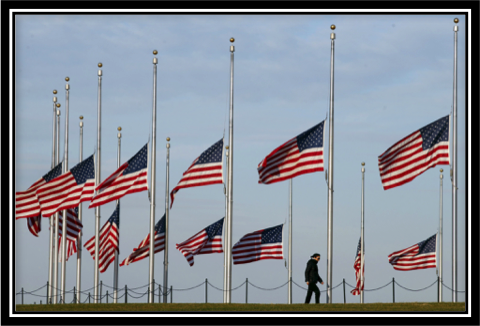
Haff StaffLast month, as my husband and I and our three children drove homeward after an epic road-trip across miles and miles of United States, we started to notice a pattern. Colorado, Nebraska, Iowa, Indiana, Illinois… My kids wanted to know what was wrong with all the American flags. I explained to them the phenomenon of “half-staff”. When something really bad happens in our country, people hang the flags at half-staff on purpose as a way to show their grief and support. My son asked, “Did something bad happen in each of these places?” I assured him that it was to show support, not because every city we passed had something horrendous happen in it. But deep inside, I shuddered at that fearful possibility.
Safety and Fear

If we don’t feel safe, our natural human reaction is fear. Saint John, disciple of Jesus the Messiah, said, Perfect love drives out fear. Fear will always creep in, but love is the best way to combat the fears we face. Carl Medearis, author and specialist in Muslim-Christian relations, poses a relevant and insightful question based on St. John’s quote: “If perfect love drives out fear, is it possible that perfect fear can also drive out love? Fear is the devil’s workshop. Perfect fear drives out love…Only one remains. Fear or love.”

If my safety is compromised, my natural reaction is fear. But fear and love are at odds in my soul. Fear leads to anger and hate. Love leads to freedom, joy and peace. Even though love is risky and sometimes dangerous, I choose that. As far as I am able, I want to combat the tempting momentum of fear by sharing stories of love and peace with the concerned callers checking in on my safety. I choose to teach love to my children. I choose to receive love from those around me…my students, my neighbors, my coworkers. I choose to extend love to someone living in fear. I don’t know if it’s safe to live here or there in our turbulent world, but I do know where I DON’T want to live, and that is in fear.

Generous Neighbors

I have had the joy of living in a predominantly Arab Muslim neighborhood for 15 years.  Here is an article I wrote that was published in the Yemeni American News–it is a reflection of the virtue of Generosity I have learned from my Middle Eastern neighbors, especially during the month of Ramadan.  My Arab neighbors make me a better Greek!

I opened the screen door and gave a hearty shout for my kids to come in for the night and get ready for bed. I love the ebb and flow of our neighborhood in east Dearborn that we have called home for the past 15 years. In the winter all the kids stay indoors and just grow inches taller, and then each spring there is a grand neighborhood reunion where kids pop out of houses like flowers popping out on the little Magnolia tree in our front yard.

And then there’s Ramadan

As is customary in our neighborhood during Ramadan, the time just before sunset gets eerily quiet and we can smell the savory treats being prepared in the houses around us. At dark, my kids come in to get ready for bed and that is just about the same time when we hear a faint knock on the door. This time it was the youngest daughter of one of our Yemeni neighbors with a plate full of piping hot meat and potato sambusas—YUM!

Suddenly my three kids start remembering what they love about Ramadan, being raised to follow Jesus the Messiah in a predominantly Muslim community. It’s not just the warm sambusas, syrupy yellow cake, Lebanese knafeh, or our all-time family favorite—layered, buttery sabayah sprinkled with black sesame seeds. It’s about the blessing of generosity, Ramadan Kareem. The Messiah Jesus teaches us to value generosity and hospitality. Our Muslim neighbors regularly model what that looks like in our community.

To my kids, Ramadan is a time of sharing and abundance. The first Eid al-Fitr etched in their memories is marked with girls in fancy dresses and boys donning daunting swords on their belts. Then there’s the candy, the henna, and even gifts of cash! Being handed dollar bills from neighborhood dads was mind-blowing for my little ones. Our neighbors set the standard high for generosity.

The Plate War continues

Being from a Greek immigrant home, I know how to battle in a plate war. When a dish comes to you full of flavorful favorites, you prepare to give it back fully loaded with more mouth-watering goodness. Bottom line: The plate never gets passed anywhere empty. Last summer during the Islamic month of fasting we got caught in a furious neighborhood plate war. We were preparing to leave on an epic summer road trip to visit family in my home state of Colorado. I was not on top of my game. I got swept under by the generosity of Ramadan. A plate came in from neighbors to the north of us and a second plate got handed to my kids from neighbors to the south. Then, foil-wrapped sabayah came from across the street! My kids and I scrambled to bake our favorite poppy-seed muffins and banana breads to return the plates amidst packing for our trip.   When it was all said and done, we still had one leftover blue floral-trimmed plate. Since then, we have spent the past year passing this plate to various neighbors on all sides, thinking we were returning it. Everyone keeps filling it and passing it back. We finally concluded that we don’t actually know who the mysterious plate belongs to. It is still our goal to return this plate—full, of course—to someone. We have yet to win that battle!

I know that Ramadan isn’t just about late-night feasting. It’s about cultivating both the personal and collective spiritual discipline of fasting in submission to God’s will. Though our own faith calls us to this discipline as well, I must say, that I appreciate a neighborhood where fasting is a topic of conversation among ten-year-olds, and breaking fast is something to share with loved ones and neighbors.DSC_0242

So to all my Muslim friends and neighbors, thank you, for your generosity. Thank you for showing us, plate by plate, the essence of kareem. And if anyone happens to recognize this plate, let me know and I can fill it full of warm, homemade banana bread or Greek-style spinach pie.

Ramadan Kareem!