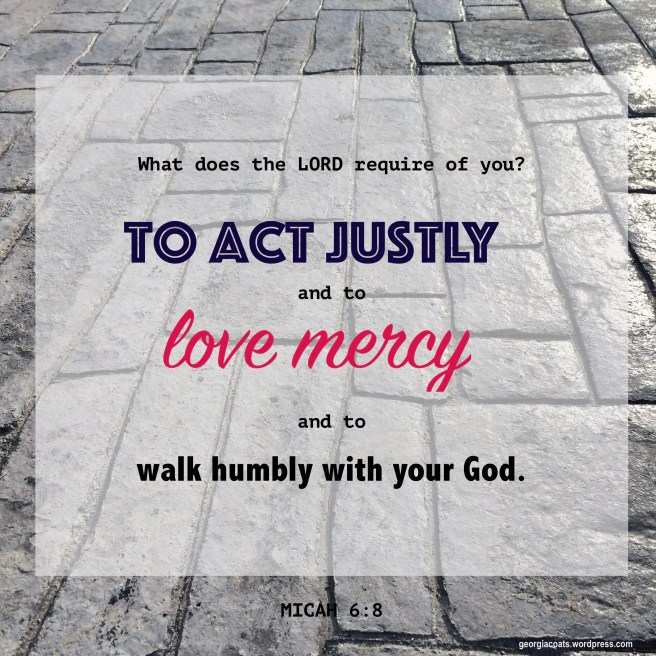
It sounds simple…
It sounds simple…
Man does not live on bread alone, but on every word that proceeds from the mouth of God. (From the Tawrah)
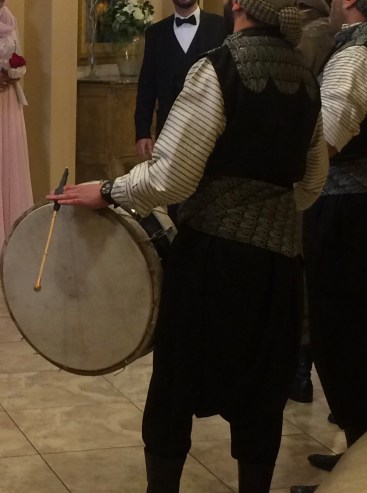
Last month, my husband and I joined our good friends at a beautiful Islamic wedding reception. He went with the men, and I with the women. It was an incredible celebration of dancing, drums, exquisite dresses, and incredible cuisine. It was a time to usher in something new and something beautiful—the union of a husband and wife in their new life together. I admired the abundant display of fruit platters and little cakes and cannolis that donned the back table. They were a vision of sweet, delicious things to  come. And though I didn’t understand much of the Arabic conversations going on amongst the ladies at my table, I understood the topic of Ramadan on the lips of many. It seemed as though everyone was anticipating this month of fasting and all that it entails.
Growing up in a Greek Orthodox Christian home, my family practiced 40 days of Lent—a vegan diet, abstaining from meat, dairy and other animal products, in anticipation for the celebration of Easter. Easter is the focal point of the Christian calendar. It is a time to celebrate new life, new hope, redemption, and forgiveness as we 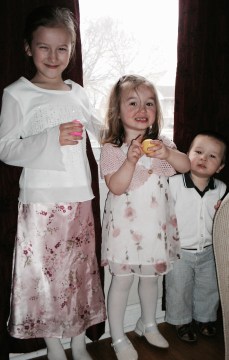 reflect on the path of suffering and victory of Jesus the Messiah. The joy of Easter is intertwined with the fasting that comes before it. As a child, my favorite Easter treats were little chocolate eggs in a colored
candy shell. I remember trying to sneak around the kitchen to curb my chocolate craving during Lent, leading up to a grand resurrection celebration. Then, on the Saturday evening before Easter, we would dress in our best celebratory garb and attend worship services long past midnight. All I could think about was arriving home to feast on all the delicacies and choice foods we had abstained from for forty days. How sweet those treats tasted after waiting so long to eat them!
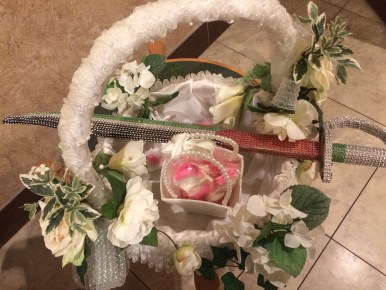
The guests abstained from celebrating until the bride and groom showed up.
When I lived on my own, away from the community aspect of this Greek Orthodox Lenten practice, I realized quickly that the little chocolate eggs didn’t taste as delectable as they did when I had abstained from them and anticipated them for 40 days. There is a time for fasting and a time for celebrating. Both are important. Jesus the Messiah used the example of a wedding feast when he described fasting to his followers. He explained that when the bridegroom enters the wedding, this is a time for celebrating. How true it was at the wedding we attended last month. We eagerly anticipated the arrival of the bride and groom. We all abstained from celebrating until they showed up.
Fasting brings to the surface our inner reality. S. Sohaib
Sometimes I fast privately, abstaining from all food and drink, day and night, for a specified amount of time, in order to focus on prayer and listening to God. The growls in my stomach are a reminder to pray. Fasting forces me to depend on God, even before food. After all, Man does not live on bread alone, but on every word that proceeds from the mouth of God. Fasting teaches me to listen more carefully to the words of God. Fasting is both a spiritual discipline and a physical detox. It is a time to rid our bodies of unhealthy toxins and also expose the dark places in our spirits. According to Qur’an scholar Sohaib Saeed of the Bayyinah Institute, “fasting brings to the surface our inner reality.” This is so true. When we are weak, our true nature comes out.
 I have studied other languages prior to Arabic, and it never occurred to me before to learn the vocabulary to talk about fasting. But in Arabic, and among my Muslim neighbors, fasting is an important topic of conversation. Living in a primarily Muslim community for the last 15 years, I have learned other valuable lessons on fasting. I appreciate the power and joy of fasting in community and breaking fast in community. My family anticipates the month of Ramadan, and not just because we are on the receiving end of the mandate to generously share with one’s neighbors. We, as part of a Muslim community, are impacted greatly by the month of fasting at our kids’ school, at the local places of business, and among friends. During this month, I am grateful to live in a community that pushes me to teach my children about this spiritual discipline at an early age. I love that kids have discussions about fasting on the playground!
Set aside a time to seek God, to embrace our weakness, and to anticipate the sweet celebrating that follows.
Whether fasting is for 30 days, breaking fast each evening, or whether it is for three days and nights straight, or a restricted diet for 40 days, what matters is the spiritual lessons that come from it: to set aside a time to seek God, to embrace our weakness, and to anticipate our breaking of fast, and the sweet celebrating that follows—like when the bride and groom show up to the wedding feast!
Published in the Yemeni American News, June 2017

There is nothing more precious than to sneak into the bedroom of my sleeping three-year old son and kiss him good night. The other night I prayed a blessing over him and sealed it with the sign of the cross on his forehead—as my parents had done for me. I felt God’s presence reminding me that Jamin Loukas was on this earth for a reason. The same goes for my father, Loukas G. Loukas.
On this day, June 10, 2012 as we remember the horrific massacre in the small village of Distomo, Greece, I am reminded of God’s great grace intervening in another generation. It was 68 years ago that my dad crouched trembling in a basement with 13 other children. Where were his parents to sneak in and check on him?
Three days after the historical D-Day in 1944, Nazi troops were traveling through the region near Distomo. In that surrounding area there were numerous resistance freedom fighters that had attacked the German troops and injured the head Nazi commander. This act sent the Nazi troops into a rage of retaliation that they unleashed on the unsuspecting peasants, farmers, priests, expectant mothers and young children of Distomo.
A Nazi soldier beat down the basement door. When he discovered a room full of children, he positioned his weapon to shoot, then aimed at the ceiling—all the while motioning the children to keep silent.
When my Yiayia Pandora and Papou George got news of something terrible happening in their village, they raced home from a day at the market as fast as their mule would take them. They wanted to gather their children close, and keep them safe. However, they never made it home. Later, their bodies were found lifeless on the side of the road.
Meanwhile, some very frightened children sat listening in a darkened basement to the sounds of death all around them—awaiting a dreadful fate of their own. A Nazi soldier beat down the basement door. When he discovered a room full of children, God Almighty intervened. The soldier positioned his weapon to shoot, then aimed at the ceiling—all the while motioning the children to keep silent. He sealed the door back up as best he could and left, shooting chickens and goats on the way out. He posted the official Nazi sign on the door that confirmed that the job there was done.
That was the day my dad was spared. At ages 16 and 14, his two older sisters became instant guardians of a two-year old. My dad was too young to comprehend God’s hand on his destiny. The story retold time and again has become his memory of the event. His first real memory came when he was five years old and his aunt took him to “meet” his parents. She pointed to their exhumed skeletons in the ground and said, “That is your mother and your father. Give them a kiss.”
People usually talk about scars as a sign of terrible things that happened in the past. I like to think about scars as a sign of healing—a reminder of God’s ability to restore, forgive, cleanse and redeem. When I look at my own scars I remember the bad that could have been and once was, but is no more. There is grace there instead. My dad was orphaned at the age of two. As a daughter with her daddy around, and as a mother with a young son, it brings me to tears to imagine not being there for my son. What were my Yiaya and Papou thinking that day as they tried to race home? What were their last prayers for their four children?
I’m thankful for a dad who checked in on me at night. And as I bless my son, I think of the scars and the grace. Because God intervened that day, my son can sleep peacefully in his bed. The same goes for his two sisters and four cousins. Because of God’s grace in that basement in Distomo 68 years ago, my dad’s alive today, and God’s purpose lives on for another generation.
The memories of my Yiayia Pandora and Papou George are eternal. They live on in my father’s heart and in the generations that live after them and hear their story. Today we remember our loss and reflect upon our scars and the grace given to us. May the memories of all 219 villagers lost in Distomo that day be remembered today.
For the LORD is good and His love endures forever; His faithfulness continues through all generations. Psalm 100:5
“You gain strength, courage and confidence by every experience in which you really stop to look fear in the face.” Eleanor Roosevelt
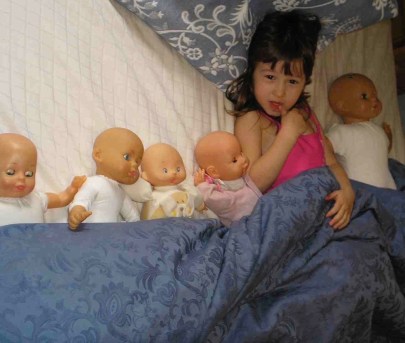 The best part about cold winter months in Michigan is snuggling under warm blankets, reading and telling stories with my kids. In these moments I often pause just to take it all in, and then thank God for the beauty of such simple yet priceless memories. Children truly are a treasure and a gift in this life. Recently, I took part in a short, two-question survey on FEAR. The first question was: What is something you are afraid of? A lot of things came to mind…debt, disease, destruction…but if I had to pick just one to write down, I would say that what I fear most regularly is something horrible happening to my children. As a mom, I do all I can to protect my children from harm. I teach them how to be safe, I stay near them in uncertain circumstances, and I try to keep them healthy.
These things were going through my mind as we read the historical account of the birth of Jesus the Messiah together. We got to the dark part of the story where a corrupt leader, King Herod, was feeling threatened by the news of a young Messiah being born. Out of fear, King Herod terrorized the Palestinian town and region he governed, and ordered the mass slaughter of all baby boys under two years old. As we read through the account, my eight-year-old son quickly named our young friend that fit that description. We all agreed that it was horrible to imagine our friends losing their 1½-year-old son to the terror of a corrupt leader.
For days I was troubled by this disturbing account of male infanticide that went on as a result of the Messiah’s birth. The families of those baby boys weren’t celebrating the birth of a promised and foretold anointed one sent from God. Instead, they grieved deep loss around the event that led to mass extermination of baby boys in and around Bethlehem. The story recounts that King Herod was “terrified” at the news of a prophetic Messiah-King entering the world and being revered by foreign Wise Men from the East. He saw this child as a threat to his powerful position of leadership. But the birth of Jesus also stirred a new hope far and wide. The coming of a promised Messiah reminded the world that God Most High is near to His people.
I tried to imagine myself living in a time and place of such need for hope—a world of terror and destruction enacted by powerful people. It didn’t take me long to realize that that is our world. Those are the bleak circumstances facing so many in war-torn Yemen today. According to a recent interview that the Yemeni American News had with the President of the National Association of Yemeni Americans (NAYA), AbdulHakem a. Alsadah, the United Nations estimate 3 million “displaced” Yemeni people. “There is no international awareness about this crisis,” Alsadah stated. Tears stream down my face when I see pictures of Yemeni children who are near death due to acute malnutrition. My heart breaks as I read stories about Yemeni parents who are forced to make hard decisions about losing their children, either to disease, destruction or starvation. According to a December 2016 article in www.theGuardian.com, one man tells of how he and his other children don’t eat so they can pay for his young daughter’s cancer medication. How does any parent face that kind of fearful reality and not lose hope?
The second question in my survey was:
What do you do when you are afraid?
Fear makes me want to hold my children tighter and never let them out of my sight. It makes me want to turn off the news because I can’t possibly process all the destruction going on in the world—in Yemen, in Syria… But what can I do about it? Fear and ignorance are the easy ways out, at least initially. If I raise my kids in fear, they are set up to react in fear. There’s a reason why the angels who came to announce the birth of the Messiah always started by saying, “Fear Not.” It’s because we do fear. Nevertheless, God Most High sends His chosen ones to a messy world because we need to hear from Him.
“Man can live about forty days without food, about three days without water, about eight minutes without air, but only for one second without hope.” H. Lindsey
It is good to be near God. His presence brings hope, and hope keeps us alive. Author Hal Lindsey said that, “Man can live about forty days without food, about three days without water, about eight minutes without air, but only for one second without hope.” In the worst of our despair, hope anchors our souls. It has to. Otherwise we wouldn’t survive the fear, terror and destruction that surrounds us. Education, compassion, prayer, hope. These are the things we must hold on to when we are afraid.
What is something you’re afraid of? What do you do when you are afraid?
So, as we really stop to look fear in the face, join me in trying a few of these things:
Give thanks for the good things God has done.
Tell a story to raise awareness of the crisis going on in Yemen.
Hug your children a little tighter.
Pray for those who suffer.
Give of your resources (time, money, or talents) to help another struggling human being.
Educate children about how to process fear.
Take a moment to grieve sad and disturbing news when you see it or hear it.
Love your neighbor.
Look for ways to spread love and kindness, especially when it is easier to spread fear or hate.
Hold on to hope as an anchor for your soul.
(Published in the Yemeni American News, February, 2017)
(Adapted from the Yemeni American News, December, 2016 publication)
When the world around me seemingly swirls with hatred, anger and fear, and my heart is heavy for the hurting, my coping mechanism is to reminisce on stories of hope. In my profession of language teaching, motivation is a key element for success. Motivation in life, as in language learning, contains two essential ingredients: 1. You have to think you can do something: hope 2. You have to think that it matters: need. In November I was reticent to click send on my article, Scooching Over, because I knew that if I made my thoughts public, my own words would move me to action, and I wasn’t sure I had the capacity to scooch over for a new friend in my daily life. The last thing I want to do in this refugee crisis is talk about doing something and then do nothing. The need was clear: I believed wholeheartedly that my small action to make a difference in one refugee’s life mattered; but I wasn’t sure I could actually do something about it on my own. That’s where hope is bigger than me. It requires me to believe that I can be involved in great and impossible things.
After taking a moment in my hectic day to pause and pray, I called my New American friend that I have endearingly nicknamed Zuzu. Zuzu and I had connected at the Sabeel Media Event in October, where she had expressed that she needed help finding a preschool for her son. I had already called at least eight preschool locations in her zip code before I got on the phone with Zuzu. I offered to come over the next day, take her to visit a preschool, and teach her some English. To my surprise, she told me NOT to come. She said that she had already found a preschool, that her family was moving to a better location, and that she was currently too busy for me to come visit her. As it turned out, there was no room in her week for me. She didn’t need my charity to survive, which made me even more determined to get to know this highly motivated woman.
When things settled for Zuzu, I came by to see her new place. In her intermediate English she reported that she had signed up for English classes at the local college, she was studying for her driver’s permit, and she was in walking distance from most of the places she needed to get to each week. She has been in the U.S. since April and is determined to settle her family here. Zuzu’s vision is bigger than she is. Her hope is deep. Her potential is great. Her work is humble. She walks her in-laws to the doctor and her son to preschool; she cooks and cleans for her household of six. At night when everything is quiet, she studies English and listens to audio messages I leave for her to practice each week. Zuzu doesn’t want to live indefinitely off of the kindness of others. On the contrary, she wants to be an agent of care and change and assistance to others. She also would like to go home if she could. But she can’t. So her plan is to bloom where she has currently been transplanted—right here in they Detroit Metro Area, MI, USA.
From our visits together I have learned that Zuzu is Syrian Kurdish. Her hope is seen in the languages she wants her kids to know: English of course, so they can thrive in their new community. Kurdish of course, because that is the language of heart and home. Arabic of course, because you can’t live in Syria and not know Arabic. She is preparing her son and daughter to function in this new world, but also to be ready to return to her beloved home country…someday, Inshallah, God-willing.
Sitting on the floor of her upper flat on soft blankets against big couch pillows, sipping warm, sweet instant coffee with milk, my first step in our mini English lessons, was to identify her goals for learning English: 1. Help her mother and father-in-law with their medical prescriptions and paperwork 2. Help her kids learn English. 3. Go to college 4. Talk about travel and places to visit 5. Tell her personal history. Zuzu believes that learning English matters. She also clearly believes she can do it. Unless you’ve ever worked with someone that motivated to learn something, it’s difficult to describe how exhilarating it is. Her need is clear. Her desire is clear. She has hope for her future that is bigger than she is. And I have the privilege of joining her venture.
As a writer, I want to carefully handle the stories entrusted to me. This past week, sipping our coffee, I pulled out the Yemeni American Newspaper and explained to Zuzu that she 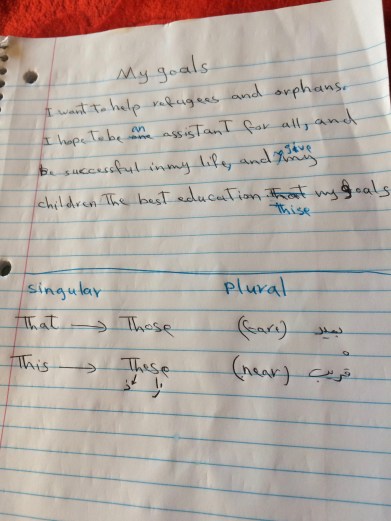
had inspired the article I wrote last month. I told her that I follow the teachings of Jesus the Messiah who says we are to love one another. His heart is for the orphans, the widows, and all those in need. As His follower, I offer what little I have with big hope. After all, the good news of great joy this Christmas season is for all people.
Zuzu shared with me another goal statement she had crafted late one night: I want to help refugees and orphans. I hope to be one assistant for all. And be successful in my life and my children the best education. That my goals. Clearly, Zuzu and I share a vision of helping those in need. Together our hearts break for the displaced people of her country. I asked Zuzu if I could publically share her beautifully articulated goals because they inspired me, and I think they would inspire others. She agreed.
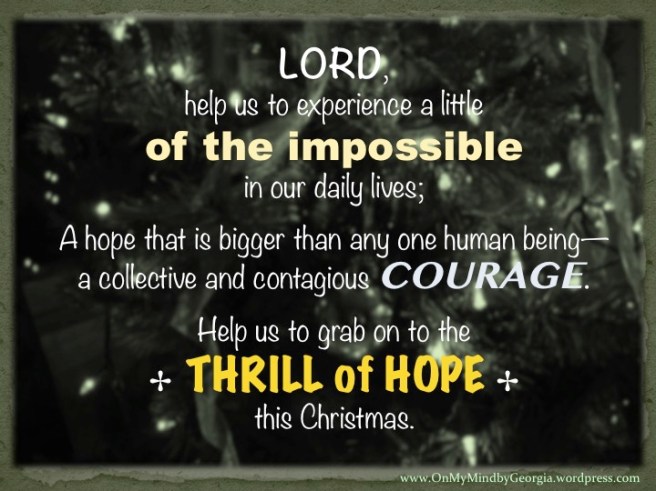
As Zuzu and I both scooch over each week to make room for each other, we hold on to the thrill of hope. My prayer is that all of us would experience a little of the impossible in our daily lives; that we would together find a hope that is bigger than the determination of any one human being—a collective and contagious courage. My prayer is for many more to get out of harm’s way and be welcomed into a safer place where hope can be nurtured, and that they can experience the good news of great joy that is for all people.
(Published in the Yemeni American News, November, 2016)
Give me your tired, your poor, your huddled masses yearning to breathe free. Emma Lazarus
The Preferred Aisle Seat
I have never been known for my punctuality. In fact, I characteristically run late. Often times it’s because I get lost trying to find places, or maybe it’s because I tend to be on Greek time, which means I’m not technically late; it just allows me a half-hour margin for arrival. At my church there are rows of seats for people to choose from as they enter the place of worship. I’m always grateful when people scoot in towards the middle seats, so that us late arrivers can slip into the aisle seats, unnoticed. I prefer to avoid the awkward attention of navigating my way through a maze of knees and handbags after the service has begun to settle into the middle. Sometimes at abundantly populated special events, the pastor up front will ask everyone to scoot in a little to make room for more people to slip into the aisle seats. I know how it feels to be scooted in for.
Lately, though, I have been on a fairly long stretch of timely arrivals, which means I have my pick of seats at church. Admittedly, I tend to choose a preferred aisle seat. I like having a bit of space on one end between me and other people that I don’t know so well. I like my space, my preferences, and my little comforts.
Joining the Response to New Americans
Last month I attended a free community event sponsored by Sabeel Media at the local library, discussing the response and the responsibility of the media to share the experiences and needs of refugees. One of the special presenters, Shane Lakatos of the Social Services for the Arab Community (SSFAC) in Toledo, challenged everyone at the event to think about the fear in our own hearts. We fear people we don’t know. And in fear, we tend to think the worst of them. Peter Twele, another special presenter and author of the book, Rubbing Shoulders in Yemen, emphasized that refugee families relocating simply need a friend if they are to successfully assimilate in a new culture. Not only have they left homes, families and jobs, they’ve lost neighborhoods, communities and connections. They need to build a new community of relationships.
So as I stood in the back of the Sabeel Media event, having arrived a little late, I started to think of my own response to the refugees joining my community.
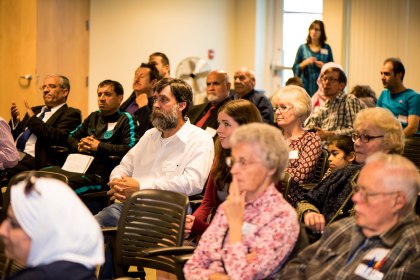 So as I stood in the back of the Sabeel Media event, having arrived a little late, I started to think of my own response to the refugees joining my community. I can donate to the cause. I can pray for those who suffer. I can speak out for the needs of these new Americans. I can even volunteer for an event of handing out free backpacks to refugee kids starting school in a new country. As I was pondering my action points, I scanned the room of attendees and my eyes fell on a beautiful young woman dressed in a bright pink sweater with a coordinated floral scarf covering her head. I was surprised to realize that I knew her, and not only that, but that I had been thinking about her. I knew her by name. I had given backpacks to her kids at a volunteer event in September.
Scooching Over, My Point of Decision
I greeted her with quiet kisses so not as to disrupt the program, and continued to listen to the needs amidst the crisis. The needs are dire. The search for hope is essential for new Americans coming into our country. The presenters’ words rang in my ears, of our own fears, and of the refugees’ need for friendship and connection with such limited resources… What was I going to do about it? But what about my crazy American schedule? Do I have room in my life for a needy new friend? Not really. There’s work, prior commitments, grad school, kids, family.
This is a crisis we are all facing. It doesn’t just belong to some people and not others. We all need to scooch over and make room for one more in our lives.
But this is a crisis we are all facing. It doesn’t just belong to some people and not others. We all need to scoot in, scooch over, squeeze closer together, and make room for one more in our lives. My little bit of comfort in my “preferred aisle seat” isn’t a lot to give up, considering the woman I’m inviting to sit next to me really wants to settle her young family after fleeing devastation and living in temporary housing for over a year. She has her dignity. She doesn’t just want to be helped. She wants to go to school, get a job, help her kids learn English and assimilate into her new community. She’s ready to work hard; she just needs some help doing it. She’s one person, one name, one face. She is just one of the tired and the poor in the huddled masses, yearning to breathe free. She’s one woman I could call a friend. Who knows, I might end up being the needy one in our relationship and discover that my scooting over to fit one more into my life was actually to my benefit. I’ve had that happen before.

When I think about all the potential things we perceive a refugee to be: a foreigner among us, a neighbor, an enemy to fear, a widow or an orphan, or someone lost and needy…I can’t help but think of what Jesus the Messiah has to say about all of them. He says to love them. Love your neighbor as yourself. Love your enemy. Look after the widow, the orphan, the lost, the foreigner among you. Jesus the Messiah chose to love me without condition and with a love so compelling that I can’t help but be changed by it. Calling one young woman this week to make time to help her find a preschool for her son, sip some tea, and help her learn English is something I can do. I can be inconvenienced in that way. I can scoot over and make a little room in my world for one more.
Religion that God our Father accepts as pure and faultless is this: to look after orphans and widows in their distress and to keep oneself from being polluted by the world. St. James
Dented by Destiny
It was a normal fall school day for my three kids. I was a little late picking them up, so I was in a rush to get to their classes, collect all their things and usher them to the car. I wasn’t thinking about making a new friend, finding grace in unfortunate circumstances, or modeling the virtue of honoring your parents on that chilly afternoon. I just wanted to get out of an over-crowded parking lot and home to feed my kids a snack after their long day at school.
Relieved to be out of the parking lot, I accelerated down the side street to the stop sign. That was the moment I encountered Fatima. Fatima was a girl in her early 20s who picked her young cousins up from school on her way home from studying at the university library. I’d like to say that I figuratively “bumped” into Fatima and struck up a conversation. But instead, I rather literally bumped into the rear end of her car with the front end of mine.
Fatima reminded me a lot of myself in such situations—she didn’t remember the name of the street we were on. She was very apologetic for having been bumped into, and she was trusting of me and ready to take down my information and be on our way.
As a teen learning to drive, I learned fender-bender protocol from my dad, who always warned me to be cautious because people take advantage of situations like that. This encounter felt different, and I think both Fatima and I felt it. But, like me, Fatima’s father worried about his young, friendly, trusting-of-others daughter who had recently been taken advantage of in another fender-bender situation. So, it wasn’t surprising that when she called for her father’s advice, he was quick to say, “Call the police!”
Honor Your Father and Mother
Apologetically, Fatima asked me if I minded that she called the police. Considering the price of a ticket, I bit my lip, and then thought of my kids in the car watching my every 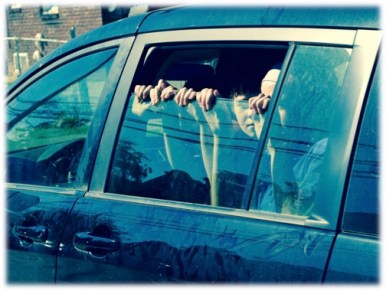 move. Fatima was honoring her father who only wanted to protect her. He had no idea what this situation was like. My dad would have counseled me the same. My husband would probably give our daughters that advice, too. I took a deep breath. I agreed that listening to her father’s advice was the best move. I silently prayed that maybe I wouldn’t get a ticket.
That was the best hour I’ve ever had waiting for an officer to arrive. Fatima and I discussed university life and libraries, I shared every snack in my purse with her cousins and my three kids, and all the kids ran races to the corner and back to pass the time.
The cop arrived and issued my ticket. I felt the tears coming, but tried not to make an emotional scene. I thanked him for doing his job and hugged Fatima good-bye. On the way home, my inquisitive oldest daughter wanted to know why Fatima had to call the police—voicing my own silent complaint. It was a good teachable moment to highlight the important principle for children to obey your parents, for this is right. It was a good choice for Fatima to make, even though it was not what I wanted her to do.
Since before the officer arrived we had exchanged phone numbers, I texted my new acquaintance after the incident, telling her I was glad to have met her and that I hoped everyone was okay. I prayed for her and pondered at why God would have our paths collide in this universe and where it could possibly go from there.
From Court to Coffee
The officer on the scene advised me to “contest” my ticket and wait for a court date. Since my run-ins with the justice system were thankfully pretty sparse, I had no idea that my new friend would be subpoenaed as well. I also had no idea how to answer all her questions when she called me right after she got her subpoena in the mail, “What do I wear to court? Where do I go? What do I say?”
On the Tuesday morning of my court date I managed to squeeze in substitute teaching for two Spanish classes at a local college before heading to contest my ticket. As I was racing (at the speed limit, of course) from the college to the court, Fatima called frantically for directions. Directions from me? Did she know that I get lost even at the mall? And that I celebrate every time I make it to Northville without a U-turn? I fumbled my way through giving her directions and we both managed to find our way to the court—PHEW!
Fatima and I sat next to each other on the hard wooden bench as we awaited my turn before a magistrate. An hour later I paid my ticket. It happened to be the exact amount I earned subbing for the Spanish classes that morning. Then Fatima and I headed off to Starbucks where we lost track of time, sharing our lives for the next two hours. What an amazing moment. I told her I believed that ours was a strange but divine encounter God had arranged for us, and she agreed. She said, “If I were older and wiser and Greek, I’d be you!” I agreed that even though our lives, cultures, and religions were so different, there was something so similar about her personality and mine. We talked faith and love and friendship and hardship. I felt in that moment that God’s kingdom had touched down in my little world.
As I headed home, high on my divine moment, I no longer wondered why the fender-bender, or the ticket. I felt like this encounter was inevitable. I was glad that Fatima chose to honor her father that day we met—otherwise we would have just exchanged information and been on our way. Waiting for the officer gave us time to get to know each other. Going to court gave us a reason to reunite. Three years later, we still get together for coffee and share life stories. Since the day our paths collided, I was drawn to Fatima’s kind and adventuresome spirit, the everyday-radical kind of living that opened us both up to our unique friendship.
 On My Mind