
White Noise—A Cry of Repentance

I’m sorry.

Not I’m sorry, but…

Not I’m sorry, in general.


Rather, specifically…

I’m sorry for my ignorance that has perpetuated an unjust status quo.

I’m sorry for my silence when advocacy was needed.

I’m sorry for all the little compromises that left your life more difficult and exhausting.


I’m sorry for my complicity in racism.

  • For my fear of not knowing what to do, and so yielding to inaction.
  • For letting false White conceptions of color blindness go unchallenged.
  • For not understanding how the systems I’m a part of and benefit from have put me in a privileged place at your expense.


I’m sorry for the White sorry buts that add salt to your wounds.

I’m sorry for being dismissive when the problems of society get too scary for me to handle.

I’m sorry for allowing this or that movie about ugly White racism to appease my conscience and make me feel like I get it—when I don’t.

I’m sorry for getting so used to Black bad news that it has become noise in the background of my passive tranquility.

I’m so sorry for reducing your trauma to my White noise.


Deliver me from the guilt of bloodshed, O God, you who are God my Savior, and my tongue will sing of your righteousness. 

Open my lips, Lord, and my mouth will declare your praise. 

You do not delight in sacrifice, or I would bring it; you do not take pleasure in burnt offerings.

My sacrifice, O God, is a broken spirit; a broken and contrite heart you, God, will not despise.  (Psalm 51: 14-17) 

Lord, forgive us for the pride of thinking we’re innocent.

Lord, expose the hypocrisy in our breaking hearts and lead us to repentance.

Lord, forgive me for being an ambassador of peace but not understanding justice.

Lord, forgive me for being so passionate about Your great love for all nations and tribes, races and languages, yet somehow not having eyes to see and ears to hear the trauma and injustice of my Black brothers and sisters.

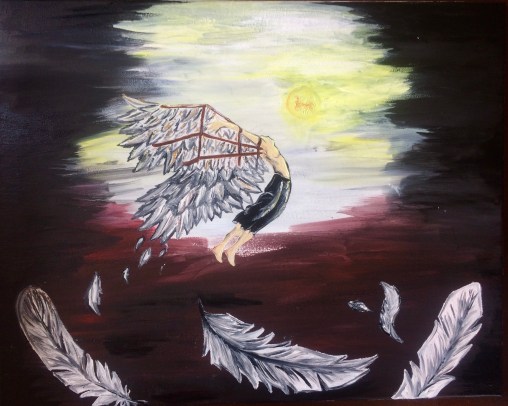
Lord, forgive us for our White supremacy—for standing too high on a pillar of infection—like an abscess on our nation.  It’s disgusting.

Lance it. Drain it. Then, heal it.

Like a boil that must be opened with all its ugliness to the natural medicines of air and light, injustice must be exposed to the light of human conscience before it can be cured.   MLK Jr.
 

409EFB9A-63C9-4A7E-9CF4-A471A0EFA365_1_201_a


I see now that racism is a White problem.

I understand now that Black Lives Matter—so much.  I’m sorry I never said so sooner.

I hear your cries of grief.  I’m sorry it took me so long.

I shudder at the images of George Floyd’s murder. And Ahmaud Arbery, and Breonna Taylor.  I’m sorry for your loss.  Your losses.  I’m sorry for the innumerable losses that have gone unseen.

I can know better.

I can be better.

I can do better.

It’s not your responsibility to enlighten me.  But many have taken the time to love me where I’m at and patiently help me get to a better place.  Thank you.

I know I’ll mess up again.  I know racism has had its ugly effect on me.  I know there are still offensive ways in me.

Search me, God, and know my heart; test me and know my anxious thoughts. See if there is any offensive way in me and lead me in the way everlasting. (Psalm 139:23-24)
13D18B8A-5426-4C72-B240-1D2391735475_1_201_a


For context: I am white.  I am a follower of Jesus.  I deeply value the authority of the Bible. I am a church goer.  I work in non-profit contexts.  I have been on an intensive journey of listening, learning, and lamenting since May 8, 2020–what would have been Ahmaud Arbery’s 25th birthday.  

The influencers who have significantly informed my understanding, challenged my beliefs on issues of systemic racism, and shaped how I craft my words are: Dr. MLK Jr.Dr. Robin Diangelo, Dr. Anita Phillips, Jemar Tisby, and Mona Haydar.  And my friends, Befkadu Meshesha and Ian Simkins.

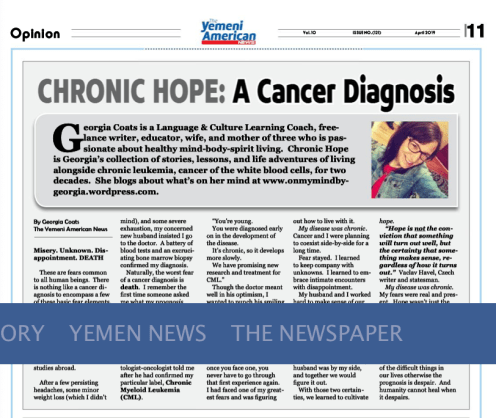
CHRONIC HOPE: A Cancer Diagnosis

Misery. Unknown. Disappointment. DEATH

These are fears common to all human beings.  There is nothing like a cancer diagnosis to encompass a few of these basic fear elements. I faced a dreaded diagnosis when I was 27 years old, newly married, and had many hopes and dreams of traveling the world and raising a family.  I was in graduate school and hoping to do some Middle Eastern studies abroad.

After a few persisting headaches, some minor weight loss (which I didn’t mind), and some severe exhaustion, my concerned new husband insisted I go to the doctor.  A battery of blood tests and an excruciating bone marrow biopsy confirmed my diagnosis.

Naturally, the worst fear of a cancer diagnosis is death. I remember the first time someone asked me what my prognosis was.  I didn’t even know that word.  I had to look it up, and let it sink in that people were actually asking me when the doctors think I might die.  That was crazy!  I was still in my twenties!

“Good news!” the hematologist-oncologist told me after he had confirmed my particular label, Chronic Myeloid Leukemia (CML).

“You’re young.

You were diagnosed early on in the development of the disease.

It’s chronic, so it develops more slowly.

We have promising new research and treatment for CML.”

Though the doctor meant well in his optimism, I wanted to punch his smiling face.  These factors were all in my favor to avoid death.  But what about living a miserable life?  What about dreams of starting a family?  So many unknowns.

The strange thing about a cancer diagnosis, is that once you face one, you never have to go through that first experience again.  I had faced one of my greatest fears and was figuring out how to live with it.

My disease was chronic.  Cancer and I were planning to coexist side-by-side for a long time.

Fear stayed.  I learned to keep company with unknowns.  I learned to embrace intimate encounters with disappointment.

My husband and I worked hard to make sense of our new circumstances.  I quit graduate school.  really hate quitting.  I gave up the dream of studying abroad.

Two things were certain amidst the unsettling unknowns: 

1. God is still God and He is good.

2. My husband was by my side, and together we would figure it out.

With those two certainties, we learned to cultivate hope.

“Hope is not the conviction that something will turn out well, but the certainty that something makes sense, regardless of how it turns out.”

Vaclav Havel, Czech writer and statesman.

My disease was chronic.  My fears were real and present.  Hope wasn’t just the optimism I needed to “fight this thing.”  We were clinging to the hope that this diagnosis would make sense in our lives—eventually.  Someday, our hope would be greater than our fear.

We have to make sense of the difficult things in our lives otherwise the prognosis is despair.  And humanity cannot heal when it despairs.

To ponder…

A friend of mine going through a difficult time compared her life to a garden in the winter. She said, “Hope is the promise that things will grow again.”  How do you make sense of the difficulties in life?  How would you describe hope?

IMG_2672

This article was published as the first in a series of articles for the Yemeni American News, May, 2019:

Georgia Coats is a Language & Culture Learning Coach, freelance writer, educator, wife, and mother of three who is passionate about healthy mind-body-spirit living.  Chronic Hope is Georgia’s collection of stories, lessons, and life adventures of living alongside chronic leukemia, cancer of the white blood cells, for two decades.  She often shares what’s on her mind at: www.onmymindbygeorgia.wordpress.com

Screen Shot 2019-05-04 at 12.17.00 PM

What are You Afraid Of?

“You gain strength, courage and confidence by every experience in which you really stop to look fear in the face.” Eleanor Roosevelt

OLYMPUS DIGITAL CAMERAThe best part about cold winter months in Michigan is snuggling under warm blankets, reading and telling stories with my kids. In these moments I often pause just to take it all in, and then thank God for the beauty of such simple yet priceless memories.   Children truly are a treasure and a gift in this life. Recently, I took part in a short, two-question survey on FEAR. The first question was: What is something you are afraid of? A lot of things came to mind…debt, disease, destruction…but if I had to pick just one to write down, I would say that what I fear most regularly is something horrible happening to my children. As a mom, I do all I can to protect my children from harm. I teach them how to be safe, I stay near them in uncertain circumstances, and I try to keep them healthy.
These things were going through my mind as we read the historical account of the birth of Jesus the Messiah together. We got to the dark part of the story where a corrupt leader, King Herod, was feeling threatened by the news of a young Messiah being born. Out of fear, King Herod terrorized the Palestinian town and region he governed, and ordered the mass slaughter of all baby boys under two years old. As we read through the account, my eight-year-old son quickly named our young friend that fit that description. We all agreed that it was horrible to imagine our friends losing their 1½-year-old son to the terror of a corrupt leader.

For days I was troubled by this disturbing account of male infanticide that went on as a result of the Messiah’s birth. The families of those baby boys weren’t celebrating the birth of a promised and foretold anointed one sent from God. Instead, they grieved deep loss around the event that led to mass extermination of baby boys in and around Bethlehem. The story recounts that King Herod was “terrified” at the news of a prophetic Messiah-King entering the world and being revered by foreign Wise Men from the East. He saw this child as a threat to his powerful position of leadership. But the birth of Jesus also stirred a new hope far and wide. The coming of a promised Messiah reminded the world that God Most High is near to His people.

I tried to imagine myself living in a time and place of such need for hope—a world of terror and destruction enacted by powerful people. It didn’t take me long to realize that that is our world. Those are the bleak circumstances facing so many in war-torn Yemen today. According to a recent interview that the Yemeni American News had with the President of the National Association of Yemeni Americans (NAYA), AbdulHakem a. Alsadah, the United Nations estimate 3 million “displaced” Yemeni people.   “There is no international awareness about this crisis,” Alsadah stated. Tears stream down my face when I see pictures of Yemeni children who are near death due to acute malnutrition. My heart breaks as I read stories about Yemeni parents who are forced to make hard decisions about losing their children, either to disease, destruction or starvation. According to a December 2016 article in www.theGuardian.com, one man tells of how he and his other children don’t eat so they can pay for his young daughter’s cancer medication. How does any parent face that kind of fearful reality and not lose hope?

The second question in my survey was:

What do you do when you are afraid?

Fear makes me want to hold my children tighter and never let them out of my sight. It makes me want to turn off the news because I can’t possibly process all the destruction going on in the world—in Yemen, in Syria… But what can I do about it? Fear and ignorance are the easy ways out, at least initially. If I raise my kids in fear, they are set up to react in fear. There’s a reason why the angels who came to announce the birth of the Messiah always started by saying, “Fear Not.” It’s because we do fear. Nevertheless, God Most High sends His chosen ones to a messy world because we need to hear from Him.

“Man can live about forty days without food, about three days without water, about eight minutes without air, but only for one second without hope.” H. Lindsey

It is good to be near God.  His presence brings hope, and hope keeps us alive.  Author Hal Lindsey said that, “Man can live about forty days without food, about three days without water, about eight minutes without air, but only for one second without hope.”  In the worst of our despair, hope anchors our souls. It has to. Otherwise we wouldn’t survive the fear, terror and destruction that surrounds us. Education, compassion, prayer, hope. These are the things we must hold on to when we are afraid.

What is something you’re afraid of? What do you do when you are afraid?

 So, as we really stop to look fear in the face, join me in trying a few of these things:

  • Give thanks for the good things God has done.

  • Tell a story to raise awareness of the crisis going on in Yemen.

  • Hug your children a little tighter.

  • Pray for those who suffer.

  • Give of your resources (time, money, or talents) to help another struggling human being.

  • Educate children about how to process fear.

  • Take a moment to grieve sad and disturbing news when you see it or hear it.

  • Love your neighbor.

  • Look for ways to spread love and kindness, especially when it is easier to spread fear or hate.

  • Hold on to hope as an anchor for your soul.

(Published in the Yemeni American News, February, 2017)

Where Is Safe?

(As published in the Yemeni American News, August, 2016)

YAN G Is it Safe

My husband Steve and I sat motionless on the floor of our empty upper flat and watched with racing hearts the commotion below. We had just arrived in Dearborn, on a hot, sticky August afternoon in 2001. Waiting for our belongings to be shipped, we camped out in our uncomfortably warm living room for the night. We had just finished assuring family and friends back west that we were safe and settled in our recently rented flat. That’s when we heard the rustling in the backyard, and saw the red and blue flashes of the police cars reflecting on our front window. The chase was on. Numerous police officers followed a perpetrator of a gas station robbery on foot through our yard with shouts and flashlights… Was it safe to live in Dearborn, MI?

 Just 2 years earlier, on April 20, 1999, I sat with a cake decorator in Littleton, Colorado and picked delicate toppings and flavors for my wedding dream cake when we were interrupted by the shocking news of the Columbine High School shooting. Picking frosting flowers no longer seemed so fun… Was it safe to live in Littleton, CO?

What is a Sense of Safety?

Shortly after our furniture had arrived in Dearborn and we had settled in to our flat, I signed up to teach ESL at a local center in town. I was already nervous to meet the 30 beginning-English students from a variety of Arab countries. It was a big class and I was used to teaching kids, not grown women! What would they think of my games and songs? As it turned out, my first day of teaching was September 12, 2001. I was greeted by the intensity that all of us had unglued from our TVs to come to English class. We waited and wondered with the rest of the world how the horrendous 9-11 attacks and rescues would play out. I quickly adapted my lessons to teach my students words to share in collective grief, fear, and loss. Lessons many of them were already familiar with in Arabic as they had fled their home countries to move to a safer land. Playing games and singing songs no longer seemed so relevant.

After 9-11 we got numerous calls from our family and friends still concerned for our safety. Now, every time there is Islamophobic backlash directed at Dearborn after some display of terror, we still get that concerned question…Is it safe?

I don’t fully know what is safe. I feel a little naïve on the topic. I have lived with the luxury of not worrying about my safety up until the gas station robber was apprehended in my backyard. And thanks to the rapid response of the Dearborn police, that ended pretty quickly. Wikipedia says safety has to do with being protected from harm or being able to control recognized hazards. Considering the chaos of our world right now, what is safe? Are we able to control recognized hazards? As a mom, how do I keep my kids safe and control the recognized hazards in their little lives? Unlike some of my ESL students, I have never worried that my kids would hop, skip or jump over a land mine, or that loud thundering sounds after dark were anything more than a bad rainstorm. Is safety a right we have? A luxury? A privilege for some and not others?

Flags at Half-Staff

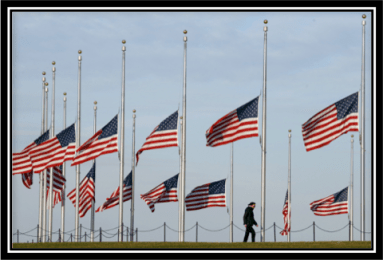
Haff StaffLast month, as my husband and I and our three children drove homeward after an epic road-trip across miles and miles of United States, we started to notice a pattern. Colorado, Nebraska, Iowa, Indiana, Illinois… My kids wanted to know what was wrong with all the American flags. I explained to them the phenomenon of “half-staff”. When something really bad happens in our country, people hang the flags at half-staff on purpose as a way to show their grief and support. My son asked, “Did something bad happen in each of these places?” I assured him that it was to show support, not because every city we passed had something horrendous happen in it. But deep inside, I shuddered at that fearful possibility.

Safety and Fear

If we don’t feel safe, our natural human reaction is fear. Saint John, disciple of Jesus the Messiah, said, Perfect love drives out fear. Fear will always creep in, but love is the best way to combat the fears we face. Carl Medearis, author and specialist in Muslim-Christian relations, poses a relevant and insightful question based on St. John’s quote: “If perfect love drives out fear, is it possible that perfect fear can also drive out love? Fear is the devil’s workshop. Perfect fear drives out love…Only one remains. Fear or love.”

If my safety is compromised, my natural reaction is fear. But fear and love are at odds in my soul. Fear leads to anger and hate. Love leads to freedom, joy and peace. Even though love is risky and sometimes dangerous, I choose that. As far as I am able, I want to combat the tempting momentum of fear by sharing stories of love and peace with the concerned callers checking in on my safety. I choose to teach love to my children. I choose to receive love from those around me…my students, my neighbors, my coworkers. I choose to extend love to someone living in fear. I don’t know if it’s safe to live here or there in our turbulent world, but I do know where I DON’T want to live, and that is in fear.