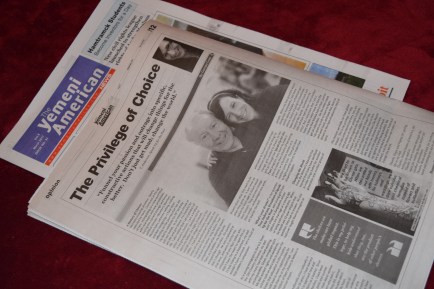
The Privilege of Choice

Funnel your passion and outrage into specific, constructive actions that will change things for the better. Don’t just get mad; change the world.    T. Anderson, Speak Up for the Poor

A History of Choices

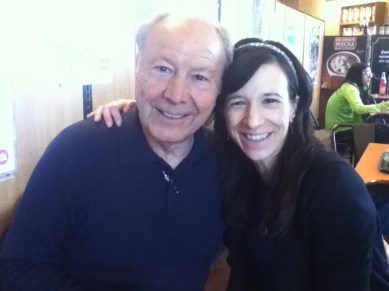
Narrowly escaping abortion. Nearly executed by Nazis. Orphaned at the age of two. Immigrating to a new land filled with new hopes and new possibilities. During this current strange and tense political climate—Women’s Marches, Muslim bans, extreme vetting, trolling, and fear mongering—I have been reflecting on the journey that has led my dad to celebrate his 75th birthday just last month. In a heated climate of pro-life and pro-choice, I’m thankful for life. I also realize that I am a product of other people’s choices. I am a product of my grandparents’ decision not to abort my father, by night, in secret, outside a small village in Greece in the 1940s. I had heard the story countless times of my grandmother’s decision not to eliminate the unexpected pregnancy that was my father, long before I ever comprehended what abortion meant. Then, as a toddler, my dad barely escaped Nazi execution. His parents didn’t though. He was orphaned at that time, and were it not for the compassion of one Nazi soldier who didn’t have the heart to open fire on 13 kids hiding in a basement, my dad wouldn’t have survived. I am a result of that soldier’s compassion.me-and-dad
As a young immigrant to the U.S. from the Old Country of Greece, my dad, with my mom, had that hard working, unconquerable, Greek, immigrant spirit. My dad worked nights and weekends, and he took on extra jobs to pursue the dream that education in this country would lead to more opportunities for his kids than he or my mom had. I am the product of their choice to believe in the American dream.

Living intentionally cross-culturally in a diverse community for 16 years, I have learned that it is best to approach new and complex situations as a learner. Since the Women’s Marches, I have been carefully reading posts and counter posts in Ping-Pong style about women who marched, women who didn’t, women who wished they did, women who were angry, women who didn’t want to get involved… My heart swelled with the pride for some of those who marched. I also understood why some didn’t. From those who chronicled their marches, I learned to value the privileges of choice we have today, because others fought for them in a previous era.

When he would ask 12-year-old girls, “What’s your dream?” they had no answer. No one had ever taught them to imagine an alternative to forced child-marriage.

The Privilege of Dreaming

My kids are privileged with choice. Since they could to talk, my kids have dreamt about what they want to be when they grow up. It was never an option for them not to dream about their futures. They can even change their minds—archaeologist one week, art teacher the next.
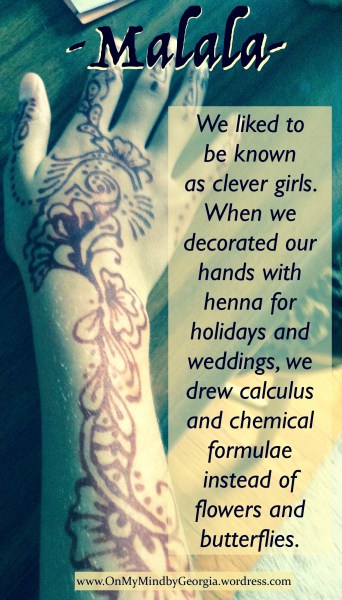
malala-3“What’s your dream?” is the question Troy Anderson, President of Speak Up for the Poor, asks young girls from poor villages in Bangladesh whose options are marriage at a young age, or being sold into prostitution. When he would ask 12-year-old girls that question, they had no answer. No one had ever taught them to imagine an alternative to forced child-marriage. Anderson realized that for things to change, girls needed to dream. As the girls go through the Speak Up for the Poor program, they learn to make a plan to make their dreams of becoming a nurse, or a business owner, or a teacher come true. These girls dare to fight societal norms to realize a better life.

Changing the World

From the Women’s Marches I’ve learned that many have sacrificed to make things better for another generation and another group of people. When my kids grumble about doing their homework, I tell them stories about Malala—a Pakistani girl whose choice of going to school was taken from her. She fought back and inspired the world. Sometimes my kids roll their eyes at me—not another story! But, crazy mom that I am, I want my kids to appreciate their privileges, to work hard for what they believe in, and to have that dare-to-dream-in-the-face-of-adversity kind of spirit.

The choices we make can have global impact. This is my privilege, to help my kids understand that they, too, are the product of other people’s choices. Who could imagine the life-giving impact of one Nazi soldier’s choice back in 1944 in a small Greek village? My kids will hopefully never have to face gunshots on the school bus like Malala did, but they can choose to promote peace on the playground, and stand up against a friend being bullied. We are all connected to a greater historical context, and the choices we make can change the world.

(Published in the Yemeni American News, March, 2017)DSC_0151
What are You Afraid Of?

“You gain strength, courage and confidence by every experience in which you really stop to look fear in the face.” Eleanor Roosevelt

OLYMPUS DIGITAL CAMERAThe best part about cold winter months in Michigan is snuggling under warm blankets, reading and telling stories with my kids. In these moments I often pause just to take it all in, and then thank God for the beauty of such simple yet priceless memories.   Children truly are a treasure and a gift in this life. Recently, I took part in a short, two-question survey on FEAR. The first question was: What is something you are afraid of? A lot of things came to mind…debt, disease, destruction…but if I had to pick just one to write down, I would say that what I fear most regularly is something horrible happening to my children. As a mom, I do all I can to protect my children from harm. I teach them how to be safe, I stay near them in uncertain circumstances, and I try to keep them healthy.
These things were going through my mind as we read the historical account of the birth of Jesus the Messiah together. We got to the dark part of the story where a corrupt leader, King Herod, was feeling threatened by the news of a young Messiah being born. Out of fear, King Herod terrorized the Palestinian town and region he governed, and ordered the mass slaughter of all baby boys under two years old. As we read through the account, my eight-year-old son quickly named our young friend that fit that description. We all agreed that it was horrible to imagine our friends losing their 1½-year-old son to the terror of a corrupt leader.

For days I was troubled by this disturbing account of male infanticide that went on as a result of the Messiah’s birth. The families of those baby boys weren’t celebrating the birth of a promised and foretold anointed one sent from God. Instead, they grieved deep loss around the event that led to mass extermination of baby boys in and around Bethlehem. The story recounts that King Herod was “terrified” at the news of a prophetic Messiah-King entering the world and being revered by foreign Wise Men from the East. He saw this child as a threat to his powerful position of leadership. But the birth of Jesus also stirred a new hope far and wide. The coming of a promised Messiah reminded the world that God Most High is near to His people.

I tried to imagine myself living in a time and place of such need for hope—a world of terror and destruction enacted by powerful people. It didn’t take me long to realize that that is our world. Those are the bleak circumstances facing so many in war-torn Yemen today. According to a recent interview that the Yemeni American News had with the President of the National Association of Yemeni Americans (NAYA), AbdulHakem a. Alsadah, the United Nations estimate 3 million “displaced” Yemeni people.   “There is no international awareness about this crisis,” Alsadah stated. Tears stream down my face when I see pictures of Yemeni children who are near death due to acute malnutrition. My heart breaks as I read stories about Yemeni parents who are forced to make hard decisions about losing their children, either to disease, destruction or starvation. According to a December 2016 article in www.theGuardian.com, one man tells of how he and his other children don’t eat so they can pay for his young daughter’s cancer medication. How does any parent face that kind of fearful reality and not lose hope?

The second question in my survey was:

What do you do when you are afraid?

Fear makes me want to hold my children tighter and never let them out of my sight. It makes me want to turn off the news because I can’t possibly process all the destruction going on in the world—in Yemen, in Syria… But what can I do about it? Fear and ignorance are the easy ways out, at least initially. If I raise my kids in fear, they are set up to react in fear. There’s a reason why the angels who came to announce the birth of the Messiah always started by saying, “Fear Not.” It’s because we do fear. Nevertheless, God Most High sends His chosen ones to a messy world because we need to hear from Him.

“Man can live about forty days without food, about three days without water, about eight minutes without air, but only for one second without hope.” H. Lindsey

It is good to be near God.  His presence brings hope, and hope keeps us alive.  Author Hal Lindsey said that, “Man can live about forty days without food, about three days without water, about eight minutes without air, but only for one second without hope.”  In the worst of our despair, hope anchors our souls. It has to. Otherwise we wouldn’t survive the fear, terror and destruction that surrounds us. Education, compassion, prayer, hope. These are the things we must hold on to when we are afraid.

What is something you’re afraid of? What do you do when you are afraid?

 So, as we really stop to look fear in the face, join me in trying a few of these things:

  • Give thanks for the good things God has done.

  • Tell a story to raise awareness of the crisis going on in Yemen.

  • Hug your children a little tighter.

  • Pray for those who suffer.

  • Give of your resources (time, money, or talents) to help another struggling human being.

  • Educate children about how to process fear.

  • Take a moment to grieve sad and disturbing news when you see it or hear it.

  • Love your neighbor.

  • Look for ways to spread love and kindness, especially when it is easier to spread fear or hate.

  • Hold on to hope as an anchor for your soul.

(Published in the Yemeni American News, February, 2017)

A New Song: In Celebration of World Arabic Language Day

Tallou Hababena  (طلّوا حبابنا) and a New Hairdo 

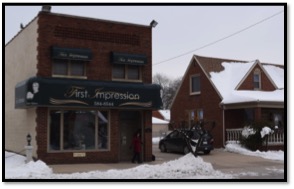
first-impression

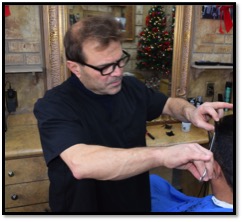
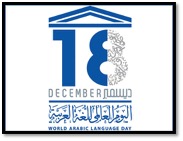
I sat robed in a black plastic cape, my wet hair combed over my face for precise styling. Sometimes a new hairdo from my long-time Lebanese stylist, Toufic, at First Impression Hair Salon, involves cake and tea with his lovely wife, or buying a box of Girl Scout cookies from one of his daughters. As he snips and trims with precision and care, Toufic always fills me in on the latest news of his family, his country and the unrest of the region. I also like to freshen up my rudimentary Arabic skills with him and learn a new phrase or two. But it was unusually quiet this Thursday morning without the standard news from the “Old Country” rattling on in the background. That set me up for the perfect moment to inquire about Tallou Hababena.  Tallou Hababena was the new song my daughter had been fervently practicing with her low intermediate Arabic class at her school. They had to memorize the song and perform a traditional debke dance in preparation for the UN World Arabic Language Day, which is recognized globally and annually on December 18.

word-arabic-l-day

Inspiration to Research

A new song sums up graduate studies at Wayne State University. From the Psalms I am reminded that God is my strength and my song. This spiritual strength has carried me through the incredible combination of the increased academic challenges of fulltime graduate school and the physical weariness due to my current leukemia treatment. I have battled chronic leukemia (CML) for fifteen years, but my current treatment, Sprycel, is more toxic to my system and regularly challenges me with increased fatigue and dizziness. Being simultaneously on Sprycel and on a scholarship has pushed me to the edge of vulnerability and gratitude. I have been soaring to new heights and needing new strengths to do it. During my most difficult struggles I find hope through inspiring song lyrics. My source of inspiration has become my focus of research, new songs. Expression through song is powerful because it can be personal, social, spiritual, and cultural. A song can stir a heart, inspire a nation, or lull a child.

Contributing to the inspiration is the cultural and linguistic information contained within authentic music and lyrics. Song lyrics are a great resource for gaining cultural perspectives and memorizing new language forms. With my Spanish students, we print song lyrics and then research idioms, dialects, themes, styles, metaphors and verb tenses found in each new song. Through this wealth of cultural insight, my desire is to make life-long language learning meaningful and inspiring for myself, and for those that I teach and coach.

ps-40-3The Comprehension Quandary

So, as I sat at First Impression, my thoughts shifted from my studies back to my daughter’s Arabic song. Tallou Hababena had become my new challenge. My daughter had come to me weeks before with the Arabic script and the notecards she was using to transcribe the lyrics into English. Even though she didn’t understand the words, she was trying to prepare her best for her class performance.

As a family we want to position ourselves to engage the language and culture in our community. I’m training to be a Language Learning Coach. I am researching music for language learning purposes. I got all fired up. There was no way my girl was going to sing a song she didn’t understand in celebration of language! We went into full-on meaning-making mode: My husband acquired the translation of Tallou Hababena from a friend. We had watched various YouTube videos that helped us figure out that this song was about a songbird, nature, and the beautiful mountains of Lebanon. We knew that that title meant Come our Love. But something was missing. Why this song? How did it stir the hearts of its hearers?

Longing for Home

touficToufic felt free to enlighten me. With scissors in one hand and a comb in the other, and my wet hair in my face, his face lit up at the mention of Tallou Hababena by the prominent Lebanese singer Wadih El-Safi. “Kids wake up whistling this song. It’s a song about home. When someone has been gone, far away, for too long, their loved ones back in the villages wait for them to come home…” As Toufic burst into spontaneous song, my mind wandered to my family and loved ones far away, and how I wished I could be with them, especially at Christmastime. Tallou Hababena was in essence a version of I’ll be home for Christmas…if only in my dreams… Only this song had a beat you could clap along with, which I did, under my plastic cape! Even though I couldn’t understand all of Toufic’s words, I understood the powerful longing for my home and family back in Colorado.
My husband and I joked that before winter vacation most parents back in my hometown in Colorado were probably watching Christmas concerts, with their kids donned with jingle bells and red sweaters. But we beamed as our daughter and her 6th grade Arabic class walked onto the stage and began swaying their arms, stomping the debke, and singing along to Tallou Hababena (mostly) in unison. We were in full celebration of World Arabic Language Day, and Tallou Hababena would mark a new memory for us.

That’s the power of song. I have songs that mark some of my best memories, and some of the saddest ceremonies; songs of crying out to God Most High, songs that inspire, refresh, celebrate, and worship. I want to praise God with words and with my life, in more than one language, and I want to help others do the same.

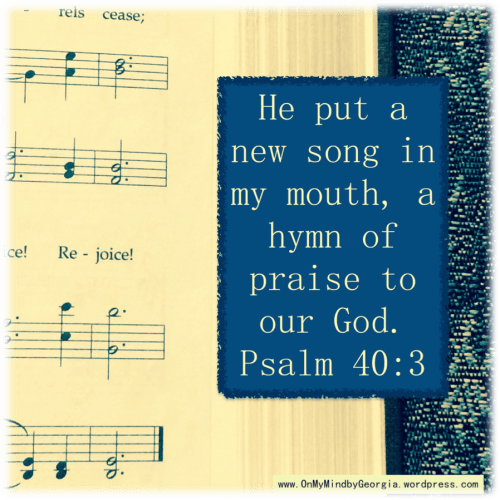
~He put a new song in my mouth, a hymn of praise to our God~    a Psalm of David

(This article was published in the Yemeni American News, January, 2017)

A Thrill of Hope: Adventures in Scooching Over

(Adapted from the Yemeni American News, December, 2016 publication)

“Do not be afraid. I bring you good news that will cause great joy for all the people…” ~Angel of God~

When the world around me seemingly swirls with hatred, anger and fear, and my heart is heavy for the hurting, my coping mechanism is to reminisce on stories of hope. In my profession of language teaching, motivation is a key element for success. Motivation in life, as in language learning, contains two essential ingredients: 1. You have to think you can do something: hope 2. You have to think that it matters: need. In November I was reticent to click send on my article, Scooching Over, because I knew that if I made my thoughts public, my own words would move me to action, and I wasn’t sure I had the capacity to scooch over for a new friend in my daily life. The last thing I want to do in this refugee crisis is talk about doing something and then do nothing. The need was clear: I believed wholeheartedly that my small action to make a difference in one refugee’s life mattered; but I wasn’t sure I could actually do something about it on my own. That’s where hope is bigger than me. It requires me to believe that I can be involved in great and impossible things.

slide2

After taking a moment in my hectic day to pause and pray, I called my New American friend that I have endearingly nicknamed Zuzu. Zuzu and I had connected at the Sabeel Media Event in October, where she had expressed that she needed help finding a preschool for her son. I had already called at least eight preschool locations in her zip code before I got on the phone with Zuzu. I offered to come over the next day, take her to visit a preschool, and teach her some English. To my surprise, she told me NOT to come. She said that she had already found a preschool, that her family was moving to a better location, and that she was currently too busy for me to come visit her. As it turned out, there was no room in her week for me.   She didn’t need my charity to survive, which made me even more determined to get to know this highly motivated woman.

When things settled for Zuzu, I came by to see her new place. In her intermediate English she reported that she had signed up for English classes at the local college, she was studying for her driver’s permit, and she was in walking distance from most of the places she needed to get to each week. She has been in the U.S. since April and is determined to settle her family here. Zuzu’s vision is bigger than she is. Her hope is deep. Her potential is great. Her work is humble. She walks her in-laws to the doctor and her son to preschool; she cooks and cleans for her household of six. At night when everything is quiet, she studies English and listens to audio messages I leave for her to practice each week. Zuzu doesn’t want to live indefinitely off of the kindness of others. On the contrary, she wants to be an agent of care and change and assistance to others. She also would like to go home if she could. But she can’t. So her plan is to bloom where she has currently been transplanted—right here in they Detroit Metro Area, MI, USA.

|Her plan is to bloom where she has currently been transplanted|

 From our visits together I have learned that Zuzu is Syrian Kurdish. Her hope is seen in the languages she wants her kids to know: English of course, so they can thrive in their new community. Kurdish of course, because that is the language of heart and home. Arabic of course, because you can’t live in Syria and not know Arabic. She is preparing her son and daughter to function in this new world, but also to be ready to return to her beloved home country…someday, Inshallah, God-willing.

Sitting on the floor of her upper flat on soft blankets against big couch pillows, sipping warm, sweet instant coffee with milk, my first step in our mini English lessons, was to identify her goals for learning English: 1. Help her mother and father-in-law with their medical prescriptions and paperwork 2. Help her kids learn English. 3. Go to college 4. Talk about travel and places to visit 5. Tell her personal history. Zuzu believes that learning English matters. She also clearly believes she can do it. Unless you’ve ever worked with someone that motivated to learn something, it’s difficult to describe how exhilarating it is. Her need is clear. Her desire is clear. She has hope for her future that is bigger than she is. And I have the privilege of joining her venture.

|Together our hearts break for the displaced people of her country.|

 As a writer, I want to carefully handle the stories entrusted to me. This past week, sipping our coffee, I pulled out the Yemeni American Newspaper and explained to Zuzu that she fullsizeoutput_9e0
had inspired the article I wrote last month. I told her that I follow the teachings of Jesus the Messiah who says we are to love one another. His heart is for the orphans, the widows, and all those in need. As His follower, I offer what little I have with big hope. After all, the good news of great joy this Christmas season is for all people.

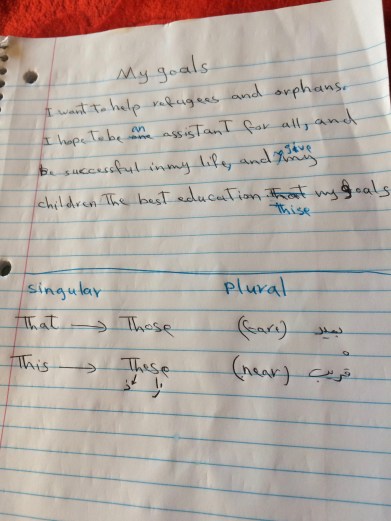
Zuzu shared with me another goal statement she had crafted late one night: I want to help refugees and orphans. I hope to be one assistant for all.  And be successful in my life and my children the best education. That my goals. Clearly, Zuzu and I share a vision of helping those in need. Together our hearts break for the displaced people of her country. I asked Zuzu if I could publically share her beautifully articulated goals because they inspired me, and I think they would inspire others. She agreed.

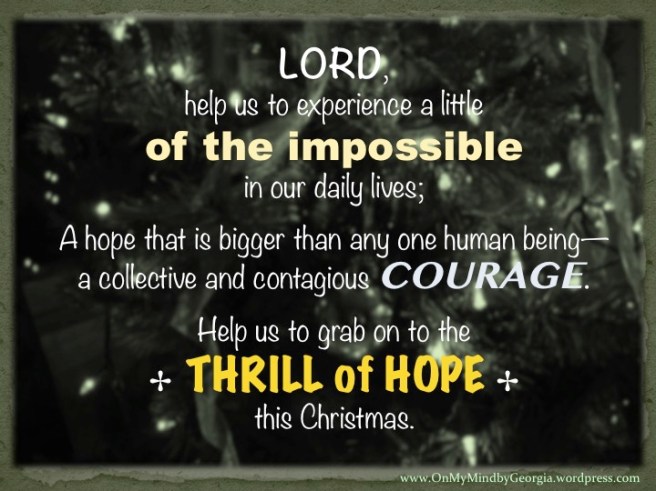
As Zuzu and I both scooch over each week to make room for each other, we hold on to the thrill of hope. My prayer is that all of us would experience a little of the impossible in our daily lives; that we would together find a hope that is bigger than the determination of any one human being—a collective and contagious courage. My prayer is for many more to get out of harm’s way and be welcomed into a safer place where hope can be nurtured, and that they can experience the good news of great joy that is for all people.

Long lay the world in sin and error pining, 

Till He appeared, and the soul felt its worth.

The thrill of hope, The weary world rejoices…

~O Holy Night~

Scooching Over

(Published in the Yemeni American News, November, 2016)

Give me your tired, your poor, your huddled masses yearning to breathe free.  Emma Lazarus

The Preferred Aisle Seat

I have never been known for my punctuality. In fact, I characteristically run late. Often times it’s because I get lost trying to find places, or maybe it’s because I tend to be on Greek time, which means I’m not technically late; it just allows me a half-hour margin for arrival. At my church there are rows of seats for people to choose from as they enter the place of worship. I’m always grateful when people scoot in towards the middle seats, so that us late arrivers can slip into the aisle seats, unnoticed. I prefer to avoid the awkward attention of navigating my way through a maze of knees and handbags after the service has begun to settle into the middle. Sometimes at abundantly populated special events, the pastor up front will ask everyone to scoot in a little to make room for more people to slip into the aisle seats. I know how it feels to be scooted in for.

Lately, though, I have been on a fairly long stretch of timely arrivals, which means I have my pick of seats at church. Admittedly, I tend to choose a preferred aisle seat.  I like having a bit of space on one end between me and other people that I don’t know so well. I like my space, my preferences, and my little comforts.

Joining the Response to New Americans

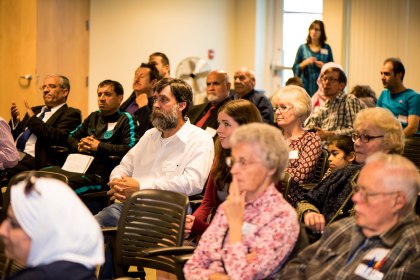
Last month I attended a free community event sponsored by Sabeel Media at the local library, discussing the response and the responsibility of the media to share the experiences and needs of refugees. One of the special presenters, Shane Lakatos of the Social Services for the Arab Community (SSFAC) in Toledo, challenged everyone at the event to think about the fear in our own hearts. We fear people we don’t know. And in fear, we tend to think the worst of them. Peter Twele, another special presenter and author of the book, Rubbing Shoulders in Yemen, emphasized that refugee families relocating simply need a friend if they are to successfully assimilate in a new culture. Not only have they left homes, families and jobs, they’ve lost neighborhoods, communities and connections. They need to build a new community of relationships.

So as I stood in the back of the Sabeel Media event, having arrived a little late, I started to think of my own response to the refugees joining my community.

sabeel-g-in-backSo as I stood in the back of the Sabeel Media event, having arrived a little late, I started to think of my own response to the refugees joining my community. I can donate to the cause. I can pray for those who suffer. I can speak out for the needs of these new Americans. I can even volunteer for an event of handing out free backpacks to refugee kids starting school in a new country. As I was pondering my action points, I scanned the room of attendees and my eyes fell on a beautiful young woman dressed in a bright pink sweater with a coordinated floral scarf covering her head. I was surprised to realize that I knew her, and not only that, but that I had been thinking about her. I knew her by name. I had given backpacks to her kids at a volunteer event in September.
Scooching Over, My Point of Decision

I greeted her with quiet kisses so not as to disrupt the program, and continued to listen to the needs amidst the crisis. The needs are dire. The search for hope is essential for new Americans coming into our country. The presenters’ words rang in my ears, of our own fears, and of the refugees’ need for friendship and connection with such limited resources… What was I going to do about it? But what about my crazy American schedule? Do I have room in my life for a needy new friend? Not really. There’s work, prior commitments, grad school, kids, family.

This is a crisis we are all facing. It doesn’t just belong to some people and not others.  We all need to scooch over and make room for one more in our lives.

But this is a crisis we are all facing. It doesn’t just belong to some people and not others. We all need to scoot in, scooch over, squeeze closer together, and make room for one more in our lives. My little bit of comfort in my “preferred aisle seat” isn’t a lot to give up, considering the woman I’m inviting to sit next to me really wants to settle her young family after fleeing devastation and living in temporary housing for over a year. She has her dignity. She doesn’t just want to be helped. She wants to go to school, get a job, help her kids learn English and assimilate into her new community. She’s ready to work hard; she just needs some help doing it. She’s one person, one name, one face. She is just one of the tired and the poor in the huddled masses, yearning to breathe free. She’s one woman I could call a friend. Who knows, I might end up being the needy one in our relationship and discover that my scooting over to fit one more into my life was actually to my benefit. I’ve had that happen before.

Version 2

When I think about all the potential things we perceive a refugee to be: a foreigner among us, a neighbor, an enemy to fear, a widow or an orphan, or someone lost and needy…I can’t help but think of what Jesus the Messiah has to say about all of them. He says to love them. Love your neighbor as yourself. Love your enemy. Look after the widow, the orphan, the lost, the foreigner among you. Jesus the Messiah chose to love me without condition and with a love so compelling that I can’t help but be changed by it. Calling one young woman this week to make time to help her find a preschool for her son, sip some tea, and help her learn English is something I can do. I can be inconvenienced in that way. I can scoot over and make a little room in my world for one more.

Religion that God our Father accepts as pure and faultless is this: to look after orphans and widows in their distress and to keep oneself from being polluted by the world.   St. James

Paths Collided

My unlikely friendship with Fatima was destined to be.  Neither of us were looking for a fight—or a friendship—but we were open to God intervening in our daily lives…  (As published in the Yemeni American News, October, 2016)

Dented by Destiny

It was a normal fall school day for my three kids. I was a little late picking them up, so I was in a rush to get to their classes, collect all their things and usher them to the car. I wasn’t thinking about making a new friend, finding grace in unfortunate circumstances, or modeling the virtue of honoring your parents on that chilly afternoon. I just wanted to get out of an over-crowded parking lot and home to feed my kids a snack after their long day at school.

Relieved to be out of the parking lot, I accelerated down the side street to the stop sign. That was the moment I encountered Fatima. Fatima was a girl in her early 20s who picked her young cousins up from school on her way home from studying at the university library. I’d like to say that I figuratively “bumped” into Fatima and struck up a conversation. But instead, I rather literally bumped into the rear end of her car with the front end of mine.

Fatima reminded me a lot of myself in such situations—she didn’t remember the name of the street we were on. She was very apologetic for having been bumped into, and she was trusting of me and ready to take down my information and be on our way.

As a teen learning to drive, I learned fender-bender protocol from my dad, who always warned me to be cautious because people take advantage of situations like that. This encounter felt different, and I think both Fatima and I felt it. But, like me, Fatima’s father worried about his young, friendly, trusting-of-others daughter who had recently been taken advantage of in another fender-bender situation. So, it wasn’t surprising that when she called for her father’s advice, he was quick to say, “Call the police!”

Honor Your Father and Mother

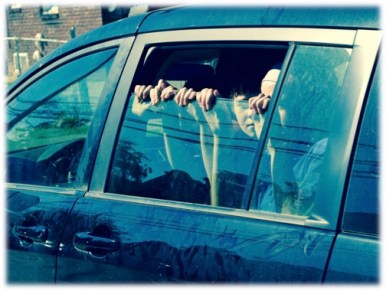
Apologetically, Fatima asked me if I minded that she called the police. Considering the price of a ticket, I bit my lip, and then thought of my kids in the car watching my every kids-car-edited-bigmove. Fatima was honoring her father who only wanted to protect her. He had no idea what this situation was like. My dad would have counseled me the same. My husband would probably give our daughters that advice, too. I took a deep breath. I agreed that listening to her father’s advice was the best move. I silently prayed that maybe I wouldn’t get a ticket.
That was the best hour I’ve ever had waiting for an officer to arrive. Fatima and I discussed university life and libraries, I shared every snack in my purse with her cousins and my three kids, and all the kids ran races to the corner and back to pass the time.

The cop arrived and issued my ticket. I felt the tears coming, but tried not to make an emotional scene. I thanked him for doing his job and hugged Fatima good-bye. On the way home, my inquisitive oldest daughter wanted to know why Fatima had to call the police—voicing my own silent complaint. It was a good teachable moment to highlight the important principle for children to obey your parents, for this is right. It was a good choice for Fatima to make, even though it was not what I wanted her to do.

Since before the officer arrived we had exchanged phone numbers, I texted my new acquaintance after the incident, telling her I was glad to have met her and that I hoped everyone was okay. I prayed for her and pondered at why God would have our paths collide in this universe and where it could possibly go from there.

From Court to Coffee

The officer on the scene advised me to “contest” my ticket and wait for a court date. Since my run-ins with the justice system were thankfully pretty sparse, I had no idea that my new friend would be subpoenaed as well. I also had no idea how to answer all her questions when she called me right after she got her subpoena in the mail, “What do I wear to court? Where do I go? What do I say?”

On the Tuesday morning of my court date I managed to squeeze in substitute teaching for two Spanish classes at a local college before heading to contest my ticket. As I was racing (at the speed limit, of course) from the college to the court, Fatima called frantically for directions. Directions from me? Did she know that I get lost even at the mall? And that I celebrate every time I make it to Northville without a U-turn? I fumbled my way through giving her directions and we both managed to find our way to the court—PHEW!

Fatima and I sat next to each other on the hard wooden bench as we awaited my turn before a magistrate. An hour later I paid my ticket. It happened to be the exact amount I earned subbing for the Spanish classes that morning. Then Fatima and I headed off to Starbucks where we lost track of time, sharing our lives for the next two hours. What an amazing moment. I told her I believed that ours was a strange but divine encounter God had arranged for us, and she agreed. She said, “If I were older and wiser and Greek, I’d be you!” I agreed that even though our lives, cultures, and religions were so different, there was something so similar about her personality and mine. We talked faith and love and friendship and hardship. I felt in that moment that God’s kingdom had touched down in my little world.

As I headed home, high on my divine moment, I no longer wondered why the fender-bender, or the ticket. I felt like this encounter was inevitable. I was glad that Fatima chose to honor her father that day we met—otherwise we would have just exchanged information and been on our way. Waiting for the officer gave us time to get to know each other. Going to court gave us a reason to reunite. Three years later, we still get together for coffee and share life stories. Since the day our paths collided, I was drawn to Fatima’s kind and adventuresome spirit, the everyday-radical kind of living that opened us both up to our unique friendship.

Hijacking Radical

I appreciate the Muslims in my community who motivate me to be more courageous about my own expressions of faith through their everyday radical.  As we commemorate the horrendous 9-11 attacks, and as many contemplate Abraham’s tremendous trust in God’s perfect provision during the Eid of Sacrifice, I wonder, what would it look like if we were all a little more radicalized to show extreme love, drastic kindness, and fanatical forgiveness in a hurting world?  Thanks, everyone, for taking a moment out of your lives to consider my thoughts on radicalism.  (As published in the Yemeni American News, September, 2016).

Defining Radical Religious Practices

When I was in college my roommate and I had a hunger to learn more about our faith and live out what we believed, even when other people thought we were a little bit crazy. We wanted to be radical about what we believed. By radical I mean, we wanted to pray publically when others would have thought it awkward or inappropriate. We wanted to stand out in modesty and purity of heart when other girls we knew were choosing to wear smaller shorts and date lots of guys. We wanted to study our Holy Book, talk about what it says, and figure out how to live it out every day, even when others were more interested in talking about the latest drama on their favorite show. We didn’t want to judge others for their choices, we just wanted to stand out as committed, passionate, and sold out for what we believed in. That was my definition of radical. I wanted to study the teachings of Jesus the Messiah and then live them out as best I could in my context. He was radical in his day and I wanted to follow in his radical ways of kindness, love, peace, and purity in my day.

Today, if someone is radicalized, it means they have a religiously based motivation to terrorize others. The word radical has been hijacked! Why does being sold out for what one believes in have to involve hurting others? There are radicalized religious fanatics of every flavor—those who bomb abortion clinics, those who bomb twin towers, those who terrorize innocent village children… All those extreme beliefs are crimes against humanity, and they are so far from the loving heart of God.

Practicing Radical at the Gym
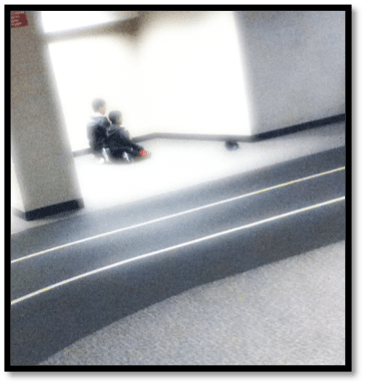
The other day I pushed myself to get to the gym rather than take a nap on the couch. I convinced myself that I would feel better after a good workout. It was hot and sticky and I grumbled in my T-shirt and capris as I anticipated getting even hotter running laps. When I walked into the rec center, I passed a modest Muslim woman working out hard in her hijab, covered from head to toe—and I thought I was hot! Motivated by her prayin gym framedcommitment to religious purity, even on a treadmill, I bounded with greater fervor up the stairs to the track. I was greeted by the sight of a man and his son pausing their workout to stop and pray eastward in the corner.  One of the things that I appreciate about living among Muslims in Dearborn, is that moments like these are “normal” occurrences at the gym.  They are also radical in my mind.  Radical by my first definition. Many devout Muslims in our community seek to live out their faith everyday, even when it seems uncomfortable, inconvenient, or just strange to those around them.

Inspired by these examples of radicalism to stand out at the gym, I decided, why not…I’m devoted to God, regardless of what others think… So, I waited my turn for the secluded prayer corner beside the track, and I knelt down and prayed. I wasn’t trying to show off or prove anything; I just wanted to take a moment out of my workout to connect to God in prayer. It was a demonstration of everyday radical. It was my small moment to take radical back from terrorism and reflect the heart of God.

Waging Peace
wage peace framedWhat would it look like if we were all a little more radicalized to show extreme love, drastic kindness, and fanatical forgiveness in a hurting and confused world?  What if we all paused to pray throughout our day more often?  One of my favorite bumper stickers challenges people to Wage Peace. What if we all practiced just a little of everyday radical by waging peace wherever we are?  Love, joy, peace, goodness, kindness…these are the fruit of the Spirit of God. These are fundamental virtues.  Maybe, then, we should all strive to be a bit more radical—and fundamentalists!


Where Is Safe?

(As published in the Yemeni American News, August, 2016)

YAN G Is it Safe

My husband Steve and I sat motionless on the floor of our empty upper flat and watched with racing hearts the commotion below. We had just arrived in Dearborn, on a hot, sticky August afternoon in 2001. Waiting for our belongings to be shipped, we camped out in our uncomfortably warm living room for the night. We had just finished assuring family and friends back west that we were safe and settled in our recently rented flat. That’s when we heard the rustling in the backyard, and saw the red and blue flashes of the police cars reflecting on our front window. The chase was on. Numerous police officers followed a perpetrator of a gas station robbery on foot through our yard with shouts and flashlights… Was it safe to live in Dearborn, MI?

 Just 2 years earlier, on April 20, 1999, I sat with a cake decorator in Littleton, Colorado and picked delicate toppings and flavors for my wedding dream cake when we were interrupted by the shocking news of the Columbine High School shooting. Picking frosting flowers no longer seemed so fun… Was it safe to live in Littleton, CO?

What is a Sense of Safety?

Shortly after our furniture had arrived in Dearborn and we had settled in to our flat, I signed up to teach ESL at a local center in town. I was already nervous to meet the 30 beginning-English students from a variety of Arab countries. It was a big class and I was used to teaching kids, not grown women! What would they think of my games and songs? As it turned out, my first day of teaching was September 12, 2001. I was greeted by the intensity that all of us had unglued from our TVs to come to English class. We waited and wondered with the rest of the world how the horrendous 9-11 attacks and rescues would play out. I quickly adapted my lessons to teach my students words to share in collective grief, fear, and loss. Lessons many of them were already familiar with in Arabic as they had fled their home countries to move to a safer land. Playing games and singing songs no longer seemed so relevant.

After 9-11 we got numerous calls from our family and friends still concerned for our safety. Now, every time there is Islamophobic backlash directed at Dearborn after some display of terror, we still get that concerned question…Is it safe?

I don’t fully know what is safe. I feel a little naïve on the topic. I have lived with the luxury of not worrying about my safety up until the gas station robber was apprehended in my backyard. And thanks to the rapid response of the Dearborn police, that ended pretty quickly. Wikipedia says safety has to do with being protected from harm or being able to control recognized hazards. Considering the chaos of our world right now, what is safe? Are we able to control recognized hazards? As a mom, how do I keep my kids safe and control the recognized hazards in their little lives? Unlike some of my ESL students, I have never worried that my kids would hop, skip or jump over a land mine, or that loud thundering sounds after dark were anything more than a bad rainstorm. Is safety a right we have? A luxury? A privilege for some and not others?

Flags at Half-Staff

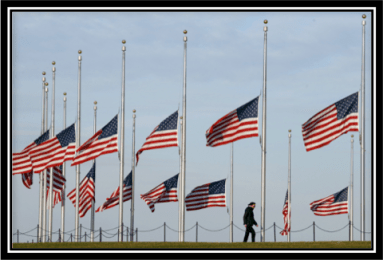
Haff StaffLast month, as my husband and I and our three children drove homeward after an epic road-trip across miles and miles of United States, we started to notice a pattern. Colorado, Nebraska, Iowa, Indiana, Illinois… My kids wanted to know what was wrong with all the American flags. I explained to them the phenomenon of “half-staff”. When something really bad happens in our country, people hang the flags at half-staff on purpose as a way to show their grief and support. My son asked, “Did something bad happen in each of these places?” I assured him that it was to show support, not because every city we passed had something horrendous happen in it. But deep inside, I shuddered at that fearful possibility.
Safety and Fear

If we don’t feel safe, our natural human reaction is fear. Saint John, disciple of Jesus the Messiah, said, Perfect love drives out fear. Fear will always creep in, but love is the best way to combat the fears we face. Carl Medearis, author and specialist in Muslim-Christian relations, poses a relevant and insightful question based on St. John’s quote: “If perfect love drives out fear, is it possible that perfect fear can also drive out love? Fear is the devil’s workshop. Perfect fear drives out love…Only one remains. Fear or love.”

If my safety is compromised, my natural reaction is fear. But fear and love are at odds in my soul. Fear leads to anger and hate. Love leads to freedom, joy and peace. Even though love is risky and sometimes dangerous, I choose that. As far as I am able, I want to combat the tempting momentum of fear by sharing stories of love and peace with the concerned callers checking in on my safety. I choose to teach love to my children. I choose to receive love from those around me…my students, my neighbors, my coworkers. I choose to extend love to someone living in fear. I don’t know if it’s safe to live here or there in our turbulent world, but I do know where I DON’T want to live, and that is in fear.

Generous Neighbors

I have had the joy of living in a predominantly Arab Muslim neighborhood for 15 years.  Here is an article I wrote that was published in the Yemeni American News–it is a reflection of the virtue of Generosity I have learned from my Middle Eastern neighbors, especially during the month of Ramadan.  My Arab neighbors make me a better Greek!

I opened the screen door and gave a hearty shout for my kids to come in for the night and get ready for bed. I love the ebb and flow of our neighborhood in east Dearborn that we have called home for the past 15 years. In the winter all the kids stay indoors and just grow inches taller, and then each spring there is a grand neighborhood reunion where kids pop out of houses like flowers popping out on the little Magnolia tree in our front yard.

And then there’s Ramadan

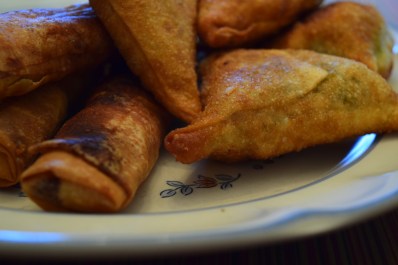
As is customary in our neighborhood during Ramadan, the time just before sunset gets eerily quiet and we can smell the savory treats being prepared in the houses around us. At dark, my kids come in to get ready for bed and that is just about the same time when we hear a faint knock on the door. This time it was the youngest daughter of one of our Yemeni neighbors with a plate full of piping hot meat and potato sambusas—YUM!

Suddenly my three kids start remembering what they love about Ramadan, being raised to follow Jesus the Messiah in a predominantly Muslim community. It’s not just the warm sambusas, syrupy yellow cake, Lebanese knafeh, or our all-time family favorite—layered, buttery sabayah sprinkled with black sesame seeds. It’s about the blessing of generosity, Ramadan Kareem. The Messiah Jesus teaches us to value generosity and hospitality. Our Muslim neighbors regularly model what that looks like in our community.

To my kids, Ramadan is a time of sharing and abundance. The first Eid al-Fitr etched in their memories is marked with girls in fancy dresses and boys donning daunting swords on their belts. Then there’s the candy, the henna, and even gifts of cash! Being handed dollar bills from neighborhood dads was mind-blowing for my little ones. Our neighbors set the standard high for generosity.

The Plate War continues

Being from a Greek immigrant home, I know how to battle in a plate war. When a dish comes to you full of flavorful favorites, you prepare to give it back fully loaded with more mouth-watering goodness. Bottom line: The plate never gets passed anywhere empty. Last summer during the Islamic month of fasting we got caught in a furious neighborhood plate war. We were preparing to leave on an epic summer road trip to visit family in my home state of Colorado. I was not on top of my game. I got swept under by the generosity of Ramadan. A plate came in from neighbors to the north of us and a second plate got handed to my kids from neighbors to the south. Then, foil-wrapped sabayah came from across the street! My kids and I scrambled to bake our favorite poppy-seed muffins and banana breads to return the plates amidst packing for our trip.   When it was all said and done, we still had one leftover blue floral-trimmed plate. Since then, we have spent the past year passing this plate to various neighbors on all sides, thinking we were returning it. Everyone keeps filling it and passing it back. We finally concluded that we don’t actually know who the mysterious plate belongs to. It is still our goal to return this plate—full, of course—to someone. We have yet to win that battle!

I know that Ramadan isn’t just about late-night feasting. It’s about cultivating both the personal and collective spiritual discipline of fasting in submission to God’s will. Though our own faith calls us to this discipline as well, I must say, that I appreciate a neighborhood where fasting is a topic of conversation among ten-year-olds, and breaking fast is something to share with loved ones and neighbors.DSC_0242

So to all my Muslim friends and neighbors, thank you, for your generosity. Thank you for showing us, plate by plate, the essence of kareem. And if anyone happens to recognize this plate, let me know and I can fill it full of warm, homemade banana bread or Greek-style spinach pie.

Ramadan Kareem!