CHRONIC HOPE #6: The Luxury of Looking Forward

“If you can’t fly then run, if you can’t run then walk, if you can’t walk then crawl, but whatever you do you have to keep moving forward.”

Martin Luther King, Jr.

When I was first diagnosed with chronic myeloid leukemia (CML) in my 20s I stopped looking too far forward.  Planning for the future felt presumptuous, so I learned to live more fully in the present.
IMG_5562

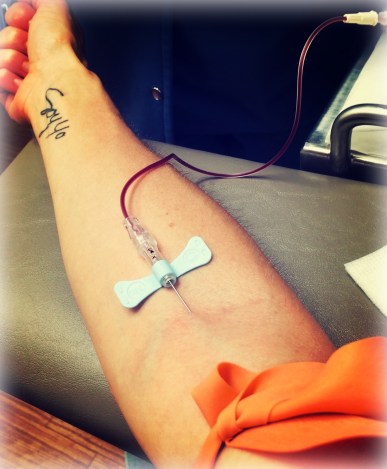
September 2019 marked 19 years since my cancer diagnosis.

I’ve had the privilege of reflecting back on 2 decades of living alongside a cancer diagnosis while continuously being treated for it.

4 different cancer treatments.

12+ bone marrow biopsies.

2 cutting edge miracle meds.

3 miracle babies. 

3 times achieving medicated remissions.

2 relapses.

1 Master’s Degree.  

Tens of thousands of dollars invested.

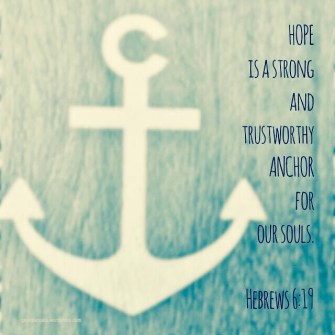
This journey is chronic. Chronic struggles. Chronic tears. Chronic persistence. Eventually forging a resilient chronic hope that anchors the soul.

I have learned invaluable life lessons of chronic hope: 

We all have struggles.  We all need help.  We all seek a hope that is bigger than us.

We don’t rise above our struggles alone.
fullsizeoutput_1488

I can dare to make long-term goals that are bigger than me, because others dared before me.

In 1959 a researcher identified a very specific chromosomal abnormality present in CML patients.  In the 1990s my first miracle medication was developed—a targeted immunotherapy treatment that was revolutionary.  The standard chemotherapy treatments do not discriminate between healthy cells and cancerous ones, thus, leaving the patient with a myriad of miserable toxicities and a bleak prognosis.  But this miracle medication targeted and treated a very specific problem inside of me, on a genetic level.  It was proven more effective, more efficient, and less toxic than standard chemo.

It changed the world for people like me.


Reflecting back is essential for moving forward.

Now, with 3 growing kids, a specialized degree as a language and culture learning coach, and a healthy body in medicated remission, I dare to look forward.

There are so many people along the way who have given of themselves for me to be in this privileged place.

Like the doctor who created my miracle med after building on a researcher’s breakthrough 30 years earlier, what offerings can I bring that just might change the quality of life for a single soul?

These words of Dr. Martin Luther King, Jr. both scare and inspire me:

“An individual has not started living until he can rise above the narrow confines of his individualistic concerns to the broader concerns of all humanity.”  MLK, Jr.

As a language learning coach, I love to champion individuals towards greater possibilities in their lives.  But MLK Jr.’s words challenge me further forward.  How can I rise above my personal cancer and be a part of treating malignancies that face all humanity?

While Dr. Martin Luther King, Jr.’s impact on society was profound, maybe he started with small offerings and a few champions in his life.  I can do that!  I can spend precious life energy trying to figure out my present and future impact, courageously taking small steps forward.

“If I cannot do great things, I can do small things in a great way.”  MLK, Jr.
IMG_5578

Thank you, dear people in my life, who have championed me along the way to fight my battles with cancer—my devoted Greek-immigrant family, my loving husband in sickness and in health, my life-giving friends, my empathetic professors and generous neighbors.

Thank you, doctors and researchers, for devoting your lives and your minds to profoundly changing my prognosis and my quality of life.

Thank you, Dr. Martin Luther King, Jr., for your wisdom and impact on the world, and for encouraging me to bravely take baby steps far beyond my personal cancer.

Thank you, readers, for allowing me to reflect back and dare into the future on this journey of chronic hope.
IMG_3359


This article was published in a series of articles for the Yemeni American News, October, 2019:

Georgia Coats is a Language & Culture Learning Coach, freelance writer, educator, wife, and mother of three who is passionate about healthy mind-body-spirit living.  Chronic Hope is Georgia’s collection of stories, lessons, and life adventures of living alongside chronic leukemia, cancer of the white blood cells, for two decades.  She often shares what’s on her mind at: www.onmymindbygeorgia.wordpress.com
CHRONIC HOPE #4: A Potential Risk of Fighting Cancer

“How dare you be so irresponsible with your wife’s health?  Don’t you understand the risks you’re putting her through by getting her pregnant in her condition?”

I watched my husband’s face change from shock to anger as the nurse unleashed her stern lecture on him.

Five years into marriage and four years into my cancer diagnosis, I was nearing my 30th birthday.  We had given up on making long-term life goals.  I let go of the dream of living abroad for language and cultural studies, and I quit graduate school.

But the dream of being a mom got stronger.

My super-effective miracle medication for chronic myeloid leukemia (CML) extended both my quality and quantity of life.  Aside from 3-month check ups, an annual bone marrow biopsy, and my daily meds, I lived a normal life.  But normal life made me hope for normal things, like a family of my own.

Truth: In this world we all face struggles.

My doctor was STUBBORNLY clear: pregnancy was out of the question.  It was too risky to subject a fetus to the potentially hazardous effects of my miracle meds. And it was too risky for me to go off my miracle meds for any reason.

After multiple heart-wrenching conversations, desperate prayers, and seeking counsel from others who had faced life’s storms and held on to hope, my husband and I felt like it was risky NOT to start a family.

Two significant things happened:

  1. We learned that we must calculate our risk and take the first step into the storm; and expect God’s reassuring presence to show up along the way.
  2. My stubborn doctor left. His replacement was willing to treat me as a whole person, instead of just treating my disease.  We needed someone to champion for the fullness of life.

Hope is a function of struggle. 

“Hope is a function of struggle,” affirms Brené Brown, author of Daring Greatly: How the Courage to be Vulnerable Transforms the Way We Live, Love, Parent & Lead.

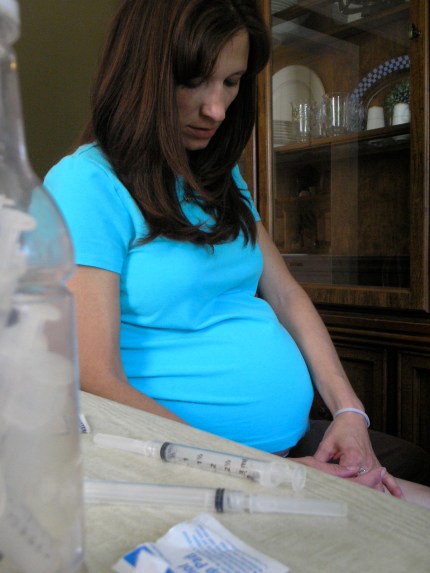
Eighteen months of chemotherapy injections were considered “safe” for growing three wondrous new lives, but they left me feverish and weak.  As I lay limp on the couch, I regularly recalculated our risk.

Giving up a safe miserable life without big dreams, for the opportunity to cultivate new life, changed something in me forever.  Ultimately, wherever beauty and life-giving possibilities exist, they are worth the pursuit.

Brené Brown reminds us that, “the willingness to show up changes us. It makes us a little braver each time.” 

My desire to be a mom dared me to set 9-month goals.  Three times. That led me to reconsider the daunting goal of graduate school to become a Language and Culture Learning Coach—this time as a non-traditional, cancer-fighting, mother of three.

Chronic struggles forged profound hope that pushed me higher and deeper in mind, body, and spiritual potential. And, in setting an example for my miracle children to live courageous lives.

The ongoing challenge is to keep hands open while living courageously—to never close in on the great gifts of life we’ve been given. I’ve been given 20 years to cultivate chronic hope. IMG_4212I find myself in a privileged place to champion others.  My heart is for those who face war, leave home, and migrate across cultural and linguistic barriers in search of the fullness of what life can be.  To these souls I hold out small offerings with open hands.

What are your dreams, forged in struggle?

Who are your champions?

What are the little offerings in your hands?

IMG_0695

This article was published in a series of articles for the Yemeni American News, August, 2019:

Georgia Coats is a Language & Culture Learning Coach, freelance writer, educator, wife, and mother of three who is passionate about healthy mind-body-spirit living.  Chronic Hope is Georgia’s collection of stories, lessons, and life adventures of living alongside chronic leukemia, cancer of the white blood cells, for two decades.  She often shares what’s on her mind at: www.onmymindbygeorgia.wordpress.com
 

CHRONIC HOPE #3: Cancer Complicates My Identity Issues

The life of a creature is in their blood.  Blood is the essence of who a person is.

By blood I am Greek.  By nationality I am a U.S. citizen.  By education I am a Spanish speaker.  By cultural experiences I resonate with my Middle Eastern neighbors of Dearborn, MI.  By faith I am a follower of Jesus the Messiah.

fullsizeoutput_2ec4

My whole life I have dabbled in multiple worlds, cultures, languages, and social groupings.  I hover on borders, struggling to figure out where I fit in.  That’s why I became a Language and Culture Learning Coach.

That’s why I have identity issues.

Enter Cancer.

By blood I have a cancer diagnosis.  More specifically, chronic myeloid leukemia (CML) is cancer in my blood cells.  Ironically, the white blood cells that function to fight off disease have become diseased.

Someone advised early on,

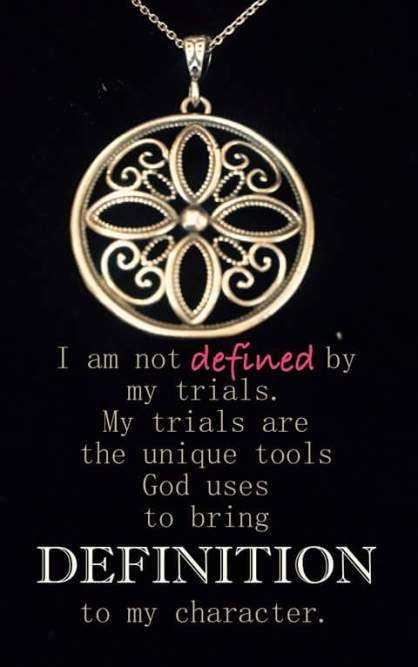
Don’t let your cancer diagnosis define who you are.

That piece of wisdom has both haunted and inspired me for that last 20 years.

When cancer runs in your blood, how do you not let it effect who you are?

To complicate things even more, I am on a cutting edge, super-effective, immunotherapy treatment. No complaints there.  When I tell people I have cancer, they want to know: Am I a survivor? Am I in remission? or Am I still battling the disease?  YES!  I dabble in all of those things.  My treatment keeps me in remission, as long as I keep taking it, daily.  Forever.

In my blood, disease moves slowly.  It’s a lifelong chronic disease, which makes me a peripheral member of another group.  The Chronic Illness Group.  People with chronic illness spend a lifetime on meds, and suffer from their diseases for decades.  There’s no glory in chronic illness.  To find support and strength in a chronic struggle, it helps to own it.  To identify with others who struggle in a similar way.

Blood-Related Issues

This summer I will travel to the Old Country, Greece, with my parents, siblings, and kids, to share with my kids a sliver of their heritage—of the identity that runs in their blood.  We will kiss my aunties and meet another generation of cousins.  We will eat great food and connect with the passion, grit, and generosity of our people.  I will admit my shortcoming to learn, and to teach my kids, the Greek language.  Relatives will look at me through the sympathetic cancer lens and say I look good, considering my health issues.

While I don’t want to be defined by the disease in my blood, I also cannot deny that it hasn’t had a significant impact on who I am.  Cancer brings definition to my character.  And for that, I am grateful.

FB_IMG_1496628639999

Thankfully, YOU don’t have to have my issues to embrace the wonderful beauty of your design.

And together let’s learn to share in the struggles of others.

Because, cancer or not, we all have issues.

fullsizeoutput_2eeb

This article was published in a series of articles for the Yemeni American News, July, 2019:

Georgia Coats is a Language & Culture Learning Coach, freelance writer, educator, wife, and mother of three who is passionate about healthy mind-body-spirit living.  Chronic Hope is Georgia’s collection of stories, lessons, and life adventures of living alongside chronic leukemia, cancer of the white blood cells, for two decades.  She often shares what’s on her mind at: www.onmymindbygeorgia.wordpress.com
 

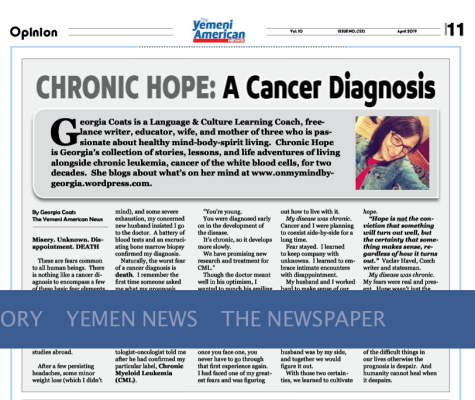
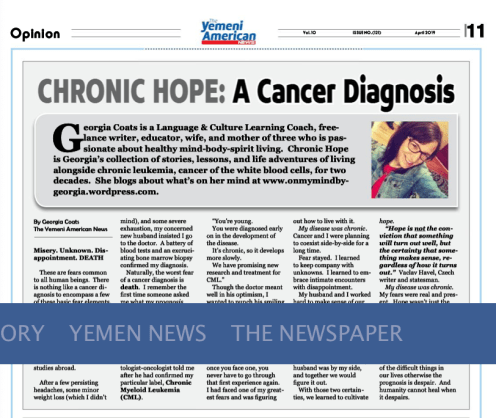
CHRONIC HOPE: A Cancer Diagnosis

Misery. Unknown. Disappointment. DEATH

These are fears common to all human beings.  There is nothing like a cancer diagnosis to encompass a few of these basic fear elements. I faced a dreaded diagnosis when I was 27 years old, newly married, and had many hopes and dreams of traveling the world and raising a family.  I was in graduate school and hoping to do some Middle Eastern studies abroad.

After a few persisting headaches, some minor weight loss (which I didn’t mind), and some severe exhaustion, my concerned new husband insisted I go to the doctor.  A battery of blood tests and an excruciating bone marrow biopsy confirmed my diagnosis.

Naturally, the worst fear of a cancer diagnosis is death. I remember the first time someone asked me what my prognosis was.  I didn’t even know that word.  I had to look it up, and let it sink in that people were actually asking me when the doctors think I might die.  That was crazy!  I was still in my twenties!

“Good news!” the hematologist-oncologist told me after he had confirmed my particular label, Chronic Myeloid Leukemia (CML).

“You’re young.

You were diagnosed early on in the development of the disease.

It’s chronic, so it develops more slowly.

We have promising new research and treatment for CML.”

Though the doctor meant well in his optimism, I wanted to punch his smiling face.  These factors were all in my favor to avoid death.  But what about living a miserable life?  What about dreams of starting a family?  So many unknowns.

The strange thing about a cancer diagnosis, is that once you face one, you never have to go through that first experience again.  I had faced one of my greatest fears and was figuring out how to live with it.

My disease was chronic.  Cancer and I were planning to coexist side-by-side for a long time.

Fear stayed.  I learned to keep company with unknowns.  I learned to embrace intimate encounters with disappointment.

My husband and I worked hard to make sense of our new circumstances.  I quit graduate school.  really hate quitting.  I gave up the dream of studying abroad.

Two things were certain amidst the unsettling unknowns: 

1. God is still God and He is good.

2. My husband was by my side, and together we would figure it out.

With those two certainties, we learned to cultivate hope.

“Hope is not the conviction that something will turn out well, but the certainty that something makes sense, regardless of how it turns out.”

Vaclav Havel, Czech writer and statesman.

My disease was chronic.  My fears were real and present.  Hope wasn’t just the optimism I needed to “fight this thing.”  We were clinging to the hope that this diagnosis would make sense in our lives—eventually.  Someday, our hope would be greater than our fear.

We have to make sense of the difficult things in our lives otherwise the prognosis is despair.  And humanity cannot heal when it despairs.

To ponder…

A friend of mine going through a difficult time compared her life to a garden in the winter. She said, “Hope is the promise that things will grow again.”  How do you make sense of the difficulties in life?  How would you describe hope?

IMG_2672

This article was published as the first in a series of articles for the Yemeni American News, May, 2019:

Georgia Coats is a Language & Culture Learning Coach, freelance writer, educator, wife, and mother of three who is passionate about healthy mind-body-spirit living.  Chronic Hope is Georgia’s collection of stories, lessons, and life adventures of living alongside chronic leukemia, cancer of the white blood cells, for two decades.  She often shares what’s on her mind at: www.onmymindbygeorgia.wordpress.com
Screen Shot 2019-05-04 at 12.17.00 PM

Responding to a Hurting World: Lessons from the Little Drummer Boy

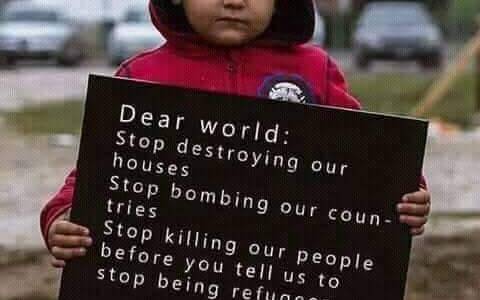
There are so many ways to get involved in a hurting world.  Which is a good thing, because there is SO. MUCH. HURT. in our world.  My heart leans towards people in transition, humans who are suffering, those who are trying to make it out of messes.  Immigrants coming to a new land.  Refugees fleeing war and manmade disasters.  Those who have left home, and in humility come to a new place.  They just need a little help along the way.

IMG_2249

So, what to do about it?  Turn to the wisdom of some classic Christmas lyrics for inspiration… the little musician who gave his all, even though it felt like so little.

Come they told me, pa rum pum pum pum

COME.  The first step is to receive an invitation and just plain show up.  The invitation is there to join something bigger than ourselves.  To be a part of something we can’t fix or solve.  To make it personal.  To just come.

IMG_5884
A new born King to see, pa rum pum pum pum

SEE.  Come and see the things that are happening in the world around us.  Let need, curiosity, pain, and empathy compel us to observe and join the messiness of our world in new ways.  To walk alongside a stranger in a strange land. To enter someone’s story.

Our finest gifts we bring, pa rum pum pum pum

BRING.  Come, see, what’s happening.  Bring what you have.  It may feel small and insignificant, but it is your offering to bring anyways.  Sometimes all I have to offer is myself.  And in a big, scary, complex world what I have feels so insignificant.

Slide2.jpg

To lay before the King, pa rum pum pum pum

LAY IT DOWN.  Let’s lay down our gifts, time, talents, resources as an offering. To show honor.  It may feel insignificant, but showing up has value. Taking time for someone shows they’re worth it.  Honoring another through a life-changing transition, and laying before them what we have expresses incredible value.

…When we come.

IMG_1027

BUTwe all face very real and present excuses, fears, and limitations…

I am a poor boy, too

I’m just one person, with limited talents and resources.  Many say… I’m not a teacher like you.  I would say… I’m not a lawyer like so-and-so, or an activist, or an influencer.  I’m just a ………………. trying to make it in the world (you fill in the blank).

Even our best is so limited.

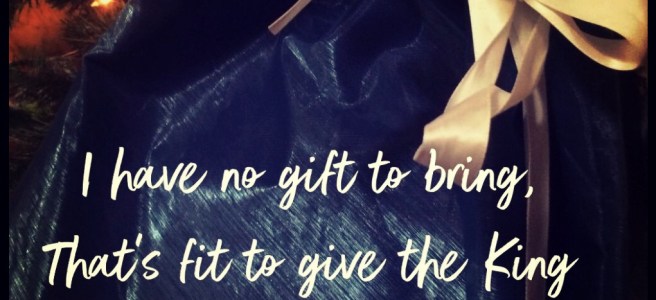
I have no gift to bring, that’s fit to give our King

I have nothing to give that would be of significance.  How can I help?  How can my small offerings possibly make a difference?

Start small.  If we all scooch over just a little in our row, we could make room for one more person to sit down.  What if everyone came, saw the need, and brought their little offerings?  That would be a significant number of insignificant offerings.  Maybe it would change the world.

What could those insignificant offerings look like?

Just come.  Show up for someone you know doing a work you admire in the world.

Just see… just listen.  Ask tough questions, hear difficult stories. Take time to process another perspective or another person’s journey.

Just bring yourself, your unique talents, your small offerings.

  • Maybe you have moments to read to a child.
  • Maybe you can pick up that book you know might challenge your thinking.
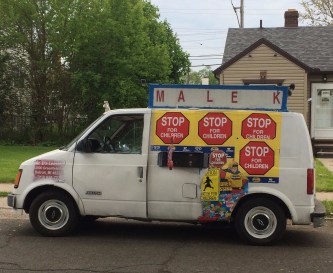
  • Maybe you can frequent a gas station or an ice cream truck where you can get to know a fellow sojourner just trying to make it in the world.
  • Maybe you invite someone new over.
  • Maybe you make that donation.
  • Maybe you share a perspective on social media that might make others think differently.
  • Maybe you start within–identifying a fear, letting go of bitterness, or choosing to forgive.

Who knows how scooching over might look for you.  Who knows what gift you bring, or how it might be fit to honor another?IMG_6942

I played my drum for Him, I played my best for Him,

pa rum pum pum pum, rum pum pum pum, rum pum, pum, pum

Whatever you do, do it wholeheartedly.  Even if it is small and insignificant.  Make it your best offering.IMG_5426

Then He smiled at me, pa rum pum pum pum
Me and my drum.

Relish in that smile.  The smile of helping someone out when they needed it most.  Showing up when it was difficult.  Offering when you felt like you had nothing.  Or maybe you are weary from many offerings that never feel like enough.  Pause.

Receive that joy.

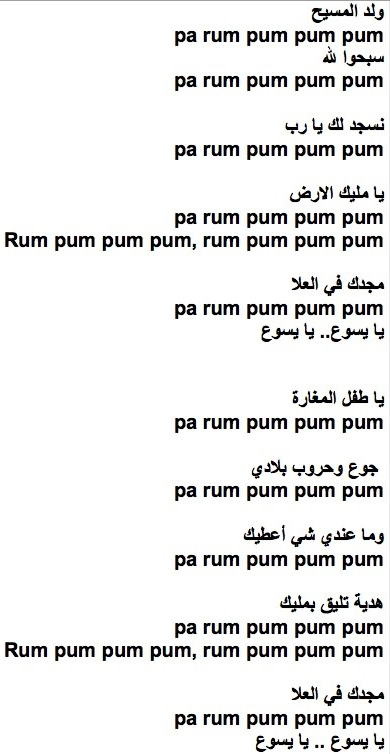
Recently, I heard an Arabic version of The Little Drummer Boy.  It was my invitation to learn some new Arabic words and practice rudimentary reading skills.  What I found was a treasured perspective I wasn’t anticipating.

Drummer Boy Arabic

With the backdrop of endless unrest in Palestine–the homeland of the Messiah and the singer–Vivian Bishara‘s lyrics of worshiping the King but having no worthy gift to bring becomes so real.  Regardless of our politics, war, hunger, and poverty are very real aspects of the world the Messiah came into–and the reason for the season today.  Emmanuel–God with us–in our messy, complex, torn up places.  Let’s come, and see, and lay down our gifts, or our lives, or both. To honor life.

To honor a Life-giving King.

… When we come.IMG_0097


When Politics are Personal: Joining Strong Beautiful People through Challenging Life Transitions

I recently wrote a post about how politics scare me, but, as a language and culture teacher, a language and culture learner, a mom, a cross-cultural neighbor, and a daughter of immigrants, I mustered up a small amount of courage to share some of my perspective on immigrants and refugee issues.  I’m not trying to take a strong political stance, but I do love the people on my path and the relationships that have enriched my life.

IMG_0695

I’ve learned that issues become much less political as they become more personal–when issues have names, faces, stories, and favorite foods.

5 observations about strong people and challenging life transitions:

  1. Leaving home is just plain hard.  My little family of 5 recently relocated after 17 years in our beloved town of Dearborn, MI.  Same language.  Same country.  No emergency. But it was SOOO HARD. Even now my heart tears and my eyes tear up for what we left behind.  Whenever things get challenging in this transition, I think of my brave Syrian Kurdish refugee friend who has relocated with her family 3 times, navigating in 4 languages–Arabic, Kurdish, Turkish, and English, with at least 2 distinct scripts to learn.  Have you ever tried to read the electric bill in a new language–deciphering the issue date, the due date, and the past due date?  Would you be able to tell the difference between tricky junk mail and important official letters written in a script that is oriented in the opposite direction than you’re used to?fullsizeoutput_28cf.jpeg
  2. We all need a little help at times in order to succeed.  In our cross-country move there were countless people who came alongside us in different ways–with food, with gentle reminders about change-of-address forms, with time and muscle to help us carry stuff.  We put our all into our move.  We calculated it for years.  But regardless, it was just bigger than us.

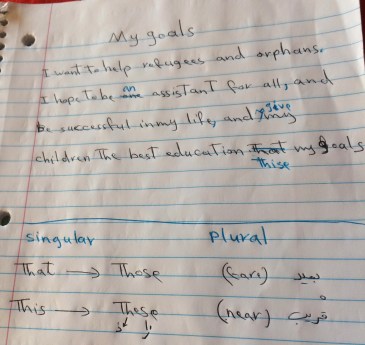
I will never forget the faces of those who have shown up in my difficult times and transitions of life.  Those people have a special place in my life journey.  Have you ever had the privilege of walking alongside someone in their unique ICU experience?  My secret honors include explaining to my English Language class full of moms the important distinction between the Spanish word molestar, which means to bother, and the English word molest, a very different meaning than bother (especially when Google translate has led them astray).  And I’ll forever cherish the joy of being one Muslim friend’s first experience in an American woman’s home.

img_6575.jpg

3. It takes courage and intentionality to show up, everyday.  I have a rule that I have applied as a mom, teacher, and learning coach: when it comes to helping others learn something new, I will only work as hard as they do.  Granted, part of my job is to teach motivation, but if a toddler learning to clean up, puts away two toys, then so will I.  If she puts away 10, I’ll show up for 10.  Fifteen women who show up for my English Language class two mornings a week.  It’s free for them to attend.  Some show up with a baby or two in tow.  Some work 12-hour shifts at Walmart on the loading dock and show up to class sporadically. I have one student who shows up with a smile, a pencil, and a notebook–even though she doesn’t know how to read or write in any language.  They show up with gratitude and grit, ready to take on their new world.  It is my great privilege to show up with them in some small way.

IMG_0070

4. My refugee and immigrant friends want the same things I want.  Most of the beautiful people on my path are other women and moms like me.  They want good, safe, happy lives for their children.  They want to contribute to their community.  They want to pay their bills and take good care of their families.  They get emotional around special holidays away from special relatives.  There is always a little bit of grief in their joy when a baby is born who may never get to meet their grandparents or uncles or cousins.  I’m amazed at the simple yet heartfelt constructions my very beginning students communicate with their limited English.  I know that they have experienced loss, that they long for their mothers’ cooking, and that they struggle with their kids spending too much time on their devices.  I have so much respect for their courage and humility to succeed in a new and strange environment. They inspire me daily to dare greatly.

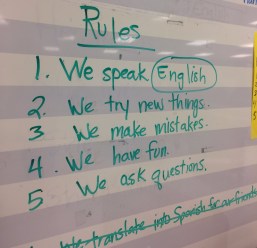
fullsizeoutput_9e05. Families strategize for success.  While I mostly spend time with women, I know that families are doing their best together.  I believe wholeheartedly that my husband deserves his own diploma when I graduated with my MA after 5 1/2 years of intensive studying and juggling.  He showed up with me and for me.  I am also keenly aware that for every married mom who shows up to learn English in my class, there are noble husbands who work tirelessly at blue collar jobs with limited English skills so that their wives can learn English, navigate the needs of their households, and maybe even plan for college.img_4690.jpgMy current adult ESL class is in an elementary school cafeteria.  It’s chaotic and interruptible.  Kids, teachers, administrators, and lunch room staff are always passing through. But we have rules–we ask great questions and we build community together.  We share music and we laugh hard–especially when Lulu is present, because every class needs a class clown.  My life is forever enriched.  I know what it is to sip yerba mate through a special straw, and savor Yemeni sabayah.  And though I have yet to try mofongo, I can’t wait to share my spanakopita recipe with my students.  I love being a part of their safe place–to learn, to take risks, to make mistakes and to grow.  They are courageous and beautiful women.  They show up.  And all our lives are richer for it.IMG_6318


Politics Scare Me: Perspective from an Intimidated Lover of Peace, Mom, & English Language Teacher

img_7266.jpgI love challenging questions within small, safe conversations.  But politics scare me. I’m horrible at citing policies, remembering dates, or interpreting statistics as fast as needed in a heated political discussion. The last thing I want to do is make a strong political stance.  But as a language and culture teacher, a language and culture learner, a mother of three, a cross-cultural neighbor, and a daughter of immigrants, people have been asking my perspective on our current political atmosphere around immigration and the refugee crisis.
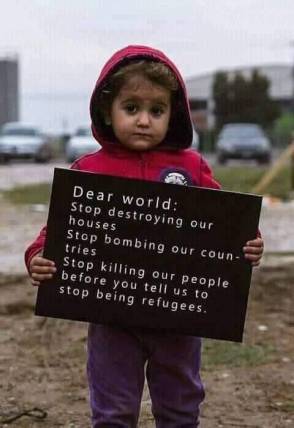
These 4 political observations come from being a lover of peace and equality in my home and in diverse communities.  With an odd number of personalities in our family, peace talks are a daily drill at our house.

  1. War, and the displacement it causes, is a worldwide problem, not just a U.S. problem.  There are many countries, like Greece and Jordan, maxing out their infrastructures to accommodate the refugees who are pouring in with no other place to go.  Comparatively, it seems that the U.S. has more room, more infrastructure, and more capacity to share the worldwide burden than we are currently.  45404965_2374453955915468_8133840680419065856_n

2. Lately we have been cultivating a national bad attitude of “me first”.  In fear we tend to operate out of scarcity rather than generosity.  As a mom, I work on these issues with my kids EVERY. SINGLE. DAY.  I want my children to learn to get along with others, be kind, and share.  If our country were my kid, I would want to teach her baby steps towards kindness, not away from it. And maybe give her a timeout or two to think about her attitude and choices.

fullsizeoutput_2744

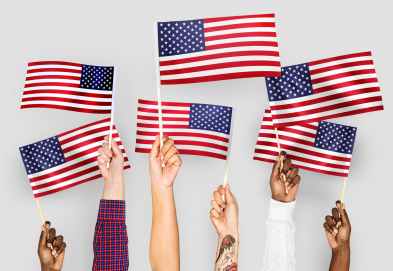
3. As a world leader, our country is positioned to be influential.  Rarely do leaders have a neutral, zero impact.  The U.S. has the power to do good in the world and influence others to follow our lead.  We are also responsible for our negative attitudes and actions.  They do not go without impact.  An insane number of children are dying in Yemen because of a civil war where both sides are receiving help from opposing world powers.  Our country has been contributing to this crisis financially.  After years of innocent people dying, we are just now making better choices about how to help the desperate rather than contribute to their dire circumstances.

close up photo of people holding usa flaglets

4. The best problem-solving of difficult issues comes when people work together. The polar opposite political extremes in our country are intense right now.  Extremes point fingers at them–the other extreme.  But what about the radical, intentional middle places, where we don’t point blame, but rather focus on problem solving, compromise, and caring for others?

Recently, my oldest daughter was rewarded by her grandparents for her excellent academic achievement.  My other two kids were also recognized for their good grades, but her excellence was dually noted in the form of an extra $20 bill, handed to my middle daughter to pass along to her sister.  This could have incited an all-out war at our house.  What to do? 1) pray for discernment in navigating towards a peaceful resolution 2) recognize the complexities and potential hurt each might feel  3) guide each one to consider the other’s perspective 4) give them space and responsibility in arriving at creative solutions together.  Ultimately, my oldest daughter decided to treat the family to FroYo.  Not all family squabbles arrive at peaceful compromises, but we are always learning and striving towards a “we” solution.

IMG_7777.JPG

I realize the world is a messy and complex place, and the last thing I want to do is minimize the work of those who labor towards peace by oversimplifying things.  I would rather run away from politics, especially when things get tense and mean.  I’m not in it to win it.  But I am in it to understand someone else’s point of view.  Sometimes people just need to be heard and want to be understood.  Sometimes hurt people hurt people.  Sometimes they are scared too.  I’ve learned that whatever the issue is, things become much less political as they become more personal–that point where issues have names, faces, stories, and favorite foods.

Así Soy Yo: A verb of Identity

My three kids have been learning Arabic in school for the past 4-9 years.  But we recently moved and switched schools, and so they they no longer have such easy access to Arabic classes. So, because I’m a master at teaching small group Spanish classes…

We had our first Saturday morning family Spanish class:

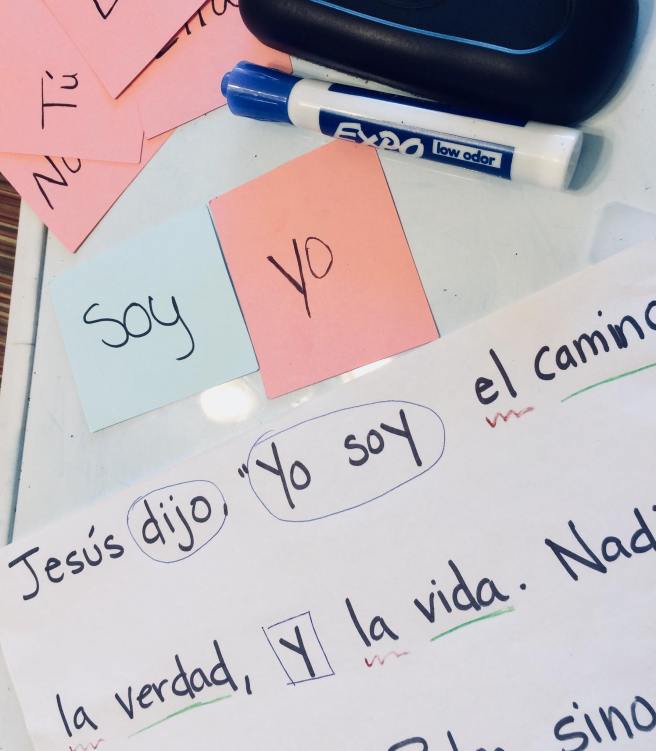
Macro level analysis of a familiar text: Juan 14:6, a Bible verse that they have previously memorized in English.  We were looking at three ways Jesus identifies himself, as the Way (el camino), the Truth (la verdad), and the Life (la vida).
Micro level grammar: subject pronouns and identity verb in the first person “Yo soy”
42273444_526153694495576_484846286676164608_o

To finish off our lesson over pancakes, we listened to one of my favorite Spanish pop songs by the Colombian band Bomba Estéreo

🎶 SOY YO
TRANSLATION: I’m me.

I fell , I got up…
I failed, I found myself,
I lived and I learned…
The harder you get hit, the deeper the beat, yeah

MESSAGE: Be who you are no matter what others may think. 🤓

They lyrics are too fast for my very beginning Spanish students, but the chorus is clear and repetitive.

Y no te preocupes si no te aprueban

cuando te critiquen tu solo di:

Soy yo

Soy yo… soy soy soy

Soy yo… yo yo yo

Así soy yo

That’s how we roll Saturday morning at our house.  Because así soy yo–that’s how I am.

IMG_0245

(It also helps that I plan on bribing them with churros.)

HOME: Somewhere between John Denver and Eminem

6ac7f42d-1837-4e10-b2a3-bcbf5248a2ab

It was midnight sometime B.C.E (Before Children Era) and I was walking the aisles of a nearly empty grocery store at Christmastime in east Dearborn. I had a breakdown in the canned food aisle as I became keenly aware of John Denver’s voice piping through the store…

And the Colorado Rocky Mountain high,
I’ve seen it raining fire in the sky,

You can talk to God and listen to the casual reply,
Rocky Mountain high, Colorado…

Home of 20+ years came rushing back as I imagined a Colorado sunset while selecting a can of beans.  My husband and I were alone in a new city, and our budget allowed us to go home for Christmas only in our dreams.

I didn’t even like John Denver. But in that moment, the power of a song lyric perfectly positioned in time and context stirred something deep in my heart.

There were countless dark days when I wanted to go running back to familiar and safe foods, friendships, traditions, scenery…

Home Sweet Home

It was my chronic leukemia treatments that routed us to the heart of Motown. One by one, each of our miracle Michiganders grounded us here.  Much of our tight budget was reserved for paying off three miracle pregnancies, treatments, and births—no regrets. It meant, though, that our young family of five embraced cozy Christmases in our little Dearborn home.

It was the adventure of diversity in east Dearborn that kept us persevering through grey skies and bone-chillingly cold winters.  It was the landscape of learning to love our neighbors and learning to be loved by them that made home here real.

It was in Motown I had learned about motherhood. Priority, ingenuity, perseverance, gratitude. The power of compelling song lyrics to draw depths of strength from a human heart. GRIT. It was driving into Detroit, scrounging for parking money at Wayne State as I pushed through five years of grad school that I knew the shift of “home” was real.

I was working towards a Master’s Degree in Language Learning.  My passion and research were in the heart of authentic song lyrics. Song lyrics are a great resource for gaining cultural perspectives and memorizing new language forms–the perfect blend of geeky and inspirational.

I was stuck in traffic heading east on the 94. Eminem came on the radio…

 Maybe that’s why I can’t leave Detroit
It’s the motivation that keeps me going
This is the inspiration I need.

Eminem’s rapped intensity stirred something in me. I had joined a collective of people struggling to survive, to push through, to succeed when the odds are against them.

621aef9c-5362-473d-89ec-1d74aecc9af9

There’s No Place Like Home

Now, our sense of home is shaken.  We will say good-bye to Motown and imagine a Rocky Mountain high.  We will establish a new home.  Home—where loved ones are waiting for us—exuberantly.  There is nothing like having people you belong to… those who long for your homecoming.  aaeb3621-71f2-4989-a9b1-da8b760fe2c1In the craziness of moving, I crave the beauty of the Rockies—quiet solitude, the forest and the streams, seeking grace in every step (J.Denver).  A place where we will continue to follow Jesus’ compelling example of loving God and loving our neighbors.

Maybe that’s why I feel so strange,
Got it all, but I still won’t change. (Eminem)

I do have it all. My heart is expanded across thousands of miles.  Grief is real because love is abundant—17 years of cultivated relationships—birthdays, funerals, Thanksgivings, play dates, countless Eid celebrations.

IMG_7737Home is Where the Heart Is

I could never turn my back on a city that made me.
And “life’s been good to me so far” (Eminem)

I don’t have to select an anthem. Instead I will make a crazy summer playlist—one where John Denver and Eminem are back to back. I’ll add a splash of Simon and Garfunkel, some Fiddler on the Roof, Kutless, Crowder, and probably Lady Gaga.

I will laugh, cry, dance, and stare off in the distance on that epic, one-way road trip at the end of July.

Home is the center of our hearts—the place where the presence of God is real. Even in the mess of my mixed emotions, chaotic packing, and our crazy summer playlist of 2018…  He makes His home with us.de86863c-499c-4dc4-89fb-a8ef53b71e24.jpg

What’s on your summer playlist?