I recently wrote a post about how politics scare me, but, as a language and culture teacher, a language and culture learner, a mom, a cross-cultural neighbor, and a daughter of immigrants, I mustered up a small amount of courage to share some of my perspective on immigrants and refugee issues. I’m not trying to take a strong political stance, but I do love the people on my path and the relationships that have enriched my life.

I’ve learned that issues become much less political as they become more personal–when issues have names, faces, stories, and favorite foods.
5 observations about strong people and challenging life transitions:
- Leaving home is just plain hard. My little family of 5 recently relocated after 17 years in our beloved town of Dearborn, MI. Same language. Same country. No emergency. But it was SOOO HARD. Even now my heart tears and my eyes tear up for what we left behind. Whenever things get challenging in this transition, I think of my brave Syrian Kurdish refugee friend who has relocated with her family 3 times, navigating in 4 languages–Arabic, Kurdish, Turkish, and English, with at least 2 distinct scripts to learn. Have you ever tried to read the electric bill in a new language–deciphering the issue date, the due date, and the past due date? Would you be able to tell the difference between tricky junk mail and important official letters written in a script that is oriented in the opposite direction than you’re used to?
- We all need a little help at times in order to succeed. In our cross-country move there were countless people who came alongside us in different ways–with food, with gentle reminders about change-of-address forms, with time and muscle to help us carry stuff. We put our all into our move. We calculated it for years. But regardless, it was just bigger than us.
I will never forget the faces of those who have shown up in my difficult times and transitions of life. Those people have a special place in my life journey. Have you ever had the privilege of walking alongside someone in their unique ICU experience? My secret honors include explaining to my English Language class full of moms the important distinction between the Spanish word molestar, which means to bother, and the English word molest, a very different meaning than bother (especially when Google translate has led them astray). And I’ll forever cherish the joy of being one Muslim friend’s first experience in an American woman’s home.
3. It takes courage and intentionality to show up, everyday. I have a rule that I have applied as a mom, teacher, and learning coach: when it comes to helping others learn something new, I will only work as hard as they do. Granted, part of my job is to teach motivation, but if a toddler learning to clean up, puts away two toys, then so will I. If she puts away 10, I’ll show up for 10. Fifteen women who show up for my English Language class two mornings a week. It’s free for them to attend. Some show up with a baby or two in tow. Some work 12-hour shifts at Walmart on the loading dock and show up to class sporadically. I have one student who shows up with a smile, a pencil, and a notebook–even though she doesn’t know how to read or write in any language. They show up with gratitude and grit, ready to take on their new world. It is my great privilege to show up with them in some small way.
4. My refugee and immigrant friends want the same things I want. Most of the beautiful people on my path are other women and moms like me. They want good, safe, happy lives for their children. They want to contribute to their community. They want to pay their bills and take good care of their families. They get emotional around special holidays away from special relatives. There is always a little bit of grief in their joy when a baby is born who may never get to meet their grandparents or uncles or cousins. I’m amazed at the simple yet heartfelt constructions my very beginning students communicate with their limited English. I know that they have experienced loss, that they long for their mothers’ cooking, and that they struggle with their kids spending too much time on their devices. I have so much respect for their courage and humility to succeed in a new and strange environment. They inspire me daily to dare greatly.
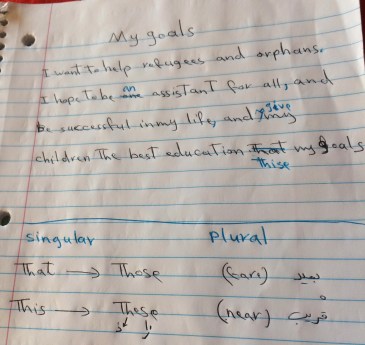 5. Families strategize for success. While I mostly spend time with women, I know that families are doing their best together. I believe wholeheartedly that my husband deserves his own diploma when I graduated with my MA after 5 1/2 years of intensive studying and juggling. He showed up with me and for me. I am also keenly aware that for every married mom who shows up to learn English in my class, there are noble husbands who work tirelessly at blue collar jobs with limited English skills so that their wives can learn English, navigate the needs of their households, and maybe even plan for college.
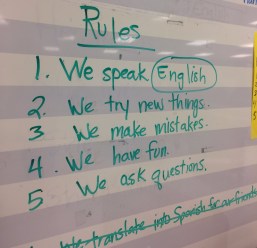
 My current adult ESL class is in an elementary school cafeteria. It’s chaotic and interruptible. Kids, teachers, administrators, and lunch room staff are always passing through. But we have rules–we ask great questions and we build community together. We share music and we laugh hard–especially when Lulu is present, because every class needs a class clown. My life is forever enriched. I know what it is to sip yerba mate through a special straw, and savor Yemeni sabayah. And though I have yet to try mofongo, I can’t wait to share my spanakopita recipe with my students. I love being a part of their safe place–to learn, to take risks, to make mistakes and to grow. They are courageous and beautiful women. They show up. And all our lives are richer for it.
 On My Mind
One thought on “When Politics are Personal: Joining Strong Beautiful People through Challenging Life Transitions”